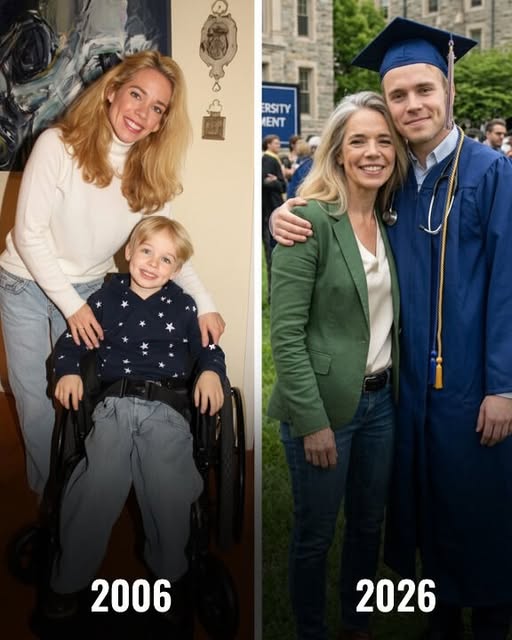
I once believed my marriage could survive any challenge life placed in our path.
I was wrong.
The day our son entered the world, my husband walked away from both of us. He left me standing alone in a hospital room with a newborn baby and a future neither of us could fully understand. Twenty-five years later, fate gave him an opportunity to confront the consequences of that decision.
The day Warren left was strangely quiet.
There were no raised voices.
No dramatic confrontation.
No slammed doors or emotional scenes.
In many ways, that silence hurt more than any argument could have.
My mother always said that anger was easier to survive because anger meant someone still cared enough to feel something.
“You can work through anger,” she used to tell me. “At least it comes from somewhere.”
What Warren left behind wasn’t anger.
It was indifference.
Cold and absolute.
Henry was only a few hours old when everything changed.
I was exhausted from labor, attached to IV lines, and holding my newborn son against my chest. One tiny hand clung to my hospital gown while a neurologist carefully explained what the early tests suggested.
“There are signs of motor difficulties,” she said gently. “We won’t know the full picture right away, but Henry will need monitoring, therapy, and ongoing support.”
I nodded without truly understanding.
The words seemed distant.
Unreal.
Then the doctor squeezed my hand.
“This isn’t anyone’s fault,” she reassured me. “Your son can still have a wonderful life. He’ll simply need additional help along the way.”
I whispered my thanks.
Then Warren grabbed his car keys.
At first, I assumed he needed fresh air.
That was always his way of handling stress.
“Could you hand me my water?” I asked.
He didn’t respond.
Instead, he stared at Henry.
Not like a father looking at his child.
More like someone examining a problem he didn’t want.
Finally, he spoke.
“I can’t do this.”
I blinked.
“What are you talking about?”
His expression hardened.
“This isn’t what I wanted, Bella. I wanted a son who could play sports with me. A son who could surf. A son who could do all the things fathers imagine.”
I waited for more.
For fear.
For grief.
For anything that sounded human.
It never came.
He picked up his jacket and left.
Just like that.
A nurse touched my shoulder.
The doctor tried to comfort me.
I barely heard either of them.
Instead, I looked down at my baby boy and kissed his forehead.
“Well,” I whispered through tears, “I guess it’s just us now.”
Two days later, I left the hospital alone.
I listened to discharge instructions alone.
I carried home medical paperwork alone.
Around me, families celebrated with balloons, flowers, and photographs.
I carried my son through those doors by myself.
For nearly a year, whenever people asked if someone was waiting for me at home, I smiled and lied.
“Of course.”
Meanwhile, Warren vanished.
Before Henry’s first birthday, divorce papers arrived.
He signed away parental responsibilities and moved away, making child support nearly impossible to pursue.
The years that followed were not inspirational.
They were exhausting.
My life became an endless cycle of therapies, appointments, insurance battles, and sleepless nights.
There were moments when I cried from exhaustion while stretching Henry’s legs during exercises.
Moments when I wondered if I could keep going.
Yet every morning, I did.
When Henry was young, people often spoke about him rather than to him.
That never lasted long.
Even as a child, he had a way of making people uncomfortable with his honesty.
At seven years old, during a school meeting, an administrator politely suggested that expectations should remain “realistic.”
Henry looked directly at her.
“Do you mean physically?”
She hesitated.
“Or do you think I’m not smart?”
The woman immediately turned red.
On the drive home, I tried to correct him.
“You can’t say things like that.”
“Why not?” he asked.
I glanced in the mirror.
He wasn’t wrong.
As he grew older, his determination became impossible to ignore.
Therapy became his training ground.
Doctors became his teachers.
Challenges became fuel.
By the age of fifteen, he was reading medical journals for fun.
One evening I asked what he was studying.
“A badly written article,” he replied.
“Why?”
“Because it talks about patients like they’re problems instead of people.”
That answer told me everything.
At sixteen, he finally admitted what he wanted from life.
“I don’t want to be the patient forever,” he said.
“What do you want to be?”
“A doctor.”
Then he smiled.
“One who actually listens.”
Years passed.
Therapy sessions turned into achievements.
Obstacles turned into victories.
Eventually, Henry was accepted into medical school.
Then he graduated at the top of his class.
A few days before graduation, I found him sitting quietly at the kitchen table.
Something was wrong.
“Henry?”
He looked up.
“Dad called.”
The words hit me instantly.
“How?”
“He found me online.”
Of course he did.
He hadn’t appeared for surgeries.
He hadn’t appeared for therapy.
He hadn’t appeared for birthdays or difficult days.
But success had finally caught his attention.
“What did he want?”
Henry shrugged.
“He said he was proud of me.”
I laughed bitterly.
Then Henry added another sentence.
“He wants to attend graduation.”
“No.”
The answer escaped before I could stop it.
But Henry remained calm.
“I invited him.”
I stared.
“Why?”
“Because I want him to hear the truth.”
Graduation day arrived.
The auditorium was packed with families, flowers, cameras, and excitement.
I kept adjusting my dress nervously.
Henry noticed immediately.
“You’re doing it again.”
“What?”
“Straightening your dress every thirty seconds.”
I laughed.
Then Warren arrived.
Older.
Gray-haired.
Weathered by time.
But still unmistakably Warren.
He approached confidently.
“Bella.”
“Warren.”
His attention immediately shifted to Henry.
He looked at his son standing independently.
No wheelchair.
No cane.
No visible limitations.
“Son,” he said proudly.
Henry remained polite but distant.
“Good evening.”
Warren smiled.
“You’ve done remarkably well.”
Henry simply nodded.
Moments later, his name was announced.
He squeezed my hand.
“You okay, Mom?”
“I am now.”
Then he walked onto the stage.
The audience applauded as he approached the podium.
After setting down his notes, he looked across the room.
“People love stories like mine,” he began.
A few laughs followed.
“They see the white coat and assume this is a story about determination.”
Then his expression softened as he looked directly at me.
“But determination isn’t why I’m standing here.”
The room became silent.
“I’m here because my mother never quit.”
My eyes filled immediately.
“When doctors explained my condition, my father left that same day.”
The audience shifted uncomfortably.
“My mother stayed.”
His voice remained steady.
“She stayed through every therapy session. Every difficult night. Every doctor’s appointment. Every moment when people expected less from me.”
I could barely breathe.
“She walked into every challenge my father ran away from.”
Across the auditorium, Warren sat motionless.
Then Henry looked directly at him.
“This achievement does not belong to both of my parents.”
The silence felt enormous.
“It belongs to the one who showed up.”
Then he turned back toward me.
“Mom,” he said softly, “everything good in my life started with you.”
That was it.
The moment I completely broke down.
Tears streamed down my face as the entire auditorium rose to its feet.
Students.
Professors.
Doctors.
Families.
Everyone stood applauding.
For the first time, I didn’t care who saw me cry.
After the ceremony, Henry found me in the hallway.
“You okay?”
I laughed through tears.
“No. That speech was completely unfair.”
He smiled.
Then Warren approached.
His face was tight with frustration.
“You brought me here for that?”
Henry didn’t flinch.
“I brought you here for the truth.”
Warren opened his mouth.
Henry stopped him.
“You left on the first day,” he said calmly. “My mother stayed for every day after that. If you want to know who deserves credit for my life, look at her.”
For once, Warren had nothing to say.
No explanation.
No excuse.
No defense.
And in that moment, the man who had abandoned his family finally understood exactly what his decision had cost him.
He stood alone.
Exactly where his choices had left him.