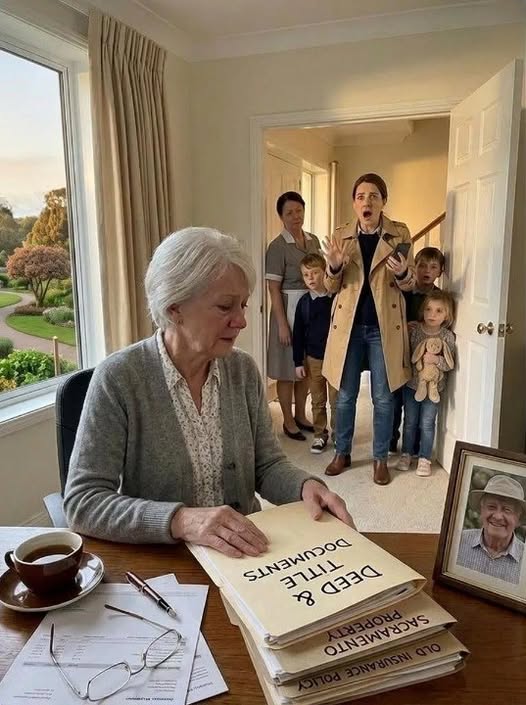
At seventy years old, Margarita Ellington thought life had already tested her in every possible way.
After losing her husband, the quiet inside their Sacramento home felt overwhelming. Every corner reminded her of the life they had built together. The familiar rooms seemed filled with memories, while the absence of his presence followed her everywhere. Day after day, she moved through the house relying on routine, old photographs, and determination, slowly accepting the idea that loneliness might simply be part of growing older.
Then, on a rainy evening, everything changed.
Her daughter Lily arrived unexpectedly at the front door with her two children and nowhere else to turn.
The end of Lily’s marriage had left her emotionally devastated and financially unstable. The divorce had been painful and public, and she showed up carrying exhaustion, embarrassment, and desperation. Despite the complicated history between them, Margarita opened her home without hesitation.
For the first time in a long while, the house felt alive.
Children’s laughter echoed through the hallways. Toys appeared in every room. Morning cartoons filled the living room with noise, and tiny shoes lined the entrance. Margarita found herself preparing family meals again, packing lunches, and enjoying a sense of purpose she had not felt since her husband’s passing.
When Lily thanked her through tears and called her a lifesaver, Margarita allowed herself to believe that perhaps their relationship was finally healing.
Unfortunately, that feeling did not last.
Over time, appreciation slowly transformed into expectation.
At first, the criticism seemed harmless.
Lily made comments about her mother’s clothing, suggesting she looked outdated. She questioned how the house was decorated, complained about meals, criticized the way Margarita interacted with the children, and found fault with habits that had been part of Margarita’s life for decades.
Rather than argue, Margarita adapted.
She changed little things.
She avoided certain topics.
She became quieter during family dinners.
Little by little, she made herself smaller in hopes of keeping peace within the household.
Yet nothing she did seemed sufficient.
The more she compromised, the more demands followed.
Eventually, the situation reached a breaking point.
One warm afternoon, Margarita was tending to the rose bushes her late husband had planted years earlier. While working in the garden, she overheard Lily speaking on the phone inside the kitchen. The open window carried every word into the yard.
“She’s becoming a burden,” Lily said with a laugh. “Honestly, I’m only here because it’s cheaper than paying rent somewhere else.”
Then came laughter.
Not affectionate laughter.
Not playful laughter.
Cruel laughter.
Margarita stood motionless among the flowers, gripping the pruning shears as the reality settled over her.
In that moment, she understood something painful.
Her daughter no longer saw her as a mother.
She saw her as a convenience.
That evening, a quiet transformation took place.
Margarita didn’t argue.
She didn’t cry.
She didn’t confront Lily.
Instead, she made a decision.
She would stop sacrificing herself for someone who no longer valued her.
From that day forward, she began taking control of her life again.
She consulted an attorney.
She reviewed ownership documents for the house.
She organized her finances and secured her future.
Then, without discussing it with anyone, she placed the property on the market.
Several weeks later, after all paperwork had been completed and every detail finalized, she invited Lily to sit down with her at the kitchen table.
Lily assumed they were about to discuss household expenses or daily responsibilities.
Instead, Margarita calmly informed her that the house had been sold.
The announcement left Lily speechless.
“You sold it?” she asked in disbelief.
“I did,” Margarita replied.
“What happens to us now?”
Margarita explained that she had already arranged temporary assistance and financial support to help Lily and the children transition to a new situation. The grandchildren would be cared for.
But the arrangement they had been living under was finished.
The free housing.
The constant emotional support.
The endless sacrifices.
All of it.
Lily’s shock quickly turned into anger.
She accused her mother of abandoning her.
Of being selfish.
Of betraying her family.
But Margarita remained composed throughout the entire confrontation.
For the first time, she understood a truth she had ignored for years:
Protecting your own well-being is not selfish.
Allowing yourself to be used indefinitely is not love.
Within a matter of weeks, Margarita left California behind.
She purchased a small cottage along the Oregon coastline, surrounded by fresh ocean air and towering pine trees. The home was modest, peaceful, and completely her own.
No criticism filled its rooms.
No one judged her choices.
No one controlled how she lived.
For the first time in years, she experienced genuine peace.
Her mornings were spent walking beside the shoreline.
Her evenings were devoted to quiet moments on the porch with tea in hand, listening to the distant crash of waves against the cliffs.
The silence that once frightened her no longer felt lonely.
It felt comforting.
Meanwhile, Lily was forced to face reality without her mother constantly rescuing her.
Life became more difficult.
Responsibilities became unavoidable.
Consequences arrived without warning.
Years passed before she finally reached out.
When Margarita answered the phone, she immediately noticed the difference in her daughter’s voice.
There was humility where entitlement had once existed.
Lily apologized sincerely.
There were no excuses.
No attempts at manipulation.
Only honesty.
Margarita listened.
Eventually, she chose forgiveness.
But forgiveness did not mean returning to old patterns.
Their relationship was rebuilt carefully, one step at a time, supported by clear boundaries and mutual respect.
Margarita continued to be present for her grandchildren. She attended birthdays, celebrated holidays, and cheered at school events.
However, she never again allowed herself to disappear within someone else’s expectations.
On her seventy-fifth birthday, she sat wrapped in a blanket on the porch of her Oregon cottage, gazing out at the endless ocean beneath a cloudy sky.
For the first time in many years, she felt completely at peace.
Not because she had sold a house.
Not because she had moved away.
But because she had finally learned an important lesson:
True freedom begins the moment you stop abandoning yourself to make everyone else comfortable.
And she realized that the most valuable legacy she could leave behind was not money, property, or possessions.
It was the example of a woman who finally recognized her own value and chose to live accordingly.