My dad’s reply came almost immediately.
“Dear, thank you for this second chance. I can’t wait to become a family again.”
I stared at the screen until the words blurred.
A second chance.
That was what he called it.
As if we’d all been sitting around for ten years waiting for him to return.
As if Mom hadn’t spent those years working extra shifts, packing lunches, paying bills, fixing broken appliances, and trying to raise children who kept asking why their father had chosen to leave.
As if the rest of us hadn’t learned how to celebrate birthdays without him.
How to survive holidays without him.
How to answer the question, “Where’s your dad?” without telling the whole story.
I looked at Mom.
She was still sitting at the kitchen table, twisting that dish towel between her fingers.
“Mia,” she said quietly, “maybe you shouldn’t have done that.”
“Why?”
“Because I don’t know what I’m going to say when he gets here.”
I sat across from her.
“You don’t have to say anything.”
She looked at me.
“He’s still your father.”
“No,” I said. “He’s the man who left.”
Mom flinched.
I immediately regretted how harsh it sounded.
But it was true.
My father, Henry, walked out when Mom was eight months pregnant with Hannah.
He didn’t leave after some dramatic fight.
There wasn’t a final screaming match or a slammed door that explained everything.
He simply packed a bag and left.
Then he stopped calling.
At first, Mom waited.
Then she stopped waiting.
And eventually, we stopped asking when he was coming back.
The strangest thing about abandonment is how ordinary it eventually becomes.
You learn to live around the empty chair.
You stop setting an extra place at the table.
You stop expecting headlights in the driveway.
You stop wondering whether the phone ringing might be him.
Until one random Tuesday, ten years later, his name suddenly appears on your mother’s phone.
And somehow, the old wound is bleeding again.
Sunday came quickly.
Mom spent most of the afternoon moving around the kitchen without accomplishing much.
She checked the oven three times.
Rearranged the plates.
Changed the tablecloth.
Then changed it back.
My siblings arrived one by one.
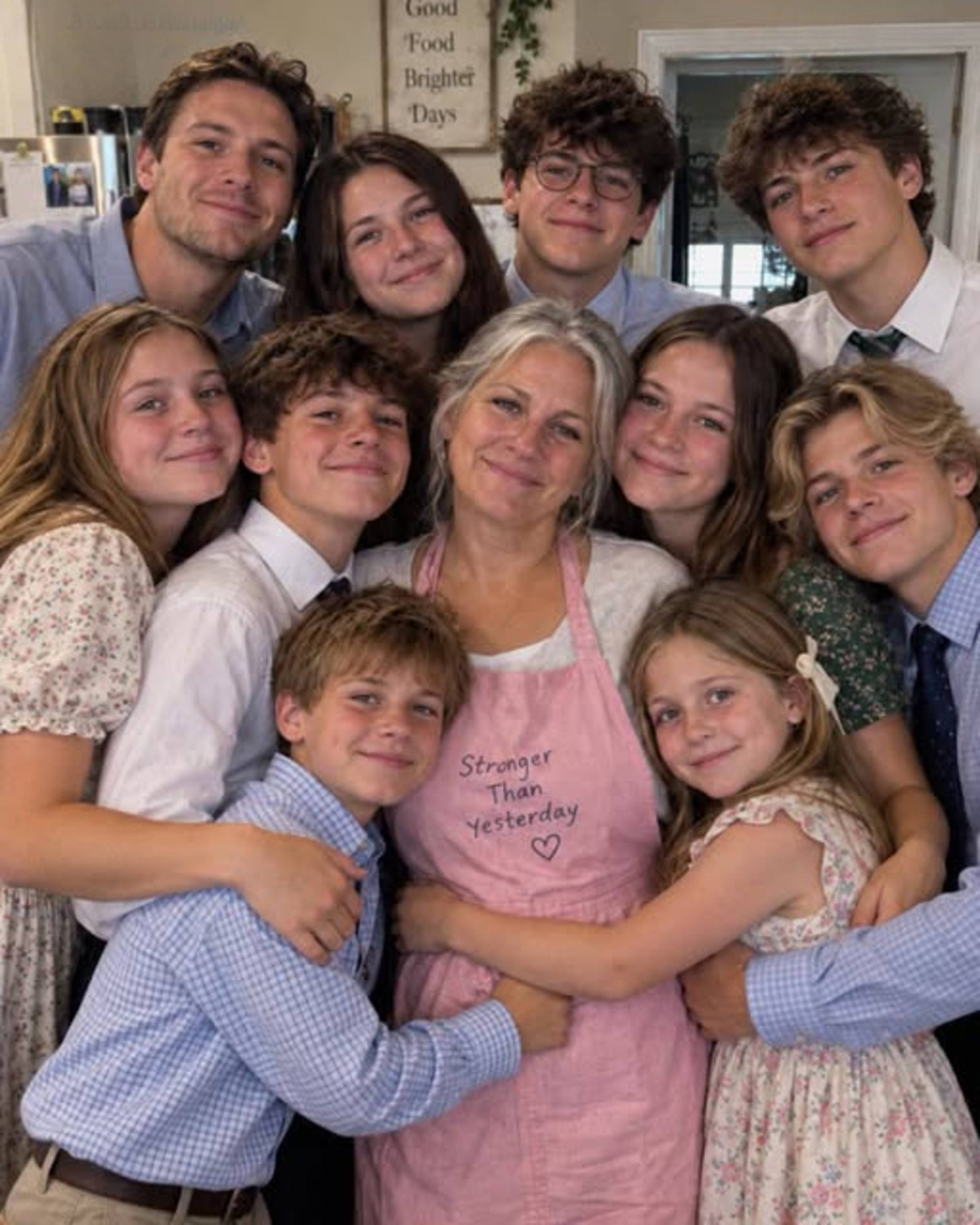
There were ten of us.
Ten school pictures still lined the hallway in mismatched frames, each one representing a year when Mom had somehow managed to keep the family moving forward.
Henry used to brag about those children from the pulpit.
“My blessings,” he’d call us.
People in the congregation would smile.
They never knew that some of those “blessings” were already learning what it felt like to sleep with an empty stomach because Mom’s paycheck had been late.
They never saw her crying at the kitchen table after another bill arrived.
They never saw her sitting in the driveway because she didn’t want us to see her fall apart.
By seven o’clock, everyone was there.
The house was full.
Too full.
People stood in corners, whispered in hallways, checked the windows.
Then the doorbell rang.
Nobody moved.
I finally walked toward it.
Mom caught my arm.
“Mia.”
“I know.”
I opened the door.
Henry stood there wearing a dark suit.
He looked older.
Of course he did.
His hair was gray around the temples. His face was thinner. There were lines around his eyes that hadn’t been there when he left.
For half a second, I saw the father I remembered.
Then the feeling disappeared.
He smiled.
“My girl.”
I didn’t hug him.
“Come in.”
He stepped through the doorway.
His eyes moved around the house.
The photographs.
The furniture.
The children.
He looked stunned.
“You all grew up.”
My younger brother laughed bitterly from the dining room.
“Yeah. That tends to happen when ten years pass.”
Henry looked at him.
“I’m sorry.”
Noah crossed his arms.
“For what?”
Henry didn’t answer.
We sat down.
Mom was at the head of the table.
Henry sat across from her.
For several seconds, nobody spoke.
Then he cleared his throat.
“I know I have a lot to make up for.”
Nobody responded.
“I made mistakes.”
Hannah finally spoke.
“You keep saying that.”
Henry looked at her.
“I was lost.”
“You were gone,” she said.
Silence.
He swallowed.
“I’ve changed.”
My oldest brother leaned back.
“How?”
Henry looked around the table.
“I’ve found my faith again.”
That almost made me laugh.
Almost.
“You had faith when you left,” I said.
He looked at me.
“I know.”
“No. You don’t.”
My voice shook, but I didn’t stop.
“You stood in front of people every Sunday and called us your blessings. Then you walked away from the blessing you were actually responsible for.”
Mom lowered her eyes.
Henry stared at the table.
“I was ashamed.”
“Of what?”
“Of myself.”
“Then why did you leave us?”
He didn’t answer.
That silence told me more than any explanation could have.
Finally, he whispered, “Because I thought I could start over somewhere else.”
There it was.
Not a mistake.
Not confusion.
Not fate.
A choice.
He had wanted another life.
And we’d been the life he left behind.
Mom’s eyes filled with tears.
Henry reached across the table.
“I regret it every day.”
Mom pulled her hand away.
“You don’t get to decide when I’m ready to forgive you.”
He nodded.
“I know.”
“And you don’t get to move back into this house because you’re lonely.”
“I know.”
“You don’t get to call what happened a mistake.”
He looked at her.
“What should I call it?”
Mom’s voice broke.
“Abandonment.”
Nobody spoke.
The word sat in the center of the table.
Heavy.
Accurate.
Impossible to soften.
Then something unexpected happened.
Henry started crying.
Not dramatically.
Not for attention.
He simply covered his face and began to shake.
For years, I’d imagined this moment differently.
I’d imagined him begging.
I’d imagined screaming.
I’d imagined someone throwing him out.
I had never imagined feeling sorry for him.
But I did.
Not enough to forget.
Not enough to excuse him.
Just enough to remember that people can become the worst versions of themselves and still regret what they’ve done.
He wiped his face.
“I don’t expect you to forgive me tonight.”
“Good,” I said.
He nodded.
“But I’d like to try.”
Mom looked at him for a long time.
“Trying isn’t coming home.”
“I understand.”
“Trying is earning the right to be invited back.”
Henry nodded.
“Then that’s what I’ll do.”
Nobody applauded.
Nobody hugged him.
Nobody declared the family healed.
But something changed.
Because for the first time, he wasn’t asking us to pretend the past hadn’t happened.
He was finally admitting that it had.
After dinner, Henry stood near the doorway.
He looked at the hallway photographs again.
Ten children.
Ten lives he had missed.
He touched one of the frames.
“I don’t deserve this family.”
Mom answered from behind him.
“Maybe not.”
He turned.
“But they’re still your children.”
He nodded.
“I know.”
Then he left.
No dramatic reconciliation.
No instant forgiveness.
Just a man walking back into the night with the consequences of his choices finally following him.
Mom closed the door.
Everyone stood there quietly.
Then my youngest sister whispered, “So… are we supposed to forgive him?”
Mom looked at all of us.
“No,” she said.
“You’re supposed to decide for yourselves.”
I looked at her.
She smiled through her tears.
“Forgiveness is something you give when you’re ready. Trust is something someone earns.”
That sentence stayed with me.
Because I’d spent so much time believing the dinner was about exposing Henry.
It wasn’t.
It was about giving Mom and my siblings something we’d never had when he left.
A choice.
He had made his choice ten years ago without asking any of us.
This time, we got to choose what happened next.
Maybe Henry would change.
Maybe he wouldn’t.
Maybe one day we’d learn to forgive him.
Maybe some of us never would.
But he wasn’t moving back into our home simply because he had finally decided he missed it.
Home wasn’t a place he could return to whenever loneliness caught up with him.
Home was something he had abandoned.
And if he wanted to become part of it again, he would have to rebuild what he had destroyed—one phone call, one apology, one uncomfortable conversation, one earned piece of trust at a time.
Later that night, Mom and I stood in the kitchen washing dishes.
She handed me a plate.
“You were pretty hard on him.”
“I know.”
She smiled faintly.
“Thank you.”
“For what?”
“For saying what I couldn’t.”
I looked at her.
“You shouldn’t have to say it alone anymore.”
She squeezed my hand.
And for the first time in years, the house felt less like the place where our father had left us.
It felt like what it had always been.
Ours.
Henry could knock again someday.
Maybe we’d answer.
Maybe we wouldn’t.
But this time, the door would be ours to open.