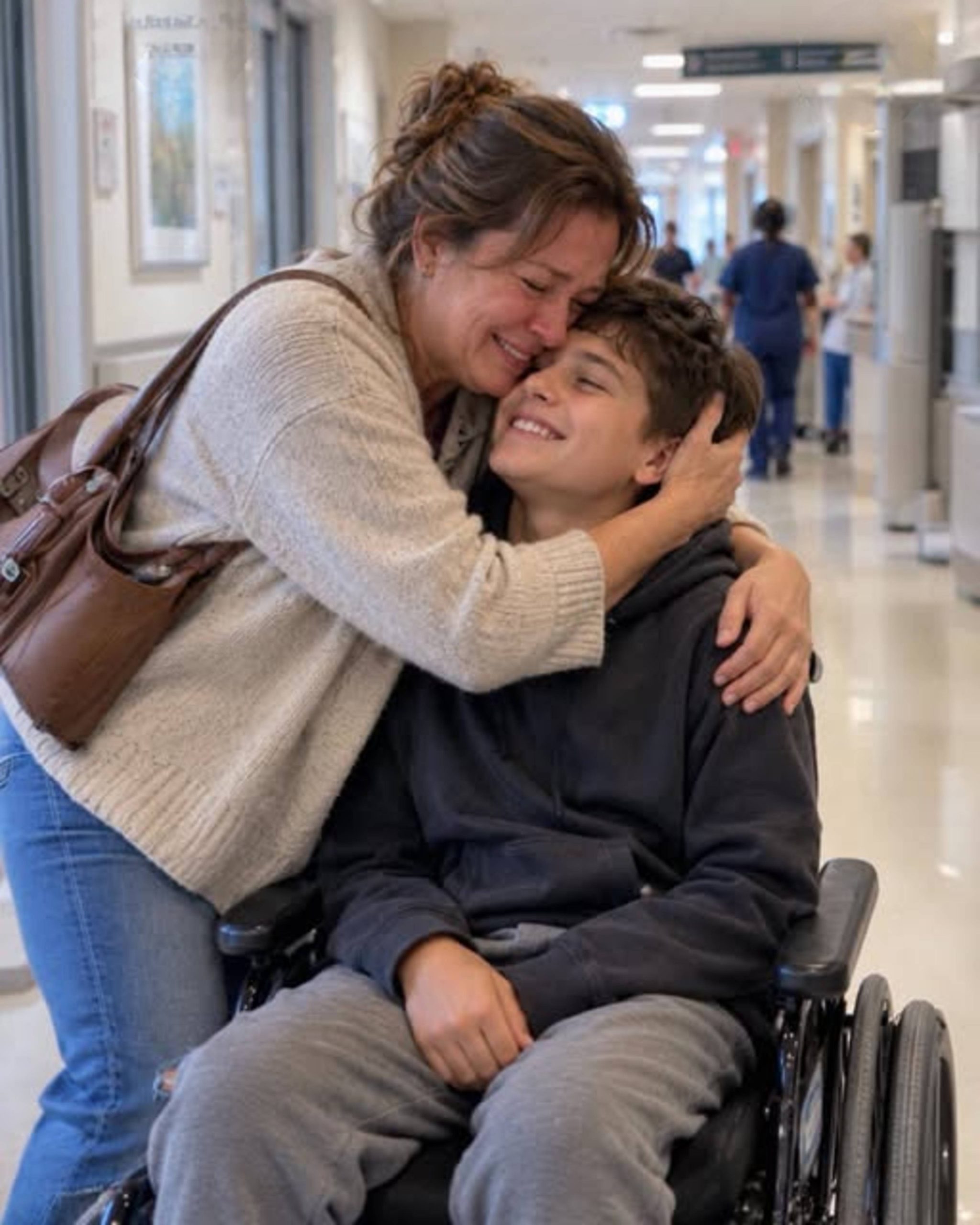
For three years, I watched my terminally ill son’s world grow smaller.
Not all at once.
That would have been easier to understand.
It happened slowly, quietly, almost politely.
A friend stopped coming over because he was “busy.” Another promised to visit after the next exam and never did. Birthday invitations became fewer. Messages that once arrived every hour eventually became one every few weeks, then once every few months, and finally nothing at all.
Life kept moving.
Just not for Ethan.
My son checked the same dead group chat every morning.
He never wrote anything in it anymore.
He just scrolled.
Sometimes he would stare at the screen for several seconds before moving his thumb again.
There were pictures from football games he used to attend.
Birthday parties he hadn’t been invited to.
Inside jokes he no longer understood.
Sometimes his old classmates complained about homework or posted terrible photographs of each other.
Ethan would occasionally smile at one.
A real smile.
That was what hurt the most.
Because I could see how badly he wanted to still belong to that world.
I pretended not to notice.
Mothers become experts at pretending not to notice the things that would break them if they admitted them out loud.
A few months earlier, Ethan had deleted almost every private conversation with people from school.
I noticed because one evening I walked past his bedroom and saw him sitting on the edge of his bed, deleting message after message.
“What are you doing?” I asked.
“Cleaning up my phone.”
He didn’t look at me.
“You don’t have to do that.”
“I know.”
He kept deleting.
After a while, he finally said, “Seeing their names waiting there hurts more than seeing them not talk to me.”
I didn’t know what to say.
So I sat beside him.
That was all I could do.
When Ethan first got sick, his phone never stopped buzzing.
The hospital room was constantly full.
Friends came after school.
Teachers sent messages.
His teammates brought him photographs and signed a football.
People squeezed into chairs and sat on the floor.
The nurses sometimes had to remind everyone that visiting hours were over.
His best friend, Noah, practically lived there.
Noah would show up with snacks Ethan wasn’t supposed to eat and pretend he had somehow smuggled them past the nurses.
They would laugh until Ethan started coughing.
Then Noah would become serious and ask whether he was okay.
Ethan always said yes.
Even when he wasn’t.
Back then, I thought that was what friendship looked like.
People showing up when things were difficult.
I didn’t understand yet that some people only know how to love you when they believe you are coming back.
As the months passed, the visits became less frequent.
At first, there were explanations.
“I’m sorry, Ethan. I have practice.”
“I’ve got an exam.”
“My parents need me.”
“Can I come next weekend?”
Then the explanations disappeared too.
The hospital room became quieter.
The chair beside Ethan’s bed stayed empty more often.
Noah still came whenever he could.
But even he eventually had a life outside the hospital.
And I never blamed him for that.
How could I?
He was a teenager.
He had school.
He had friends.
He had a future that wasn’t supposed to involve hospital corridors and medication schedules.
That was the cruelest part.
Everyone else was allowed to keep growing.
Ethan was being forced to watch.
The doctors had been careful with their words in the beginning.
They talked about treatment options.
They talked about managing symptoms.
They talked about possibilities.
Then the words became different.
“Progression.”
“Limited response.”
“Comfort.”
“Quality of life.”
Eventually, there was nothing careful left to say.
My son was terminally ill.
I spent three years being terrified that Ethan was going to die.
But it took me much longer to understand that Ethan was watching everyone else leave him first.
There were mornings when I found him staring out the window.
“What are you thinking about?” I would ask.
“Nothing.”
I knew that wasn’t true.
One morning, I found him holding an old team photograph.
He had been wearing his football jersey.
His arm was around Noah.
There were six other boys in the picture.
Ethan looked at it for a long time.
“Do you think they remember me?” he asked.
I swallowed.
“Of course they do.”
He smiled faintly.
“That’s not what I asked.”
I didn’t answer.
Because sometimes the truth is not something you can say without making a person hurt more.
Instead, I took the photograph from his hands and placed it on his bedside table.
That night, after Ethan went to sleep, I cried in the kitchen with the lights off.
I cried because I was afraid of losing my son.
But I also cried because I could see him losing pieces of himself while he was still alive.
Then, one morning, everything changed.
It was a Tuesday.
Nothing about the morning seemed unusual.
I was making coffee.
Ethan was still asleep.
The house was quiet.
Then I heard something outside.
At first, I thought it was traffic.
Then I heard voices.
Many voices.
I walked toward the window.
I stopped.
There were people everywhere.
The street outside our house was packed.
Hundreds of them.
Teenagers.
Parents.
Teachers.
Neighbors.
People holding signs.
People holding photographs.
People wearing old football jerseys.
And they were chanting one name.
“ETHAN!”
Again.
“ETHAN!”
Again.
“ETHAN!”
My coffee slipped from my hand.
The mug hit the kitchen floor and shattered.
I didn’t even notice.
I ran upstairs.
“Ethan!”
He woke suddenly.
“What?”
“Come here.”
“What happened?”
“Just come here.”
I pulled back the curtains.
Ethan stared outside.
For several seconds, he didn’t speak.
His face changed.
Confusion.
Fear.
Disbelief.
Then tears.
“Mom…”
“I don’t know.”
The chanting grew louder.
“ETHAN! ETHAN! ETHAN!”
Ethan slowly walked toward the window.
There were so many people that the street looked completely different.
A huge banner stretched across the sidewalk.
**WE NEVER FORGOT YOU.**
Ethan covered his mouth.
“No.”
I looked at him.
“What?”
He shook his head.
“They wouldn’t.”
Then the crowd suddenly parted.
A person began walking through the middle of them.
Slowly.
Everyone turned to watch.
Ethan stopped breathing.
I knew that face too.
I had seen it hundreds of times in photographs.
I had seen that boy sitting beside Ethan’s hospital bed.
I had seen him steal fries from Ethan’s dinner.
I had seen him cry when the doctors first explained how serious the illness was.
Noah.
Ethan’s best friend.
The boy I thought had walked out of my son’s life for good.
He stopped at the front gate.
He was holding something in his hands.
An old football jersey.
Ethan’s jersey.
He looked up at the bedroom window.
Then he raised it above his head.
The crowd became completely silent.
Noah shouted:
“Ethan!”
My son couldn’t move.
Noah’s voice broke.
“We’re sorry.”
One person in the crowd began crying.
Then another.
Noah continued.
“We thought you wanted us to leave you alone.”
Ethan shook his head.
“I didn’t.”
His voice was barely audible.
I put my hand over my mouth.
Noah heard him through the open window.
“You didn’t?”
Ethan stepped closer.
“No.”
Noah’s face crumpled.
“I thought you were tired of seeing us.”
Ethan wiped his tears.
“I was tired of you disappearing.”
The crowd went silent.
Noah looked down.
Then he held up the jersey.
“We didn’t disappear.”
He turned toward the crowd.
“They didn’t either.”
Behind him were people Ethan hadn’t seen in years.
His old teammates.
His elementary school teacher.
The woman who coached his first football team.
His former classmates.
Neighbors.
People from the hospital.
A nurse Ethan remembered.
Even the boy who used to sit beside him during lunch had come.
They had all come.
Not because they wanted to pretend everything was normal.
Not because they suddenly believed they could fix what was happening.
They had come because they finally understood something.
Ethan didn’t need promises that everything would be okay.
He needed to know he hadn’t been forgotten.
Noah walked to the front door.
I opened it.
For a moment, neither of us spoke.
Then Noah looked at me.
“I should have come sooner.”
I nodded.
“Yes.”
He looked down.
“I was scared.”
“I know.”
“I didn’t know what to say.”
I looked toward Ethan.
“You didn’t need to say anything.”
Noah nodded.
Then he turned around.
The crowd began moving toward the house.
Not rushing.
Not shouting.
Just walking.
Ethan stood in the doorway.
For the first time in years, he wasn’t looking at a screen to see what everyone else was doing.
He was looking at them.
They were right there.
Hundreds of people.
Waiting for him.
And as Noah handed him the old jersey, Ethan pressed it against his chest and started crying.
Not the quiet tears I had seen so many times.
Not the tears he wiped away before anyone could notice.
He cried openly.
And for once, nobody told him to be strong.
Nobody told him everything would be okay.
They simply stayed.
That morning taught me something I wish I’d understood three years earlier.
Sometimes people don’t leave because they stop caring.
Sometimes they leave because they are afraid.
Afraid of illness.
Afraid of death.
Afraid of saying the wrong thing.
Afraid that showing up won’t be enough.
But silence can look exactly like abandonment to the person waiting on the other side of it.
And Ethan had spent three years believing everyone had forgotten him.
That morning, hundreds of people showed him they hadn’t.
His world had grown smaller.
But it wasn’t empty.
And sometimes, all it takes to remind someone that they still belong is to stop being afraid and simply show up.
That day, Ethan’s phone stayed on the table.
He didn’t check the group chat once.
He didn’t need to.
For the first time in years, the people he had been scrolling through on a screen were standing right in front of him.