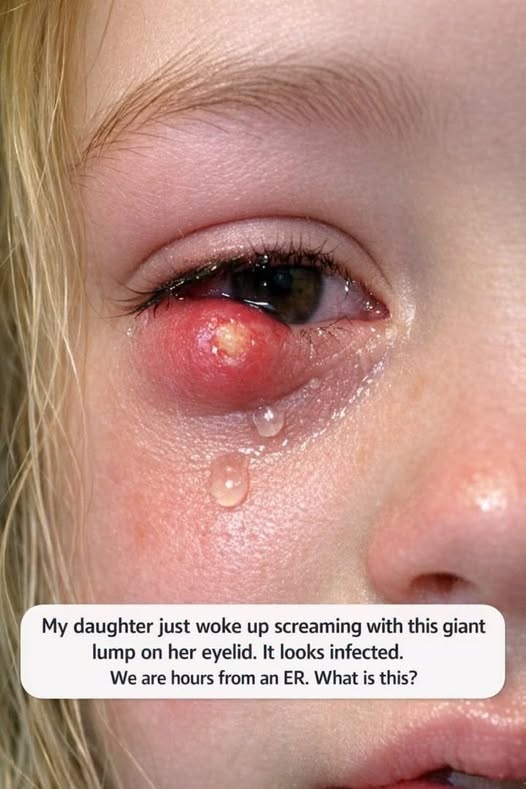
A child wakes up screaming, one eye swollen, red, and painful, and panic hits before you can even turn on the light. In the darkness, a parent may have only seconds to decide whether the swelling looks like a common stye or something that requires immediate medical attention. A small eyelid problem can sometimes look dramatic, while a more serious infection can begin with symptoms that seem deceptively similar. Suddenly, an ordinary morning becomes a frightening race to understand what is happening.
A stye is common, including in children, and typically appears as a painful, tender red lump along the edge of the eyelid, sometimes with a yellow spot in the center. Many styes improve on their own over several days or weeks. But not every swollen eyelid is simply a stye, and parents should pay attention to how quickly the symptoms are changing.
When a child’s eyelid balloons overnight, the fear can be instant and overwhelming. The swelling may make the child’s eye look dramatically different, creating the impression that something terrible has happened. Yet appearances alone cannot determine the cause. A localized stye, a blocked eyelid gland, an allergic reaction, or an infection involving the surrounding tissues can all produce swelling around the eye.
That uncertainty is what makes these situations so stressful for parents. You may be tempted to watch the child for a while and hope the swelling disappears, especially if there is a visible bump that resembles a familiar stye. For a straightforward stye, a clean warm compress held gently against the closed eye for about 5–10 minutes several times a day can encourage it to heal. A stye should never be squeezed or deliberately popped, because doing so can spread infection.
But home care is not appropriate for every situation. The key is recognizing when the symptoms no longer look like a simple, localized eyelid problem. A very painful or dramatically swollen eyelid, redness that appears to be spreading, or symptoms that are getting worse rather than better deserve medical assessment. Changes in vision are particularly important because they can indicate that the problem involves more than the surface of the eyelid.
Fever is another warning sign that should not simply be dismissed. A basic stye usually causes a localized tender lump, while systemic symptoms such as fever can raise concern about a spreading infection or another condition. Medical sources distinguish infections around the eye from infections involving the deeper tissues of the orbit, with the latter requiring urgent attention.
Parents should also pay close attention if a child has significant pain when moving the eye, reduced or blurred vision, difficulty opening the eye, a bulging appearance of the eye, or restricted eye movements. These findings can be associated with orbital cellulitis, a potentially serious infection that requires urgent medical evaluation.
A child who suddenly cannot open the affected eye, complains that they cannot see properly, or appears unusually unwell should not simply be put back to bed with the expectation that the swelling will disappear by morning. These symptoms require prompt professional assessment. The same is true when the redness or swelling seems to be spreading rapidly across the eyelid or surrounding face.
The distinction between a minor eyelid problem and a more serious infection is not always obvious to someone looking at the child at home. That is why professional evaluation matters when warning signs appear. A healthcare professional can examine the eyelid, the eye itself, vision, eye movements, and the surrounding tissues to determine what is actually happening.
It is also important not to rely on the appearance of the lump alone. A typical stye is generally localized and tender, while a more extensive infection may produce broader redness, warmth, swelling, fever, or other symptoms. What begins as something that resembles a simple eyelid bump can occasionally involve surrounding tissues, which is why worsening symptoms deserve attention.
For parents, the instinct to protect a child can become overwhelming in moments like this. Every change in the swelling can feel significant. Every complaint of pain can sound frightening. But the goal is not to diagnose the condition at home. The goal is to notice the warning signs and make the safest decision about when professional help is needed.
If the problem appears consistent with a simple stye and the child otherwise feels well, gentle warm compresses and keeping the area clean may be reasonable while monitoring the symptoms. But if the eyelid becomes increasingly red, hot, painful, or swollen, or if the child develops vision changes or other concerning symptoms, medical advice should be sought promptly.
There is also one important thing parents should avoid: trying to burst or drain the lump themselves. Even when the swelling looks like it contains fluid or pus, squeezing it can potentially spread infection. If drainage is necessary, a healthcare professional can determine whether and how it should be done safely.
The frightening part is that the first few hours can create enormous uncertainty. A child may wake up looking dramatically different, while the actual cause remains unclear. That is why parents should focus less on guessing the diagnosis and more on observing the pattern: Is the child getting better or worse? Is the redness spreading? Is there fever? Is the eye itself painful? Has vision changed? Can the child move and open the eye normally?
Those questions can help determine whether the situation is something that can be monitored or needs urgent attention.
Most importantly, parents should trust significant warning signs rather than allowing reassurance to override them. A swollen eyelid can sometimes be a minor problem, but infections around the eye can become serious, particularly when deeper orbital tissues are involved. Prompt treatment is important when those complications are suspected.
So when a child wakes with one eye swollen, red, and painful, the answer is not always “panic,” and it is not always “wait and see.” It is careful observation, appropriate basic care when the symptoms are mild, and knowing when the situation has crossed the line into something that needs professional evaluation.
A small stye may eventually disappear with simple care. But severe pain, rapidly spreading swelling, fever, difficulty opening the eye, changes in vision, or pain with eye movement are signals that should not be ignored.
Because when a child’s eye is involved, guessing is never the goal.
The safest approach is to recognize the warning signs, avoid potentially harmful home treatment, and let a medical professional determine what is really causing the swelling when the situation is concerning.