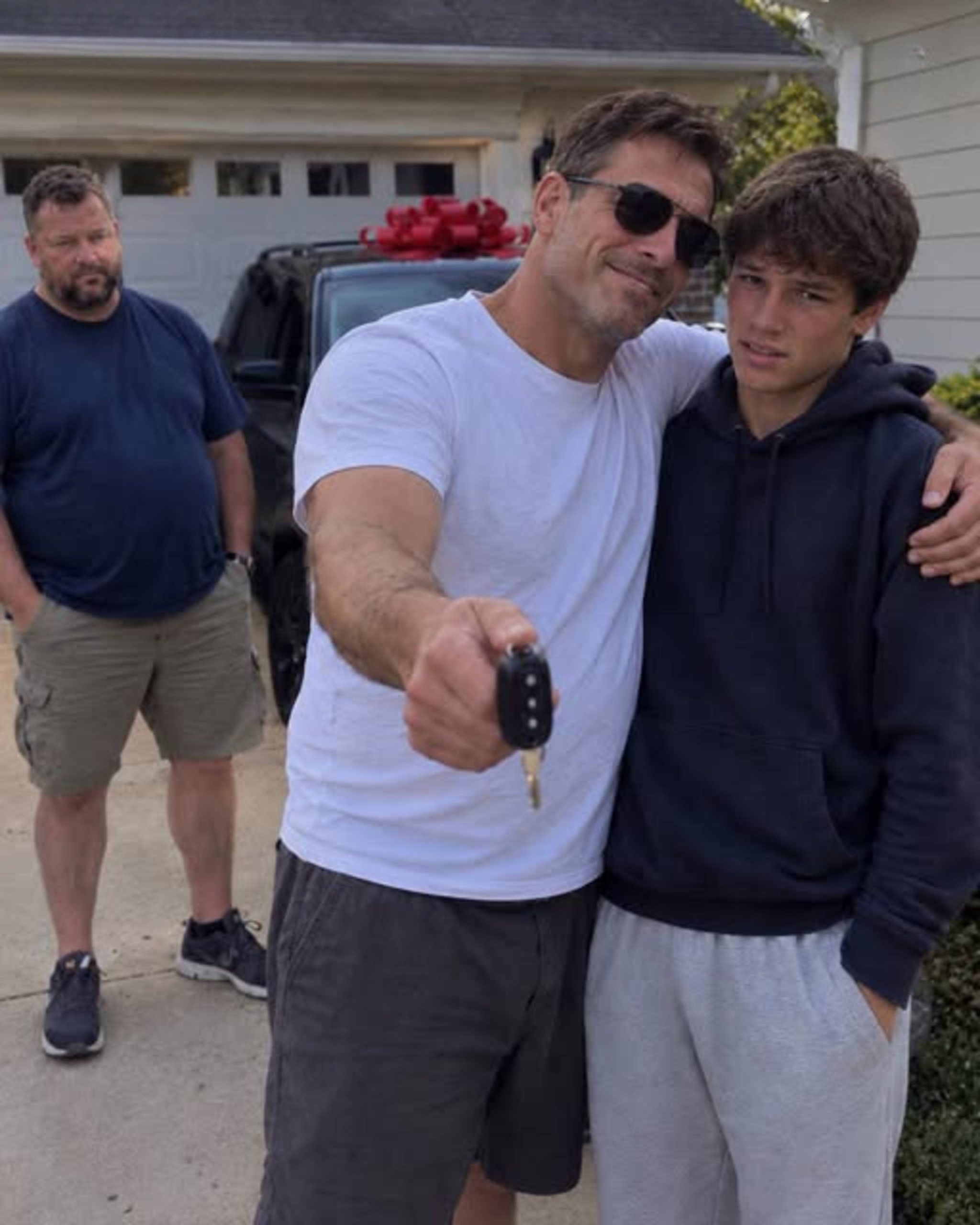
My biological father came back on my 17th birthday determined to prove he could outdo the man who had raised me.
He arrived like he was walking into a competition that only existed in his head.
He had been gone for fourteen years, but apparently that didn’t matter to him. In his mind, showing up with something expensive was enough to erase all the birthdays he had missed, all the school events he hadn’t attended, all the ordinary days when I had needed a father and he had been somewhere else.
He thought one expensive gift would settle it.
He thought the price tag would speak for him.
Then I went inside and brought something out to the driveway.
But I’m getting ahead of myself.
“Come on, son. Your stepdad could never compete with this.”
He said it with a grin.
Then he held out the keys and waited for me to thank him.
I hadn’t seen my father in fourteen years.
Fourteen years is a long time when you’re seventeen.
Long enough that the person who left can become more of an idea than a person.
For most of my childhood, it was Mom and me.
Just the two of us.
And money was the thing we talked about most without actually talking about it.
I learned to recognize the signs.
I knew when the electric bill was late because Mom stopped buying coffee.
She never announced it.
She didn’t need to.
One day there would be coffee in the cupboard, and the next there wouldn’t.
If I asked why, she’d smile and say, “We’re cutting back a little.”
I knew what that meant.
I knew new sneakers meant we weren’t ordering pizza that month.
I knew that if the car made a strange noise, Mom would drive it anyway because a mechanic wasn’t an option yet.
I knew birthdays were planned around what we could afford rather than what I wanted.
By thirteen, I’d learned to stop asking for things before Mom had to say no.
It wasn’t because she made me feel guilty.
She never did.
She simply worked too hard to pretend money wasn’t a problem.
She worked long hours.
She came home tired.
Sometimes she’d fall asleep on the couch before dinner.
And whenever I asked if she was okay, she’d tell me she was fine.
She wasn’t always fine.
But she always made sure I was.
Then she met Ray when I was fifteen.
At first, I didn’t know what to think.
I had grown used to it being Mom and me. There was a rhythm to our little household, even if that rhythm was sometimes held together with unpaid bills and exhausted smiles.
Then suddenly Ray was there.
And Danny was eleven.
Cara was nine.
They stayed with us every other weekend, which meant our tiny house suddenly held five people, three backpacks by the door, approximately nine thousand dirty cups, and enough noise to make me wonder how Mom had ever tolerated the silence before.
It was chaotic.
The bathroom was always occupied.
Someone was always looking for a charger.
Someone was always hungry.
Someone was always arguing over the television.
And somehow, I loved it.
Ray paid child support.
Mom still worked overtime.
Money didn’t magically get better.
We weren’t suddenly rich.
There was no new house.
No fancy vacations.
No expensive cars sitting in the driveway.
But Ray never once made me feel like I was the extra mouth causing the problem.
That mattered.
More than he probably realized.
He didn’t treat me like his wife’s son.
He treated me like one of the kids.
Every one.
Even when I was difficult.
Even when I was quiet.
Even when I acted like I didn’t care.
Especially then.
There was a season when I barely left the bench during basketball.
I told everyone I didn’t care.
I pretended it didn’t bother me.
But it did.
Every time the coach called someone else’s name, I felt something sink inside me.
One afternoon, after a game where I played for maybe four minutes, I found Ray standing by the fence.
He had waited for me.
I walked toward him, pretending to be annoyed.
“You know I didn’t really play, right?”
“I saw.”
“Yeah.”
“Why?”
Ray looked confused.
“Because you were here.”
I stared at him.
That was it.
No lecture.
No attempt to tell me I was secretly the best player on the team.
No fake motivational speech.
He hadn’t come because I’d played well.
He’d come because I had played.
Because I was there.
Because I was his kid.
That was Ray.
No promises.
He just kept appearing.
When I needed a ride, he showed up.
When I forgot something at school, he drove back with me.
When I was sick, he left work early.
When I had a game, he sat in the stands.
When I had a bad day, he didn’t always ask me to explain it.
Sometimes he just sat nearby.
When I nearly failed chemistry, he sat beside me at the kitchen table until nearly midnight.
Neither of us understood the material very well.
In fact, Ray understood the periodic table less than I did.
At one point, I threw my pencil down.
“You’re literally making this worse.”
He looked at the textbook.
“Probably.”
I laughed despite myself.
Then I looked at him.
“Why are you still here?”
He shrugged.
“Because you haven’t figured it out yet.”
I rolled my eyes.
But somewhere inside, I knew exactly why.
He stayed because he could.
Because he wanted to.
Because leaving wasn’t his first instinct.
Later that night, after we’d finally gotten through the chemistry problem, I said something I hadn’t planned to say.
“You’re not even my dad.”
Ray didn’t get angry.
He didn’t correct me.
He simply looked at me for a second.
Then he said, “Parents don’t get to quit before their kids do.”
The room went completely quiet.
Parents.
He didn’t seem to notice he’d said it.
I did.
I carried that sentence with me.
A few months later, Mom married him.
There wasn’t a huge wedding.
There wasn’t a dramatic celebration.
It was simple.
But for the first time, I remember looking at Ray and realizing that our family wasn’t temporary anymore.
He wasn’t just Mom’s boyfriend.
He wasn’t just the guy who came around every other weekend.
He was family.
Years passed.
My biological father remained absent.
No birthday calls.
No school events.
No basketball games.
No late-night chemistry sessions.
No sitting beside me when things went wrong.
Nothing.
And eventually, I stopped waiting.
Then, on my seventeenth birthday, he appeared.
I recognized him immediately.
That surprised me.
After fourteen years, I had imagined I might not.
But there was something about his face that made the memories come rushing back.
He stood in the driveway beside an expensive vehicle.
It was polished.
New.
The kind of thing that made the rest of our neighborhood look suddenly ordinary.
He held out a set of keys.
“Come on, son,” he said. “Your stepdad could never compete with this.”
I stared at him.
He looked proud.
As if he had finally arrived at the right moment.
As if the car could explain where he’d been.
As if seventeen years of life could be measured against a vehicle.
I looked at the keys.
Then at him.
He waited.
I didn’t say thank you.
Instead, I turned around.
“I’ll be right back.”
His smile faded slightly.
I walked into the house.
Down the hallway.
Past the kitchen.
Past the photographs.
And into the room where Ray kept all the things he’d saved over the years.
I picked something up.
Then I walked back outside.
My biological father was still standing beside the expensive car.
He looked confused when he saw what I was carrying.
I stopped in front of him.
For the first time, he seemed to understand that this wasn’t going to be the competition he had imagined.
Because he had brought me something expensive.
Ray had given me something money couldn’t buy.
He had given me years.
And now I was about to show my biological father exactly what fourteen years of simply *being there* looked like.