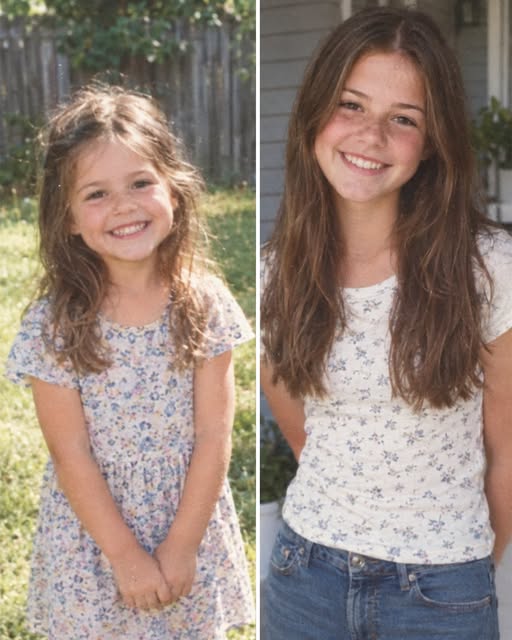
The girl next door looked at me for about three seconds before I said a name nobody had spoken around her in ten years.
“Margot?”
She stopped halfway up our driveway.
“…What?”
My husband Greg turned toward me so fast he nearly dropped the box he was holding.
“Nicole?”
I couldn’t answer either of them.
The Most Ordinary Afternoon in the World
Our new neighbors had come over to introduce themselves that Saturday. Joan and Thomas Ellery, moved in three days earlier from outside Columbus because Thomas had taken a job with the district.
Until that moment, everything about it had been painfully, completely ordinary.
Moving boxes stacked in the driveway. Polite introductions. Joan apologizing for the state of her hair. Thomas explaining he’d already broken a lamp.
And a teenager who apparently hated unpacking and had made that known.
Joan turned and called toward their house.
“Mia! Come say hi!”
And a fourteen-year-old girl came out the front door in a hoodie and sweatpants, walking with the specific reluctance of a kid who has been pulled away from her phone.
For a second I forgot what I’d been about to say.
It wasn’t just her eyes, though it was partly her eyes.
It was what she did with her hand.
The Thing With Her Thumbnail
Mia pressed her thumbnail into the side of her index finger. Rubbed it twice. Then curled her fingers into her palm.
My daughter did that.
Margot did that every single time she was nervous, from the time she was about two and a half.
At four, she’d started hiding her hands behind her back when she did it, because I kept telling her she was going to rub a hole straight through that finger. She’d get caught and put both hands behind her and look at the ceiling like a tiny criminal.
And now a girl I had never seen before in my life was standing ten feet away doing it in my driveway.
“Margot?” I said again. It came out as almost nothing.
Mia took a step backward.
Thomas immediately moved between us.
“Okay — what’s going on here?”
Greg caught my arm.
“Nicole. Look at me.”
“Look at her hand.“
“What?”
“She’s doing it. Greg, she’s doing the thing.”
“We Knew This Day Might Come”
Mia pulled both hands in against her chest.
“Doing what?”
And I looked past her at Joan.
Joan’s face had gone completely white.
And then she said the sentence that took the ground out from under my entire life.
“We knew this day might come.”
Greg let go of my arm.
“What did you just say?”
Thomas turned on her, sharp.
“Joan.”
I came down off the porch.
“What does that mean? What does that mean?”
“We didn’t take anyone’s child,” Joan said, fast. “I need you to hear that first. We have never taken anyone’s child.”
Greg’s whole body went rigid beside me.
“Then how do you know we had one?”
Mia stared at her mother.
“Mom?”
Joan swallowed.
“Three weeks ago I found Margot’s picture online.”
And the ground went out from under me completely.
The Saturday That Split My Life in Half
Ten years earlier, an entirely ordinary Saturday in June had become the worst day of my life.
I was in the kitchen making grilled cheese. Greg was in the backyard playing hide-and-seek with our four-year-old.
I could hear both of them through the window over the sink.
“Eight! Nine! Ten! Ready or not!”
Margot squealed somewhere out there — that specific shriek kids do when they’re delighted and trying to be quiet at the same time.
Then it went quiet.
A few minutes later Greg came through the back door too fast.
“Nicole. Margot’s gone.”
And I actually laughed at him.
“She’s hiding, babe. She’s gotten really good. She was in the recycling bin on Tuesday.”
“I’m serious.”
The Gate That Wasn’t Quite Latched
We searched the house. The shed. Under the deck. Behind the hedge. Inside the dryer, because a four-year-old will absolutely get inside a dryer.
Greg called her name until his voice was gone.
Then I saw the back gate.
It wasn’t standing wide open. That’s the detail that has never once let me alone.
It was resting against the latch. Pushed not quite closed, the way a small person pushes a gate when they can’t reach the mechanism.
“Greg.”
He followed where I was looking.
And across the road, about sixty feet from that gate, was the bus stop. The one I had used with Margot dozens of times to go downtown to the library on Thursdays.
Ten Years of Not Knowing
Within two hours there were police in my kitchen. By evening there were forty neighbors and a helicopter.
Her face went up on every pole in three counties. She was on the news for nine days.
Weeks turned into months and the calls slowed and then stopped.
And then, eventually, people stopped saying they’ll find her.
They started saying things like you have to keep living. Which was kind, and which was also the exact moment I understood that everybody else had finished.
We moved in year three because neither of us could breathe in that house. I could not walk past that gate.
But I never stopped looking.
In grocery stores. In airports. On playgrounds, which is a terrible place to be a woman scanning faces. I count children in crowds without deciding to. I still do it now.
And every June, on her birthday, I would sit with a photograph of a four-year-old and try to age her forward in my head.
And now a fourteen-year-old named Mia lived thirty yards from my front door.
What Joan Had Found Three Weeks Earlier
Joan took a breath and held onto the porch rail.
“Thomas got the job here, so I started reading about the area before we moved. Schools, the neighborhoods, some local history — I do that, I over-research everything. And I found an article.”
“About my daughter.”
“About a little girl who went missing from this street ten years ago. And the photograph—”
She stopped.
“Say it.”
“She looked exactly like Mia’s baby pictures. And the age lined up. And the timing lined up.”
Thomas stepped closer to Mia.
“We thought it could be a coincidence. Kids look like other kids.”
“We were going to get advice,” Joan said. “Once we were settled. We had an appointment with a family attorney for the eighteenth.”
Greg stared at her.
“You waited three weeks.“
“We had a photograph,” Thomas said. “That’s all we had. We weren’t going to sit our daughter down and tell her she might be a missing child because two little girls have the same nose.”
“And then we moved in,” Joan said.
Her eyes came up to mine.
“And you opened your door and said her name.”
“My Name Is Mia”
And then a fourteen-year-old cut clean through four arguing adults.
“Could everybody stop talking about me like I’m not standing right here?”
Nobody said anything.
She looked directly at me.
“And my name is Mia.”
That hurt. Not because she said it cruelly — she didn’t. Her voice barely went up at all.
It hurt because she said it the way you correct someone about anything else. A fact. A simple, obvious fact about herself that she assumed I’d want to know.
“You’re right,” I said. “I’m sorry.”
She watched my face.
“Okay. Mia. I’m sorry, Mia.”
The Fight Greg and I Had Inside
Greg pulled me into the house. The door hadn’t finished closing.
“We need proof.”
“I know.”
“Then we need it now. A glass. A hairbrush. She had a soda, there’s a can in their—”
“We are not taking a child’s DNA out of somebody’s recycling bin.”
His face went tight in a way I hadn’t seen in years.
“Nicole. That is our daughter. She is standing twenty yards away and you want to—”
“We don’t know that.”
“Then let’s find out.“
“I intend to.”
“How?”
“By asking her.”
He stared at me.
“She’s fourteen.“
“Exactly.”
What I Realized Standing in My Own Hallway
For ten years I would have sworn under oath that there was nothing — nothing on this earth — I wouldn’t do for an answer.
I have imagined getting on planes. I have imagined lying to people. I once followed a woman with a blonde child through a mall in Indianapolis for eleven minutes.
Then I remembered that girl standing in my driveway while four adults discussed her over her head like a problem somebody had handed us.
“She isn’t evidence, Greg.”
“And if she says no?”
That one took something out of me.
I picked up my keys.
“Then we live with it until she’s ready.”
What I Said Standing in Their Living Room
I went next door before fear could change my mind.
Joan opened the door.
“I need to ask Mia whether she wants testing. Her, not you. And if she says no, this conversation is over and I will never bring it up again.”
Joan looked at me for a second and then stepped aside.
Mia was on the couch with one leg folded under her. Thomas stayed by the kitchen doorway.
I stayed standing. That felt important.
“Do you want to know whether there’s a connection?”
She studied me.
“You already think I’m her.”
“I think you might be, honey. But I don’t know. And I’ve spent ten years being sure about things that turned out to be nothing.”
“What’s the difference?”
“If I Am Margot, What Happens?”
Then she asked the question.
“If I am. What happens?”
And my very first thought came up instantly and completely: you come home.
I nearly said it. It was most of the way out of my mouth.
Instead I looked around that room.
Her shoes were kicked off under a chair, one on top of the other. A backpack was leaning against the wall with a water bottle in the side pocket.
And on the shelf there was a framed photo of her and Joan laughing beside a birthday cake shaped like a cat.
That wasn’t a placement. That wasn’t a temporary arrangement.
That was her whole life.
“We figure it out,” I said.
“Who decides?”
“You get a say. In every single part of it.”
Her eyes narrowed.
“You mean that?”
“Yes.”
“Even if you don’t like what I decide?”
“Yes.”
She was quiet for a while.
Then she said, “Okay. Let’s do the test.”
The Folder Joan Brought to My Table
While we waited, I asked Joan for every early record she had from before Mia came to them.
She brought a manila folder to my dining room table the next evening.
“I’ve been through these a hundred times,” she said.
“Then let’s go through them a hundred and one.”
Mia stayed upstairs at her own house by choice. I respected that more than I can say.
Halfway through, I found a report.
A young girl, approximate age four, found asleep at the end of a bus route in a city forty miles from here.
On the same afternoon my daughter walked through a gate.
“She Was Four, Nicole”
I pushed that report across the table to Greg.
He read it and shook his head.
“Margot wouldn’t have gotten on a bus.”
“There was a stop across the street.”
“She was four.“
“She’d ridden it with me twenty times. She knew the driver’s name. She used to ask me whether the buses went to sleep at night.”
I put my hand flat on that page.
“She knew that bus, Greg.”
The report said the child appeared to have boarded with a group of other passengers. She was found asleep near the end of the line.
She knew her first name.
She called her parents Mommy and Daddy.
And her directions home were exactly what a four-year-old’s directions are: the yellow house. Across from the bus. Near the tree with the swing.
I read that line about the swing and had to put the folder down for a minute.
How Two Cases Stayed Separate for Ten Years
Joan slid another page across.
“Her identifying information wasn’t consistent in the earliest records. Look at the dates. Look at the spelling on this one.”
I stared at it.
“And nobody connected her to Margot? Nobody?”
Thomas shook his head.
“Not then. Not for years.”
I want to be honest here, because people always want a villain in this story and I have gone looking for one and not found the one they want.
Those records gave us pieces, not a clean answer. Somewhere very early on, wrong or incomplete information got entered and then followed her from one file to the next and the next. A missing child in one county and a found child in another stayed separate.
There’s a review underway now. There are questions I still don’t have answers to and may never get.
But nobody stole my daughter.
Nobody hid her.
Something that should have been caught simply wasn’t. By people who were tired, or careless, or working with a system that didn’t talk to itself.
And on the other side of that failure, another family loved her for a decade.
That truth turned out to be much, much harder to hate than a villain would have been.