For years, I convinced myself that life worked like some enormous balancing sheet. I believed that if I worked hard enough at my job, paid every bill on time, and sacrificed enough of myself inside our small home, eventually things would balance out. I kept waiting for the moment when we would finally reach “enough.” Enough money that I wouldn’t stand in grocery aisles comparing cereal prices ounce by ounce. Enough heat that I wouldn’t stare guiltily at the thermostat before moving it above sixty-five. Enough emotional peace that I could walk through my own house without feeling invisible inside it.
But over time, I realized “enough” was not some destination waiting at the end of hard work. It was a constant struggle. A fight happening every single day at checkout counters, over unpaid bills, and during sleepless nights spent doing math in my head trying to figure out which expense could survive another week without collapsing everything. “Enough” became something that haunted me, always close enough to imagine but never close enough to hold onto.
The hardest days were always Tuesdays.
In our house, Tuesday had quietly become “rice night,” though we never officially called it that. It sounded less humiliating when treated like tradition instead of necessity. I would stand at the kitchen counter staring at a package of discounted chicken thighs and a few aging carrots, mentally calculating how to stretch everything into dinner for three people plus leftovers for lunch the next day. Every grain of rice felt important. Every spoonful mattered. And somewhere in the back of my mind, I constantly wondered which bill I could delay another ten days before everything around us started shutting off.
Dan would come inside from the garage looking exhausted beyond words. His hands stained with grease, shoulders slumped, clothes carrying the smell of engines and metal. Every day he repaired cars worth more than our yearly income while we struggled to afford groceries ourselves. We would exchange the same tired conversation every evening — little updates about work, weak jokes about our daughter Sam constantly staring at her phone, quiet attempts at normalcy. But even while talking to him, my attention stayed fixed on the stove and the steaming pot because I was still silently measuring whether the food would be enough.
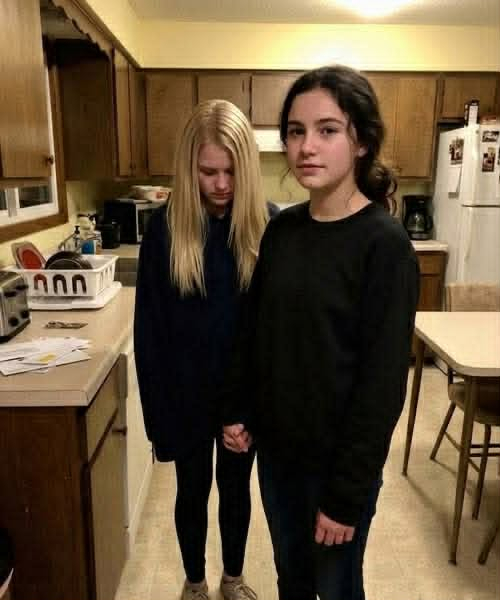
Then one evening, Sam walked through the door with another girl behind her.
The girl wore an oversized dark hoodie that practically swallowed her whole. She clutched the straps of a faded purple backpack so tightly her knuckles looked pale. Her eyes never lifted far from her worn sneakers. Sam didn’t even ask permission before bringing her in. She simply said quietly, “This is Lizie. She’s staying for dinner.”
And to my own shame, my first emotion was fear.
Not anger exactly. Not cruelty. Just the immediate panic of a mother who had already divided dinner into exactly three and a half portions inside her head. I remember gripping the knife tighter while staring at this unfamiliar child and thinking, irrationally and selfishly, that she was one more person I could not afford to feed.
Then I really looked at her.
She was trembling slightly despite standing in a warm kitchen. Her cheeks looked hollow in a way no teenager’s face should. There was exhaustion in her posture far too heavy for someone so young. And suddenly it became painfully obvious that whatever hunger she carried went much deeper than missing one dinner.
So I swallowed my resentment, pushed the fear somewhere deep and ugly inside myself, and quietly pulled out a fourth plate.
Watching Lizie eat that night broke something open inside me.
She didn’t eat the way hungry teenagers usually do. There was no excitement, no rushing toward food. Instead, she moved with careful restraint, taking tiny portions as though terrified of inconveniencing anyone. One small spoonful of rice. One chicken piece. Exactly two carrot slices. She flinched every time silverware clinked too loudly or Dan laughed suddenly across the table. She carried herself like someone trying desperately to disappear.
Conversation during dinner felt fragile.
Dan tried making things easier by asking about school after learning she shared gym class with Sam. Lizie answered softly, almost whispering. When she admitted that algebra was her favorite subject because she liked patterns and predictability, something about that answer crushed me unexpectedly. A child loved math because everything else in her life felt unstable.
As she prepared to leave, Sam grabbed a banana from the counter and handed it to her casually.
“House rule,” she said. “Nobody leaves without taking something.”
The second the door closed behind Lizie, all my fear exploded outward.
“We can barely afford food for ourselves!” I snapped at Sam. “We cannot feed every person you feel sorry for!”
But Sam refused to back down.
With tears burning in her eyes, she explained how Lizie almost fainted in the school bathroom earlier that week. How her father worked two jobs after her mother died. How they’d been living without electricity. How sometimes Lizie pretended she wasn’t hungry because there wasn’t enough food at home.
And suddenly my careful calculations felt shameful.
While I obsessed over rice portions and grocery math, there was a girl nearby genuinely slipping through the cracks of survival itself. A child quietly disappearing while adults around her struggled to stay afloat.
The next day, something inside me changed.
I stopped obsessing over making every chicken thigh stretch perfectly. I started buying the largest bags of pasta I could find. Lizie slowly became part of our routine, then part of our household. At first she apologized constantly for taking up space. Sometimes she fell asleep sitting at the counter because exhaustion overwhelmed her before dinner even finished.
Then one afternoon her backpack tipped over.
A stack of “Final Warning” notices spilled onto the floor beside a notebook page titled: “What we take first if we get evicted.”
I stared at that list for a long time.
Seeing a child calmly preparing for homelessness rearranges something inside you permanently.
Eventually Lizie’s father, Paul, showed up at our door. He looked emotionally destroyed — a man crushed beneath grief, pride, exhaustion, and the impossible pressure of trying to keep his family alive after losing his wife. Dan finally sat him down and spoke to him honestly as another father, convincing him to accept help instead of drowning alone trying to prove he could survive without it.
What followed wasn’t some magical transformation.
It was paperwork. Food pantries. Calls to schools. Negotiations with landlords. Discount shopping. Tight budgets. Long evenings trying to untangle problems too large for one struggling family to carry alone.
And somehow, despite spending more and stretching ourselves even thinner financially, our home started feeling fuller instead of emptier.
For years, I believed life worked like a closed system — that giving more automatically meant having less. But Lizie changed that understanding completely. She taught me that “enough” is not measured only in money, food, or square footage. Sometimes enough means not carrying fear alone anymore.
Eventually the electricity returned to Lizie’s home. Eviction threats eased. Life stabilized little by little. She stopped coming over because she needed food and started coming simply because she wanted to. The frightened girl who once flinched at every loud sound slowly transformed into someone who laughed freely across our kitchen table.
Months later, I stood at the same stove that once filled me with panic and resentment.
Dinner wasn’t fancy. Nothing about our lives had suddenly become wealthy or easy. But as I listened to Sam and Lizie laughing in the other room, I realized I wasn’t counting carrots anymore. I wasn’t calculating rice portions. I wasn’t mentally preparing for scarcity.
I simply placed four plates on the counter.
And for the first time in years, I understood something clearly:
The thing I’d spent my whole life chasing had never been money alone.
It was this.
An open door.
An extra chair.
People carrying one another instead of surviving separately.
That night, without needing numbers or calculations to prove it, I finally understood there was more than enough for all of us.