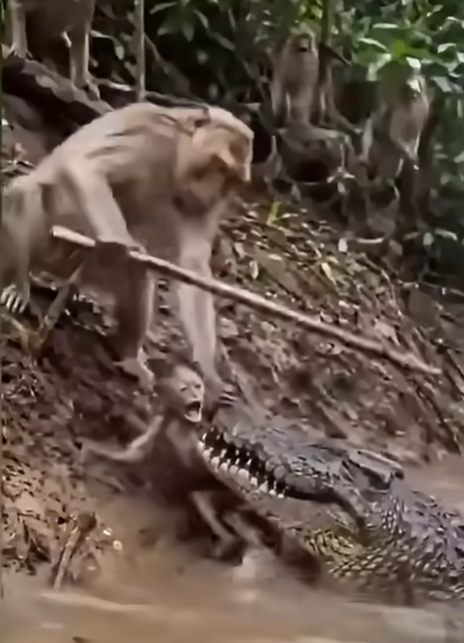
A baby’s scream cuts through the muddy river air.
In the grainy footage, a tiny monkey hangs helplessly from the jaws of a crocodile as its entire troop erupts into panic. One adult lunges toward the predator. Another grabs a branch and swings it desperately. The water ripples violently as the crocodile thrashes, sending muddy spray across the surface.
On the riverbank, dozens of monkeys watch in horror.
For a few seconds, nobody seems to know what to do.
Then instinct takes over.
The cries of the infant become louder.
One adult moves closer.
Another follows.
Branches are lifted. Bodies shift forward. The troop gathers together, forming a trembling semicircle around the scene.
And suddenly, what looked like a helpless struggle becomes something much more powerful.
The animals aren’t simply watching.
They’re trying to help.
What unfolds in those few seconds is more than a viral clip. It is a raw, unscripted collision between predator and family, captured in a moment when instinct, fear, and loyalty all collide.
The baby’s cries pierce through the chaos.
Every movement seems frantic.
The crocodile twists in the muddy water while the tiny monkey remains caught in its jaws. The adults hesitate for only a moment before one of them dares to move closer.
It is an incredibly dangerous decision.
But the adult doesn’t immediately retreat.
Instead, it reaches toward the crocodile.
Another monkey appears with a branch, waving it toward the predator as though trying to make itself appear larger or force the crocodile to release its grip.
The attempt is desperate.
The risk is enormous.
And yet the troop keeps gathering.
More monkeys appear along the bank.
Some remain farther away, watching.
Others edge closer.
The entire group seems caught between two powerful instincts—the instinct to survive and the instinct not to abandon one of their own.
The water continues to churn.
The baby’s cries continue.
And for those watching the footage, the uncertainty becomes almost unbearable.
Did the adults manage to distract the crocodile?
Did the infant survive?
Or was the struggle already beyond saving?
The video never clearly reveals what happened to the baby afterward.
That unanswered question is what makes the footage so difficult to forget.
When the screen goes dark, there is no neat ending.
No explanation.
No confirmation.
Only the memory of those few frantic seconds.
But there is another part of the scene that stays with people long after the footage ends.
The monkeys did not simply scatter.
They did not all run for safety.
Some moved toward the danger.
They reacted to the baby’s cries.
They gathered together.
They appeared to recognize that one of their own was in trouble.
Of course, animals do not experience the world exactly as humans do, and we should be careful about assigning human emotions to their behavior.
But watching that moment makes the distance between us feel strangely small.
Fear is visible in the troop.
So is urgency.
And whatever combination of instinct, social bonds, and protective behavior drove those adults forward, the result is difficult to watch without feeling something.
In the muddy spray and frantic screams, the wild suddenly stops feeling distant.
The river becomes a battlefield.
The troop becomes a family fighting against something far stronger than any one of them.
And the tiny monkey at the center of it all becomes a reminder of how fragile life can be in the wild.
There is no guarantee that courage will be enough.
There is no promise that loyalty will change the outcome.
Sometimes nature offers no happy ending.
But for those few seconds, the adults moved toward danger anyway.
They saw one of their own in trouble.
And they refused to simply look away.
That may be the part of the footage people remember most—not whether the troop won, but the fact that when one tiny life was in danger, others moved closer instead of farther away.
In the muddy water, surrounded by panic and uncertainty, the wild showed something that felt painfully familiar:
sometimes, when someone we love is in danger, fear doesn’t make us run.
It makes us move toward them.