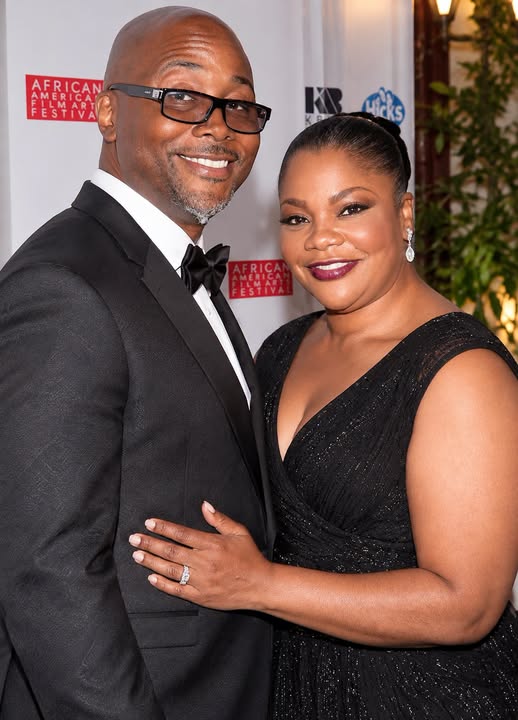
Mo’Nique says her career didn’t just slow down — it was stopped. Roles she thought she’d landed suddenly vanished. Phone calls went quiet. Meetings that once seemed promising ended without explanation. And behind it all, she believes, was a powerful whisper she could never quite prove, but could always feel.
For an actor who had already fought her way to the top, the silence was almost harder to understand than rejection.
Mo’Nique has painted a picture of a career quietly rerouted, not by a lack of talent or effort, but by a perception she says she never agreed to wear. In her telling, a private conflict became a public label, and that label followed her into casting rooms, contract talks, industry conversations, and unanswered calls.
At first, she says, she tried to tell herself it was simply the business.
Roles disappear.
Projects change.
Directors change their minds.
People move on.
That is Hollywood.
But when the same thing happens again and again, eventually you stop calling it coincidence.
She describes walking into auditions confident that she had done the work, believing she had earned her place in the room. She knew what she could bring to a character. She knew how hard she had worked to get there. Yet opportunities she believed were within reach seemed to drift away without a clear explanation.
There was rarely a dramatic confrontation.
No one necessarily sat her down and said, “This is why.”
Instead, there were unanswered messages.
Sudden changes.
Closed doors.
Silence where there had once been conversation.
And sometimes, silence can be louder than rejection.
According to Mo’Nique, the frustration wasn’t simply losing individual roles. It was the feeling that someone else’s version of her had begun arriving in rooms before she did.
A reputation.
A story.
A whisper.
Something she says she could sense, even when she couldn’t always point to a document or a single person and say, “There. That’s the reason.”
That uncertainty made it even more painful.
Because how do you fight something you can’t see?
How do you defend yourself against a conversation you were never invited into?
How do you prove that an invisible barrier exists when the people behind it can simply tell you that there was never a barrier at all?
Her husband, she has said, wanted her to fight back legally. He urged her to sue, believing that the situation had gone too far and that silence would only allow the damage to continue.
But Mo’Nique faced a different question.
Was winning a lawsuit the only way to reclaim her voice?
She chose something riskier.
She kept talking.
She kept performing.
She kept telling her side.
And that decision came with its own price.
Speaking publicly about powerful people and powerful institutions can close doors just as quickly as staying silent can. There is always the possibility that saying too much will make the next opportunity even harder to find.
But she appears to have reached a point where the fear of being misunderstood became smaller than the fear of being erased.
So she turned interviews into testimony.
She turned stand-up stages into places where difficult conversations could survive.
She refused to let an uncomfortable chapter disappear simply because other people preferred a cleaner version of the story.
Years later, her decision to keep speaking seems less about reopening old wounds and more about refusing to let someone else write the final paragraph of her career.
She knows people will disagree.
She knows some will believe her completely, while others will question parts of her story.
But for Mo’Nique, the point is not necessarily convincing every person in the room.
It is making sure her own voice remains in the room.
Because careers can be interrupted.
Roles can disappear.
Phones can stop ringing.
Doors can close.
But an artist’s legacy is not supposed to belong entirely to the people who controlled the doors.
Mo’Nique has spent years insisting that whatever happened behind those doors deserves to be discussed openly rather than buried beneath industry silence.
Whether audiences fully accept her claims or not, she is demanding something that matters deeply to anyone who has ever felt misunderstood: the right to answer for herself.
She doesn’t want her legacy reduced to a rumor she never got to challenge.
She wants the record to contain her voice, too.
And perhaps that is the riskiest thing she chose of all — not fighting to be welcomed back into a room, but refusing to pretend the room never shut its door on her.