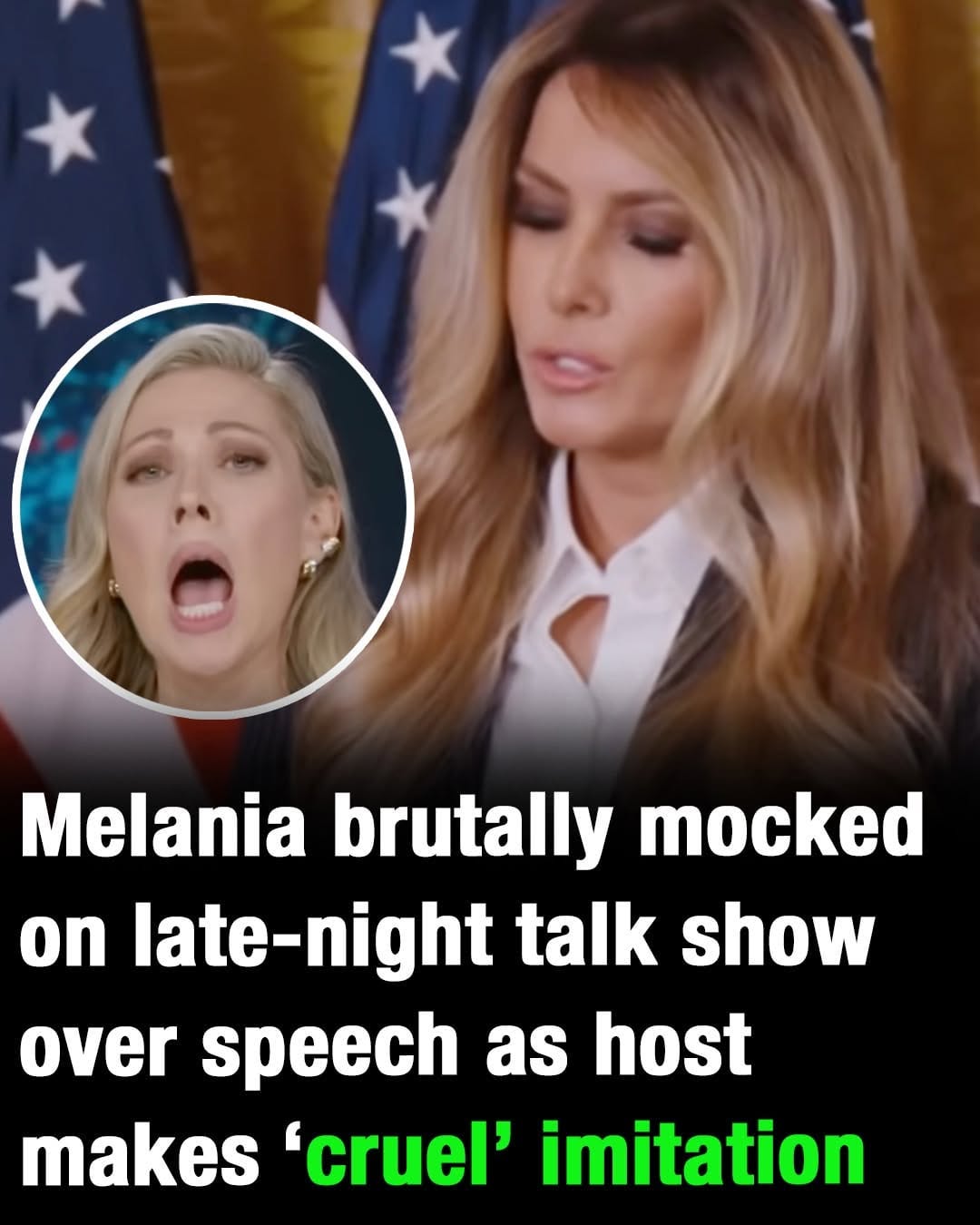
Melania Trump stepped onto the stage to celebrate innovation, technology, and the achievements of some of America’s brightest young minds. The event was intended to focus on the future—a world increasingly shaped by artificial intelligence, scientific breakthroughs, and rapidly evolving technologies. For a brief moment, the spotlight appeared fixed on students, researchers, and the possibilities that lie ahead. Yet within hours, much of that conversation had been replaced by something entirely different.
Late-night television seized upon her speech, transforming a message about innovation into a source of viral comedy. Clips spread rapidly across social media platforms. Headlines focused less on the ideas she presented and more on the way she delivered them. What had begun as a discussion about artificial intelligence soon became a debate about accents, public personas, and the boundaries of political satire.
One of the most talked-about responses came from comedian Desi Lydic on The Daily Show. In a widely shared segment, Lydic impersonated Melania Trump, exaggerating her speaking style and comparing her delivery to that of an artificial intelligence chatbot. The performance drew laughs from some audiences who viewed it as a sharp comedic critique of political messaging and public image. Others, however, felt the jokes targeted Melania herself more than the substance of her remarks.
The segment portrayed her as almost robotic, suggesting she sounded less like a person speaking passionately about technology and more like an automated system reading prewritten prompts. The comparison quickly gained traction online, with viewers sharing clips and memes that echoed the same theme. To supporters of the joke, it was simply another example of political satire doing what it has always done: exaggerating public figures for comedic effect. To critics, however, it crossed a line, shifting attention away from ideas and toward personal characteristics that have long made Melania a target of public commentary.
Much of the disagreement centered on whether the humor was aimed at her message or at qualities she cannot easily change. Critics argued that mocking her accent risked turning a political critique into something more personal. They questioned whether the laughter stemmed from disagreement with her ideas or discomfort with the way she speaks. Supporters of the satire countered that public figures regularly face exaggerated impressions and that no politician or political spouse should be exempt from comedic scrutiny.
Lost amid the debate was the subject Melania had originally intended to discuss. Her speech focused on artificial intelligence and its growing role in shaping society. She spoke about a future in which advanced technologies influence everything from healthcare and education to military strategy and scientific research. References to robotic surgery, autonomous systems, and emerging innovations painted a picture of a world changing at remarkable speed.
These are not trivial topics.
Artificial intelligence is already transforming industries across the globe. Algorithms assist doctors in diagnosing illnesses. Machine learning systems analyze vast amounts of data in seconds. Automated technologies influence transportation, manufacturing, finance, and communication. Governments, businesses, and researchers are increasingly wrestling with questions about how these tools should be used and regulated.
Yet rather than debating those issues, much of the public conversation became focused on personality.
Did she sound natural?
Did she sound scripted?
Did she sound like artificial intelligence herself?
The irony was difficult to ignore. A speech about AI ended with people discussing whether the speaker sounded like AI.
This reaction reflects a broader challenge in modern political discourse. Complex issues often struggle to compete with personal drama, viral clips, and social media controversies. Discussions about technology policy, ethics, innovation, and the future require time and attention. Personality-driven debates, on the other hand, spread quickly and demand little effort from audiences. As a result, serious topics are frequently overshadowed by moments that are easier to share, mock, or turn into entertainment.
Artificial intelligence raises profound questions that society has only begun to address. How should autonomous systems be regulated? What happens when machines can perform tasks traditionally done by humans? How can innovation be encouraged while protecting privacy, security, and ethical standards? These are conversations that affect nearly everyone, regardless of political affiliation.
Instead, public attention often drifts toward individuals rather than ideas.
Whether one viewed Desi Lydic’s impression as clever satire or unfair mockery, the larger story may be what happened afterward. The debate became less about the future of artificial intelligence and more about the person delivering the speech. The substance of the message faded behind reactions to tone, style, and presentation.
In many ways, that shift reveals something important about the current media landscape. Public figures are increasingly judged not only by what they say but by how they say it. Every pause, expression, accent, and mannerism can become part of the story. Sometimes those details illuminate larger truths. Other times they distract from them.
The deeper question remains unresolved. Artificial intelligence continues advancing regardless of political jokes, viral clips, or late-night comedy segments. Its influence grows each year, touching more aspects of daily life and reshaping industries at a pace few could have imagined only a decade ago.
So while audiences continue debating whether Melania Trump sounded awkward, robotic, inspiring, or scripted, the technology she was discussing continues moving forward. The real challenge is not deciding whether someone “sounds like ChatGPT.” The real challenge is determining who will shape the future of artificial intelligence, what values will guide its development, and how society will adapt to changes that are already underway.
Those questions remain far more significant than any punchline.