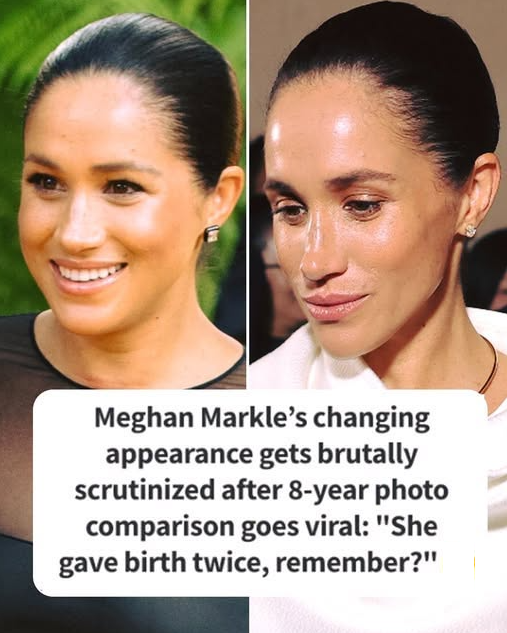
The photos spread across the internet in a matter of hours, triggering a wave of speculation, debate, and endless commentary. Side-by-side images comparing a younger Meghan Markle with more recent photographs quickly became viral fuel, inviting millions of strangers to scrutinize every detail of her appearance. One image captured the actress before royal life transformed her into a global figure. The other showed a woman who has spent years navigating extraordinary public attention, intense criticism, motherhood, and constant media scrutiny.
Almost immediately, social media transformed into a courtroom of amateur investigators.
People zoomed in on her jawline.
They analyzed her nose.
They debated her cheeks, her smile, her hairline, and even the shape of her eyes.
Some insisted the differences were evidence of cosmetic procedures. Others argued that the changes were completely natural. Within hours, countless theories flooded comment sections, blogs, and discussion forums, each claiming to possess the definitive explanation for what they believed they were seeing.
Yet beneath the noise lies a much larger question.
Why are people so determined to explain every change in a woman’s face?
The reality is that faces change.
They change with age.
They change with stress.
They change with pregnancy and motherhood.
They change with weight fluctuations, sleep patterns, illness, lifestyle choices, lighting conditions, camera lenses, makeup techniques, and hairstyles. Even subtle differences in facial expression can dramatically alter how someone appears in a photograph.
For Meghan Markle, these factors have been amplified by circumstances few people will ever experience.
Over the past decade, she has transitioned from television actress to member of the British royal family, become a wife and mother, relocated continents, endured relentless public criticism, and lived under levels of scrutiny that would overwhelm most people. Such experiences inevitably leave marks—not necessarily through surgery or cosmetic procedures, but through the natural process of living.
Experts frequently caution against drawing conclusions from photographs alone. Images are notoriously unreliable evidence. Camera angles, focal lengths, filters, editing software, lighting conditions, and even facial posture can create dramatic visual differences between two photographs taken years apart. Yet despite these warnings, public fascination with celebrity appearances continues to grow.
Part of the obsession stems from society’s complicated relationship with aging.
For decades, women in the public eye have faced enormous pressure to remain youthful. When they appear older, critics question why they have “let themselves go.” When they appear younger, critics speculate about cosmetic enhancements. The result is an impossible standard where nearly every visible change becomes a target for judgment.
Meghan has become one of the most visible examples of this phenomenon.
Whether discussing her fashion choices, family relationships, public appearances, or physical appearance, public conversations often seem less interested in facts than in creating narratives. The side-by-side photographs have become another chapter in that pattern, allowing people to project assumptions onto images while often ignoring the realities of human aging.
Notably, Meghan has never publicly confirmed undergoing cosmetic surgery. Nevertheless, speculation continues to fill the vacuum left by uncertainty. For some observers, the absence of an explanation becomes evidence itself, even when no credible proof exists.
The speed with which these discussions spread reveals something important about modern culture. Social media encourages constant comparison, rewarding outrage, controversy, and speculation. A simple photograph can generate millions of interactions because people are naturally drawn to transformation stories, especially when those stories involve celebrities.
Yet the viral comparisons may ultimately reveal far more about society than they do about Meghan Markle.
They expose our discomfort with aging.
They highlight our fascination with appearance.
They reveal how quickly public curiosity can become judgment.
Most of all, they demonstrate how difficult it remains for women to simply grow older in public without being asked to justify every visible change.
Perhaps the most overlooked explanation is also the simplest.
The woman in those photographs is older.
She has lived through experiences that changed her life.
She has become a mother.
She has endured stress, joy, controversy, success, and disappointment.
Like every human being, her face reflects those years.
And maybe that doesn’t require a scandalous explanation at all.
In the end, the photographs do not necessarily prove surgery, secrets, or hidden transformations. They may simply show what happens when time passes and life leaves its imprint on a person. The real story is not whether Meghan Markle looks different than she did years ago.
The real story is why so many people refuse to believe that change can happen naturally.