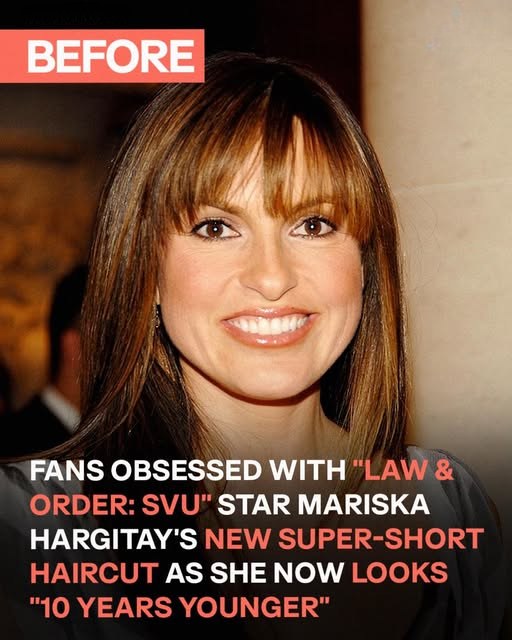
People’s reactions to Mariska Hargitay have obviously changed recently, and it goes beyond simple nostalgia for her many years on television. It’s how one seemingly insignificant alteration may spread and turn into a cultural phenomenon. On its own, a haircut is commonplace. However, a haircut is never just a haircut for someone whose face has come to represent a character like Olivia Benson on Law & Order: Special Victims Unit. People quickly interpret, celebrate, analyze, and—inevitably—project meaning onto the statement.
Adir Abergel, Hargitay’s longtime hairstylist, posted a series of photos that seemed more like a well-planned editorial reveal than a typical salon update, which sparked the recent attention. She had a freshly cut, chin-length bob in the pictures; it was soft, contemporary, slightly disheveled, and purposefully unpolished in a way that conveys confidence rather than carelessness. It was the kind of metamorphosis that sharpens rather than erases a person’s individuality. And it hit home immediately for fans who have followed her through decades of character development, procedural drama, and red carpets.
The time was also important. This wasn’t merely a change for the sake of change. It came just before she made her Broadway debut in “Every Brilliant Thing,” a major career turning point. Everything was reframed by that setting. The haircut ceased to be a purely cosmetic decision and instead became a part of a broader story of transition—an actress entering a new stage, both literally and figuratively.
In a culture that has been conditioned to react emotionally and rapidly to visual change, the response on social media transpired precisely as one might anticipate. Not only did fans praise the appearance, but they also told stories about it. They interpret it as a sign of youth, self-assurance, and regeneration. Some perceived it as a throwback to her early SVU years, when her face was framed by shorter cuts. Others presented it as a break from an appearance that had been so closely linked to a single figure for so long that it had practically become cultural shorthand.
It’s interesting to note how quickly the topic of hair was brought up. People were responding to time as much as style. Because it’s kind of like viewing a visual chronicle of Hargitay’s public life as her hair changes over time. When SVU originally debuted in the late 1990s, she frequently made appearances with shorter, darker cuts—practical, crisp, and consistent with the grounded intensity of a new procedural soap attempting to establish itself. There was a sense of immediacy in those early designs, as if someone were creating a figure from the inside out.
Her hair grew longer, softer, and changed with the rhythms of longevity and fashion as the show established itself as a cultural institution. Longer, more flowing styles replaced the shorter silhouettes, and Olivia Benson’s looks became nearly synonymous with her. That rendition of her appearance became famous for millions of spectators because it persisted rather than because it was static. With the audience, it grew older. It survived shifting television eras, streaming changes, and shifting perceptions of what a top female detective should look like on TV.
The character’s long, brown wave, which so many people now immediately identify with, evolved beyond simple design. It turned into continuity. A visual assurance that Olivia Benson would stay stable, dependable, and identifiable even as episodes evolved and plots became more complex.
This explains why the latest shift seemed so intense. It disrupts a type of visual memory that people were depending on without realizing it. That history is not erased by a chin-length bob, but it is disturbed by its familiarity. Her face is reframed in a way that compels the observer to take another look at the person behind it as well as the style.
That tension was evident in the online response. Some fans expressed admiration, characterizing the cut as youthful, invigorating, and fresh. Others highlighted how it more clearly draws attention to her face characteristics, as if the length removal also eliminated a layer of narrative expectation. Some even went back to her past, pointing out that she has always carried shorter styles with grace and that this comeback feels more like a full circle than a departure.
However, there is more insightful information about how viewers interact with well-known public figures hidden behind the enthusiasm. Familiarity can eventually solidify into expectation. The lines between character and actor become hazy in the public’s mind when someone plays a part for decades, particularly one as deeply ingrained in culture as Olivia Benson’s. Identity is shaped by one’s hair. In a visual sense, not a metaphorical one. People begin to perceive it as fixed instead of changeable.
Therefore, any alteration, even something as basic as getting a haircut, causes a tiny fracture in that mental image. And there’s room for interpretation in that break. Social media uses phrases like “she looks younger,” “she looks free,” and “she looks different in a way I can’t quite place” instead of just “she looks great.” These statements are more about perception getting up to reality than they are about hair.
At this point in her life and work, there is also the additional dimension of transition. Compared to long-running television, moving into theater, particularly Broadway, brings a distinct kind of creative energy. It is more tangible, more immediate, and more contained. Even if that interpretation isn’t specifically intended, getting a new haircut in that situation can feel like taking off an old outfit before putting on a new one.
However, the simplicity of her own response is what most strikes me. She authored, “Changing gears.” Two simple, understated words that defy over-explanation. And part of what makes the moment so powerful is that constraint. People are not given instructions on how to understand the change. It just recognizes motion.
That sentiment was further supported by the stylist’s photographs. They weren’t too produced or posed. Glimpses of preparation rather than the final presentation, they conveyed a sense of backstage change. Soft lighting, vanity mirrors, and open expressions in between attention-grabbing moments. Rather than being a final revelation, it was more like seeing a moment of becoming.
Nevertheless, the public response unavoidably completes the image in its own unique way. The most effective and persistent thing that contemporary celebrity culture does is transform incomplete moments into whole stories. A haircut turns into a new look. A metaphor emerges from a reinvention. When a metaphor is applied to something that is really still just hair, it becomes a narrative about time, identity, aging, relevance, and continuity.
But maybe that’s precisely why it resonates. Because one of the few outward manifestations of identity that can be swiftly altered while yet feeling incredibly intimate is hair. It is not permanent, yet it carries memories. It conveys sentiment without needing to be explained. It has the ability to identify eras without erasing them.
The progression in Hargitay’s case is a sequence of returns and departures rather than a straight line. Each phase—short, long, layered, sleek, tousled—was loosely connected to a time in her life and profession but was never really contained by it. The presence behind the style, rather than the style itself, is what stays constant. Even when others perceive it as fixed, the steadiness of someone who has lived long enough in public view to recognize that image is always changeable.
Thus, the present moment seems as another turn in that continuous rhythm rather than as a break. It serves as a reminder that even the most identifiable people are constantly moving. Still getting used to it. They continue to choose which version of themselves will be featured in the upcoming chapter, often in private and without making a public statement.
Ultimately, the tale is not the haircut. People only utilize it as a surface to get to one. The true narrative lies behind it all, the lengthy trajectory of a public persona, a profession, and a character that has spanned decades without ever coming to a standstill.
And that feeling of continuity through change is what endures after the thrill wears off. It’s a straightforward human adjustment that millions of people can see, not a reinvention for spectacle. A change that, whether we are aware of it or not, speaks more about time passing than it does about transformation.