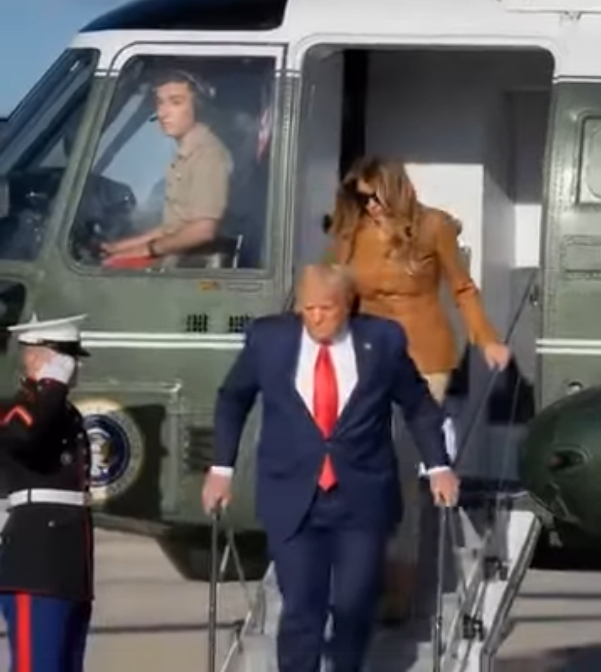
The rotors were still spinning when the first warning crackled through the communication channels. What was supposed to be a routine presidential flight over British soil suddenly transformed into a moment of uncertainty that no security planner ever wants to face. A technical malfunction. A hydraulics problem. An emergency landing. Within minutes, one of the most heavily protected aircraft operations in the world was no longer following its carefully scripted plan.
Aboard Marine One were President Donald Trump and First Lady Melania Trump, traveling during a visit designed to showcase the strength of the relationship between the United States and the United Kingdom. Instead, attention shifted from diplomacy to safety as officials scrambled to respond to an unexpected mechanical issue.
For those watching from the ground, the situation unfolded quickly.
For those inside the aircraft, every minute likely felt much longer.
The helicopter was forced to make an unscheduled landing after crews detected a problem involving the hydraulic systems, one of the critical components required for safe flight operations. Security teams immediately activated contingency procedures, and a backup helicopter was dispatched to continue the journey.
What should have been a brief twenty-minute flight suddenly stretched into a tense forty-minute operation.
During those moments, questions spread rapidly.
Was everyone safe?
How serious was the malfunction?
Could the visit continue as planned?
Would the incident affect the high-profile meetings scheduled for later that day?
In modern politics, perception often moves faster than facts, and speculation quickly filled the vacuum left by limited information.
For a brief period, the focus was no longer on economic agreements, international partnerships, or royal ceremonies.
It was on a helicopter in the sky.
The image carried a symbolic weight far beyond the technical problem itself.
Presidential travel is designed to project confidence, precision, and control. Every movement is coordinated months in advance. Every route is carefully planned. Every contingency is rehearsed.
Yet even the most sophisticated systems remain vulnerable to unexpected failures.
The emergency landing served as a reminder that technology, regardless of its complexity, can never completely eliminate risk.
For a moment, the enormous machinery of global power seemed surprisingly fragile.
One mechanical issue.
One altered flight path.
One reminder that even presidents depend on machines that can fail.
Fortunately, the contingency plans worked exactly as intended.
The backup aircraft arrived.
Security teams adjusted seamlessly.
The mission continued.
When President Trump finally stepped off the replacement helicopter at Stansted Airport, the visual message was clear: the schedule remained intact, and the visit would move forward.
What could have become a story of disruption quickly became a story of resilience.
The narrative shifted from mechanical trouble to political purpose.
Instead of discussing the emergency landing, attention returned to the larger objective of the trip—a series of meetings aimed at strengthening economic and strategic ties between two of the world’s closest allies.
The United States and the United Kingdom were preparing to present what leaders described as a transformative vision for the future.
At the center of those discussions stood a proposed £250 billion technology and prosperity partnership, a sweeping framework intended to deepen cooperation across some of the most important industries of the coming decades.
Artificial intelligence.
Quantum computing.
Fusion energy.
Advanced telecommunications.
Next-generation infrastructure.
Modular nuclear reactors.
These were not merely policy buzzwords.
They represented sectors expected to shape economic power, national security, and technological leadership throughout the twenty-first century.
Officials on both sides described the initiative as far more than a traditional trade arrangement.
Instead, it was presented as a long-term strategic alliance designed to ensure that both nations remained competitive in an increasingly complex and rapidly changing global landscape.
The timing carried additional significance.
As geopolitical competition intensifies and technological breakthroughs increasingly determine economic influence, partnerships between trusted allies have become more valuable than ever.
For both governments, cooperation was not simply about growth.
It was about security.
About supply chains.
About energy independence.
About maintaining influence in a world where emerging technologies are becoming instruments of geopolitical power.
Against that backdrop, the helicopter incident almost seemed symbolic.
A reminder that even the strongest alliances and most advanced systems require constant maintenance, adaptation, and preparation for unexpected challenges.
Following the flight disruption, attention turned to a series of high-profile engagements that underscored the importance of the visit.
At Windsor Castle, President Trump and First Lady Melania Trump were welcomed during a rare second state visit hosted by the British royal family.
The occasion carried considerable historical significance.
State visits are among the most prestigious diplomatic events a country can offer, reflecting both political relationships and broader national ties.
King Charles III and Queen Camilla played central roles in the ceremonial aspects of the visit, reinforcing the longstanding relationship between the monarchy and the United States.
The setting provided a striking contrast to the earlier tension in the sky.
Ancient stone walls.
Formal ceremonies.
Military honors.
Royal traditions stretching back centuries.
For a moment, the urgency of modern politics seemed to blend with the weight of history.
Yet beyond the ceremonial images lay serious discussions about the future.
Later meetings at Chequers brought President Trump together with Prime Minister Keir Starmer as both leaders focused on economic cooperation and strategic planning.
Their message emphasized shared opportunity.
Shared investment.
Shared innovation.
And shared responsibility.
Trump’s vision remained characteristically direct.
He argued that economic growth would come through deregulation, expanded energy production, private-sector investment, and the removal of barriers that slow technological development.
In his view, the partnership represented billions of dollars in potential investment and countless opportunities for businesses on both sides of the Atlantic.
Supporters viewed the proposal as ambitious and forward-looking.
Critics questioned whether such sweeping promises could be fully realized.
But regardless of political perspective, few disputed the scale of what was being proposed.
The industries involved have the potential to shape economies for generations.
Artificial intelligence alone is expected to transform everything from healthcare and education to defense and manufacturing.
Quantum technologies could redefine cybersecurity and computing power.
Fusion energy promises the possibility of cleaner and more abundant power sources.
Advanced communications systems could reshape global connectivity.
Each sector represents enormous opportunity.
Each also carries significant risks and competition.
That reality helps explain why both governments appear eager to strengthen cooperation.
The modern economy increasingly rewards nations capable of innovating quickly while maintaining trusted partnerships.
No country can easily navigate these challenges alone.
As discussions continued behind closed doors, the earlier helicopter incident remained a talking point among observers.
Not because of its technical details.
But because of what it symbolized.
One moment, global leaders were confronting an unexpected mechanical failure thousands of feet above the ground.
The next, they were discussing technologies intended to shape humanity’s future.
The contrast highlighted the strange duality of modern leadership.
Powerful yet vulnerable.
Confident yet dependent on systems that can break.
Focused on the future while constantly managing present risks.
By the end of the day, the emergency landing had become only a footnote in a much larger story.
The aircraft issue had been resolved.
The schedule continued.
The meetings proceeded.
The alliance remained intact.
Yet the image lingered.
A presidential helicopter descending unexpectedly from the sky.
A backup aircraft racing into position.
A brief interruption reminding everyone that certainty is often an illusion.
The engines may falter.
Machines may fail.
Plans may change without warning.
But nations, like people, are ultimately judged by how they respond when unexpected challenges appear.
For the United States and the United Kingdom, the message emerging from the visit was clear.
Despite turbulence—whether mechanical, political, or economic—the partnership endures.
And both countries appear determined to build their future together, even when the journey occasionally requires an unexpected landing.