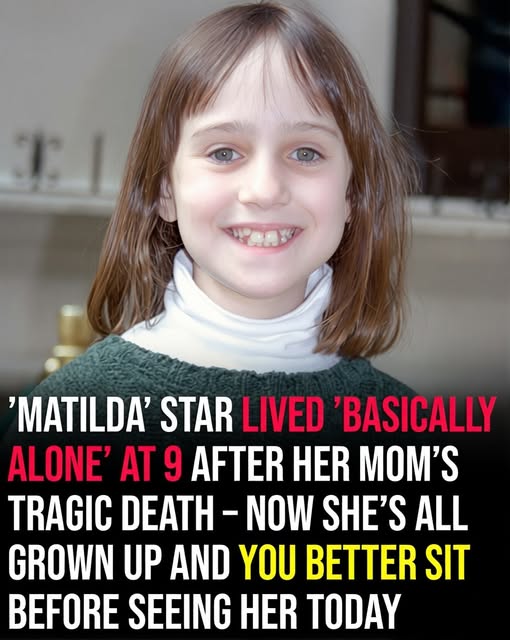
The entertainment industry has long harbored a reputation for being exceptionally fickle, but the harsh reality of how it treats the brightest child stars has rarely been laid bare with such devastating honesty. Mara Wilson, who is set to turn thirty-nine in July, was once one of the most recognizable and beloved faces in global cinema. In the early 1990s, she captured the hearts of millions of moviegoers with her undeniable charm, sharp wit, and precocious acting abilities. Yet, as she grew older and the innocent cuteness of childhood faded, she quietly vanished from the silver screen, leaving an entire generation wondering what happened to the magical girl they had grown up watching on television.
In a series of candid revelations, Wilson has opened up about the dark underbelly of the entertainment business, detailing how the very people who once championed her talents eventually abandoned her when she no longer fit their narrow aesthetic standards. The actress, who began her career as a radiant five-year-old in the 1993 comedy classic Mrs. Doubtfire, alongside the legendary Robin Williams, recently reflected on the transactional nature of fame. She summarized her exit from the industry with a brutal assessment of Hollywood values, noting that the industry essentially became burned out on her. She highlighted a disturbing, pervasive mindset among power brokers in the entertainment world, stating that if you are no longer considered cute or conventionally beautiful in their eyes, then they view you as completely worthless.
Before she became a household name, Mara Wilson was a California-born youngster taking her first steps into the spotlight through television commercials. It was during this period that she received the invitation that would change the trajectory of her life. Starring as the youngest child in Mrs. Doubtfire immediately thrust her into the upper echelons of Hollywood, turning her into a star overnight. Despite the sudden influx of fame and attention, her parents were determined to keep her grounded. They celebrated her successes but maintained strict boundaries around her ego. Whenever she would playfully boast or act as if she were the greatest, her mother would gently but firmly remind her that she was simply a kid doing a job, not the center of the universe. This grounded upbringing would prove vital as she navigated the treacherous waters of the entertainment industry.
Wilson swiftly landed another legendary part after her debut’s enormous success. She took on the role of Susan Walker in 1994. Natalie Wood first made the character famous in the 1947 classic Miracle on 34th Street. Wilson described the bizarre audition experience in an essay for the Guardian. She boldly told the production company that she didn’t believe in Santa Claus, but she did believe in the tooth fairy. For a youngster her age, she brought a remarkable combination of reality and intelligence to the screen.
Working closely with the talented Danny DeVito and his real-life wife, Rhea Perlman, she was cast in what would turn out to be her most memorable and defining performance by 1996: the title character in Matilda. Even while the movie made her very happy and gave her a chance to show off her amazing versatility as a young performer, the time it was being made also happened to be the lowest point in her personal life. Her mother, Suzie, was fighting breast cancer at the time Matilda was being filmed. In the end, her mother lost the battle, leaving eleven-year-old Mara to deal with an unfathomable, devastating loss.
The ensuing grief was severe and permanently altered her. Wilson has talked a lot about how her life was clearly divided into two periods: the period before she lost her mother and the period after. Her mother had been a constant source of support, affection, and safety. The intense demands of celebrity were nearly intolerable without her. Wilson has stated that she was the unhappiest she had ever been, even though she was extremely well-known and in high demand by studios. She longed for a typical childhood, away from the demanding demands of film sets and the curious gaze of photographers.
The shift away from acting started to take shape as she approached adolescence, and it wasn’t really her own decision. The roles and scripts just stopped flowing in. Wilson was outgrowing the adorable, angelic persona that had made her famous as she progressed through puberty, and Hollywood was searching for a particular kind of child star. She described herself during that time as simply another strange, nerdy, noisy girl with horrible teeth and bad hair whose bra strap was usually showing, struggling with the awkwardness of adolescence in the public glare. By the time she was thirteen, no one in the business had praised her appearance or called her cute for years.
This rejection had a severe psychological impact. Wilson had embraced the poisonous Hollywood ideology, believing that she was worthless since her career was declining. She believed that she was completely worthless if she was no longer attractive, thus she immediately linked her professional downfall to her physical beauty. The studios were obviously moving on from the child stars they had formerly abused, and she was suffering from acute burnout from the industry’s unrelenting speed, yet it was hard to deal with the hurt of rejection.
When the fantasy adventure Thomas and the Magic Railroad was released in 2000, she was eleven years old and had her final significant movie role. She experienced a visceral sense of disgust when she read the script at that age. For someone who had previously experienced such a severe loss and matured so rapidly, the characters were too youthful and the content was far too immature. The parts, in her opinion, were uninspired and degrading.
Mara Wilson’s relationship with the public eye has radically changed since then. She went from being an unintentional kid celebrity to becoming a well-known author and writer. Her journey from the dazzling lights of Hollywood sets to a peaceful, contented life of obscurity is chronicled in her writings, especially the novel Good Girls Don’t. She has shared in her articles the strange lessons she picked up on sets and the harsh reality of growing up in a field that demands perfection. Ultimately, giving up acting was a reclamation of her own identity rather than a defeat, demonstrating that her value goes well beyond her youthful charm.