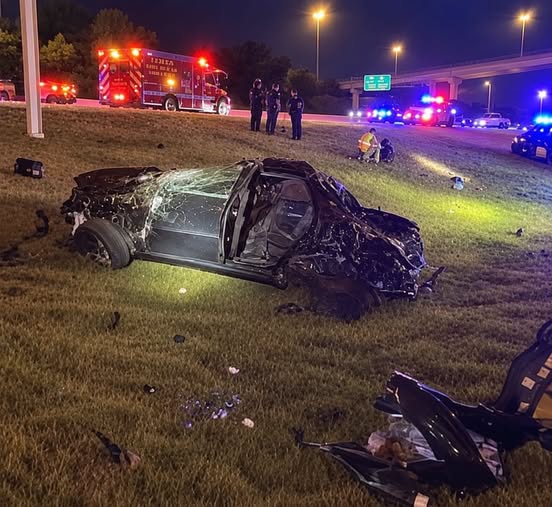
A normal Manhattan afternoon exploded into chaos in a matter of seconds. The streets were busy, people were going about their routines, traffic moved through the city, and there was nothing to suggest that a devastating tragedy was moments away. Then everything changed. A vehicle suddenly veered from the roadway and struck pedestrians, turning an ordinary day into a scene of confusion, fear, and heartbreak. Two people lost their lives, others were injured, and families were suddenly forced to confront news they never expected to receive. Sirens screamed through the streets as emergency crews rushed toward the scene, while stunned witnesses stood nearby trying to understand what had just happened.
In the heart of Manhattan, the tragedy unfolded with terrifying speed. One moment, the area was filled with the ordinary sounds of a busy city—cars moving, people walking, conversations, horns, and the constant rhythm of New York life. The next, those sounds were overwhelmed by screams, emergency vehicles, and the confusion that follows a sudden disaster. Witnesses described a scene that was difficult to comprehend, with people rushing to help while others stood frozen in shock. Within minutes, police officers, firefighters, and medical personnel converged on the area, attempting to secure the scene and provide assistance to those who had been struck.
For the victims and their families, however, there was no way to simply move on from those few seconds. Two lives had been cut short, leaving behind loved ones who now have to cope with an unimaginable loss. The injured were taken for medical treatment, while investigators began the difficult process of determining exactly what caused the vehicle to leave the roadway. A busy Manhattan street had suddenly become the center of a major investigation, with every detail potentially important.
As the initial shock began to settle, the focus shifted toward the driver and the circumstances surrounding the crash. The 61-year-old driver was taken into custody as investigators began working to reconstruct the sequence of events. At this stage, the reason the vehicle suddenly veered into pedestrians remained a central question. Was the driver experiencing a medical emergency? Was there a mechanical or technical problem with the vehicle? Could another factor have contributed? Investigators must examine each possibility carefully rather than relying on assumptions.
That means the investigation will likely depend on far more than eyewitness memories alone. Surveillance cameras positioned around Manhattan could provide crucial footage showing what happened immediately before the vehicle changed direction. Investigators can examine the vehicle itself for mechanical problems, inspect its braking and steering systems, and review available electronic data that may help establish what the vehicle was doing in those final moments. Skid marks, debris, the vehicle’s final position, and the location of the victims can also help investigators reconstruct the path it traveled.
Witnesses may provide another important piece of the puzzle. People who were nearby could remember seeing the vehicle moments before the collision, hearing a sound, noticing unusual driving, or observing something inside the car. Investigators will compare those accounts with physical evidence and video footage. Memories can differ, especially after a traumatic event, which is why investigators must test individual recollections against objective evidence before reaching conclusions.
The driver’s medical history and condition may also become relevant if investigators are examining the possibility of a medical crisis. A sudden loss of consciousness, a seizure, a cardiac event, or another medical emergency can potentially cause a driver to lose control. But such possibilities cannot simply be assumed. Medical evidence would need to establish whether a condition actually occurred and whether it could explain the driver’s actions immediately before the crash.
At the same time, investigators will examine whether the vehicle itself played a role. Modern cars contain numerous electronic systems, and investigators may be able to retrieve information concerning speed, braking, steering, acceleration, and other vehicle functions, depending on the model and what data remains available. A mechanical failure could potentially produce a sudden loss of control, but again, that possibility must be demonstrated through inspection and evidence rather than speculation.
The circumstances surrounding the crash will also determine what happens next legally. Being taken into custody does not by itself establish criminal responsibility, and investigators must determine what the evidence shows about the driver’s actions and state of mind. If authorities determine that a criminal offense occurred, prosecutors can evaluate the available evidence and any applicable charges. If the evidence points toward an accident or an unexpected medical or mechanical event, that would also become part of the investigation’s conclusions.
For people who witnessed the tragedy, the emotional impact may last far longer than the emergency response itself. Sudden crashes can leave witnesses replaying the same images repeatedly, wondering whether they could have done something differently or trying to understand how an ordinary afternoon could change so quickly. In a city as large and constantly moving as Manhattan, tragedies like this can temporarily bring an entire neighborhood to a standstill.
The victims’ families are now facing the most painful part of the story. Behind the police reports and investigation are individual lives, relationships, memories, and futures that will never unfold as planned. Every traffic collision is ultimately more than a collection of statistics or evidence markers. For the families involved, the loss is personal and permanent.
Meanwhile, investigators are racing to establish a precise timeline. What happened