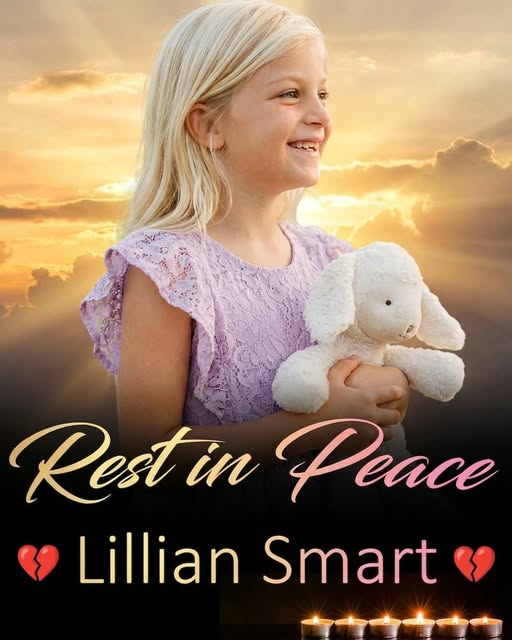
For one Louisiana family, a perfect summer day became a nightmare no parent should ever have to experience.
An 8-year-old girl’s laughter.
A sunny lake.
A splash in the water.
Then came the fever.
The confusion.
The hospital.
And a race against an infection doctors could barely fight.
By the time the family understood what they were facing, their ordinary summer had already become something they could never escape.
They remember Lillian Smart’s smile first.
Before anyone talked about infections, medical terminology, or the terrifying words “Naegleria fowleri,” the people who knew her remembered something much simpler.
Her joy.
Friends in Ruston, Louisiana, described a little girl who seemed capable of lighting up a room simply by walking into it.
She was energetic.
Curious.
Full of life.
The kind of child whose presence could make an ordinary place feel brighter.
Her parents, Daniel and Rebecca, had no reason to believe that one ordinary afternoon at Lake Claiborne would become the last carefree day they would ever share with their daughter.
It was supposed to be summer.
A child playing in the water.
Parents enjoying the familiar comfort of watching their daughter have fun.
Nothing about the day announced what was coming.
There was no visible warning.
No dramatic sign that something was wrong.
The lake looked like a lake.
The afternoon looked like an ordinary afternoon.
And Lillian was simply being a child.
But days later, everything changed.
A fever appeared.
Then confusion.
Then symptoms serious enough to require medical attention.
Suddenly, the family’s world narrowed.
The lake was no longer the center of their summer.
The hospital was.
Instead of thinking about the next family outing, they were thinking about doctors and tests.
Instead of listening to a child laugh, they were listening to monitors.
Instead of planning tomorrow, they were hoping she would make it through today.
And then came the diagnosis.
Naegleria fowleri.
The name itself was frightening.
The organism is often referred to as a “brain-eating amoeba,” a phrase that has become widely known because of the devastating infection it can cause.
The actual disease, primary amebic meningoencephalitis, is extremely rare but can progress rapidly when it occurs.
Naegleria fowleri is associated with warm freshwater, and infection can occur when contaminated water enters the nose.
It is not something that happens to most people who swim in lakes.
That rarity is part of what makes cases like Lillian’s so difficult to comprehend.
A family can spend an ordinary afternoon enjoying freshwater without ever imagining that an invisible organism could become a medical emergency days later.
For the Smart family, there was no time to understand the unfairness of it.
There was only time to fight.
Doctors worked.
Her parents waited.
The community prayed.
And people across Ruston began following Lillian’s story, hoping that somehow the ending could still change.
Neighbors rallied around the family.
Local businesses supported the **“Love for Lillian”** fundraiser.
People who had never met the little girl began caring about what happened to her.
That is what communities sometimes do in moments of unimaginable crisis.
They cannot take away the illness.
They cannot control what happens inside a hospital room.
But they can show a family that they are not alone.
They can bring food.
Raise money.
Send messages.
Pray.
Stand nearby.
And keep hoping.
For Lillian’s loved ones, hope became something they held onto day after day.
Every update mattered.
Every improvement could feel like a miracle.
Every setback could feel devastating.
And behind all of it were two parents facing the unimaginable possibility that their daughter might not come home.
No parent should have to sit beside an 8-year-old’s hospital bed wondering whether they will ever hear that child’s voice again.
But that became the reality of Daniel and Rebecca’s world.
Eventually, the community received the news everyone had been desperately hoping would never come.
Lillian did not survive.
The grief that followed was enormous.
For her parents, it was personal and immeasurable.
For her friends and neighbors, it was the loss of a child they had watched grow.
For people who had followed the story from a distance, it was a reminder of how quickly an ordinary day can become a tragedy.
But perhaps the most important thing about Lillian’s story is that she should not be remembered only through the illness that took her.
Naegleria fowleri became part of the story.
It should never become the definition of the girl.
People who knew her remember her smile.
They remember her energy.
They remember how she made people feel.
They remember a child who seemed to belong everywhere she went.
Those memories matter because illness can easily overwhelm the identity of someone who dies young.
The headline becomes the disease.
The disease becomes the story.
And the person slowly disappears beneath it.
Lillian deserves better than that.
She was eight years old.
She had a family who loved her.
She had friends.
She had a community.
She had a personality that people remembered.
She had a future that should have continued.
That future was taken away, but the memories of who she was remain.
Her death also brought renewed attention to the rare dangers associated with warm freshwater.
Health officials have continued to emphasize that Naegleria fowleri infections are extremely uncommon, while also advising people to take precautions in environments where the organism may be present.
Avoiding water entering the nose can reduce risk, particularly in warm freshwater settings.
But the broader lesson is not that families should live in fear of lakes.
It is that rare risks deserve respect without allowing fear to erase perspective.
Millions of people enjoy freshwater every year without experiencing this infection.
Lillian’s tragedy was extraordinarily unusual.
That is precisely why her family never imagined it could happen to them.
And that is perhaps one of the hardest parts for any family after a sudden loss.
There is always a moment when someone thinks:
We had no idea.
There was no reason to think that would be our story.
We thought she was safe.
We thought we had more time.
For Daniel and Rebecca, the memory of that lake will likely always contain two completely different images.
One is their daughter enjoying the water.
Laughing.
Playing.
Free.
The other is the hospital.
The fever.
The confusion.
The monitors.
The desperate hope.
Both memories belong to the same child.
But one represents everything that should have continued.
The other represents the moment that future disappeared.
Ruston grieved with the Smart family because Lillian’s story touched something universal.
Every parent understands the instinct to protect a child.
Every family understands how precious an ordinary day can become after it is gone.
And every community understands the desire to surround people when there is nothing else left to offer.
The fundraiser, the prayers, the messages, and the support could not change the outcome.
But they mattered.
They told the family that Lillian’s life mattered to other people too.
That her name was being spoken.
That her story had reached beyond one hospital room.
That she was remembered.
Today, the most meaningful way to tell Lillian’s story is not to focus only on how she died.
It is to remember how she lived.
As the bright little girl whose smile people noticed.
The child who brought energy into ordinary places.
The daughter whose parents loved her beyond words.
The friend whose absence left a space that cannot simply be filled.
The 8-year-old whose summer should have continued.
Her life was heartbreakingly short.
But it was not defined by its final days.
It was defined by every day before them.
And that is what her family and community can carry forward.
Not only grief.
Not only fear.
But memory.
Because the disease may explain the tragedy.
It does not explain Lillian.
Lillian was the laughter before the hospital.
The smile before the diagnosis.
The child running toward the water without knowing what the future held.
And although that summer day ended in a way no parent could ever have imagined, the joy she brought into the lives around her remains something the illness could never take away.