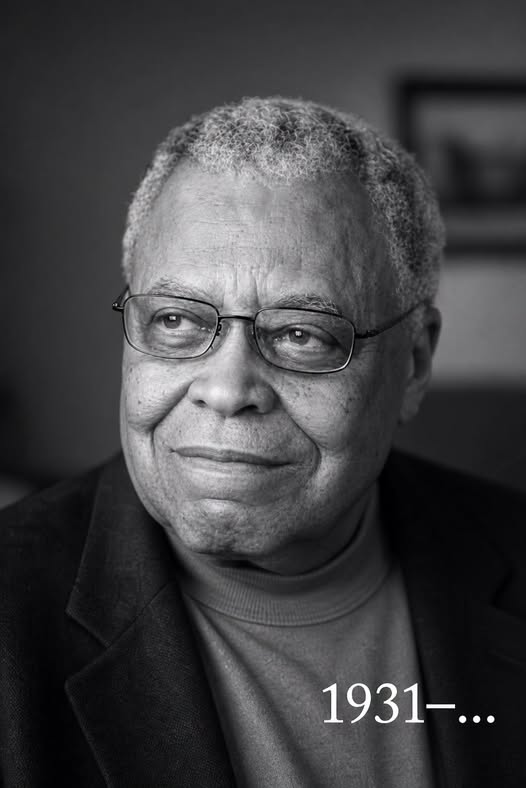
His Voice Raised a Galaxy. Now, It’s Gone Forever.
The world didn’t just lose an actor; it lost an echo that lived inside millions of hearts. James Earl Jones is gone, and something vast and irreplaceable went with him. The man behind Darth Vader and Mufasa carried our childhoods, our fears, and our hopes. His silence now feels unbearable because his voice had become one of those rare sounds we somehow assumed would always be there.
He was more than a voice. James Earl Jones carried a rare gravity, the kind that made a single line linger in the mind for years. There was authority in his delivery, but also extraordinary control. He could make a character terrifying without shouting and comforting without becoming sentimental. Whether audiences saw his face or only heard him speaking, they immediately knew who had entered the story.
On stage, on screen, and in the recording booth, he brought a depth that turned simple dialogue into something almost sacred. His Darth Vader terrified and fascinated audiences, helping transform a masked villain into one of cinema’s most unforgettable figures. The costume created the silhouette, but Jones gave the character a presence that seemed to fill every corner of the screen.
Then there was Mufasa.
For generations who grew up watching *The Lion King*, Jones’s voice represented something completely different. Mufasa was warm, protective, wise, and reassuring. Children who had once heard that same unmistakable resonance coming from one of cinema’s most frightening villains now heard it coming from a father whose words carried love, responsibility, and guidance.
That contrast revealed the extraordinary range behind the famous voice. Jones could sound commanding enough to rule a galaxy and gentle enough to comfort a frightened child. His performances were not memorable simply because his voice was deep. They were memorable because he understood how to fill that voice with emotion.
His journey to becoming one of the world’s most recognizable performers was especially remarkable because speaking had once been a source of enormous difficulty for him. As a child, Jones struggled with a severe stutter and spent periods speaking very little. Eventually, poetry and performance helped him discover a path toward using the very thing that had once caused him pain.
That transformation gave his career an almost poetic quality. The boy who once struggled to speak grew into a man whose voice became instantly recognizable across the world. What could have remained a source of fear became one of his greatest instruments.
Across seven decades, he navigated stardom with humility, transforming personal struggle into a quiet, steady strength that audiences could feel but rarely see. His career extended far beyond the two characters most often associated with his name. He worked across theater, film, and television, building a body of work that demonstrated the depth of his craft long before blockbuster franchises made his voice familiar to younger generations.
And yet, despite the fame surrounding him, there was something remarkably grounded about his presence. He didn’t need spectacle to command attention. He could stand quietly, deliver a few carefully measured words, and make an entire scene feel heavier.
Generations grew up guided by that unmistakable resonance, a sound that made galaxies feel close and animated kingdoms feel real. Parents introduced his films to their children, who eventually introduced them to another generation. His performances became part of family movie nights, childhood memories, theater history, and popular culture.
That is why his death feels different for so many people. We may never have met James Earl Jones, but we invited his voice into our homes for decades. It frightened us, reassured us, entertained us, and sometimes helped explain complicated ideas about courage, responsibility, family, and loss.
Now that he is gone, the characters remain.
Darth Vader will still breathe from behind the mask. Mufasa will still speak to Simba. Old performances will continue playing in theaters, classrooms, living rooms, and headphones. People who were not even born during the height of Jones’s career will discover him and immediately understand why that voice became legendary.
The recordings endure, but the man himself has taken his final bow.
What’s left is gratitude—for the performances, for the characters, for the decades of work, and for the extraordinary journey of a man who turned a childhood struggle with speech into one of the most recognizable voices in entertainment history.
James Earl Jones may have fallen silent, but the echo remains. It lives in galaxies far away, in animated kingdoms, on theater stages, and in the memories of millions who grew up listening.
And some voices become so deeply woven into our lives that silence can never completely take them away.