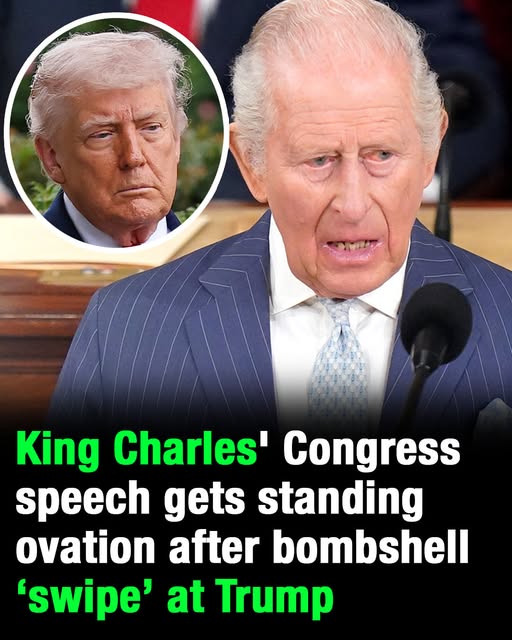
Few events in recent memory have conveyed the subtle, electric charge of King Charles III’s recent presentation to a joint session of Congress, despite the fact that the hallowed halls of the US Capitol have hosted some of the most significant moments in democratic history. A diplomatic bridge-building exercise between an old monarchy and a restless republic was supposed to be a ceremonial visit, but it quickly turned into a master session in high-stakes political scheming. The King effectively reset the rules of the Transatlantic partnership in a single afternoon by delivering what many are calling a clear “bombshell” jab at Donald Trump’s isolationist rhetoric without ever raising his voice or speaking a single disparaging phrase.
There was a lot of expectancy in the room. The coming of a British monarch symbolizes a different type of power—one based on continuity, tradition, and the long perspective of history—at a time when American politics are frequently determined by the loudest voice in the room and the most combative post on social media. This cultural capital was not wasted by Charles. It was evident as soon as he mounted the podium that he wasn’t just there to say hello or describe the two countries’ common language history. He was there to protect an international system that the populist right has been attacking more and more.
The King used a surgically precise approach. He relied on the strength of communal memory rather than the mud-slinging that characterizes contemporary political discourse. He started by bringing up the visceral memories of September 11, 2001. Charles reminded the gathered lawmakers—as well as the worldwide public watching from home—that the alliance is not a transactional commercial arrangement by recalling the moment the world stood still and the United Kingdom stood “shoulder to shoulder” with the United States in its darkest hour. This was a straightforward, albeit courteous, refutation of the persistent assertions that European allies have been “freeloaders” or have abandoned American interests.
The King portrayed the contemporary inclinations toward isolationism as a breach of a sacred promise rather than a sign of strength by basing his address on the blood and sacrifice of the past. He described the North Atlantic Treaty Organization (NATO) as a live example of a pledge made between free peoples rather than as a line item in a budget. The King was arguing that the alliance’s worth is determined by security, stability, and shared values—currencies that cannot be diminished by a single election cycle—while some political figures have spent years doubting NATO’s usefulness and speculating that the United States might desert its allies if they don’t “pay up.”
The King’s rhetoric became more intense and piercing as the address shifted from the historical to the modern. The “swipe” at the Trumpian ideology became most apparent with the move to Ukraine. The question of whether the United States should continue to help Kyiv has become one of the most divisive topics in Washington in recent months. Many on the populist right have framed aid as an act of international charity that the United States can no longer afford or as an unneeded drain on American resources. With the poise of an experienced statesman, Charles deconstructed this frame.
He maintained that backing Ukraine is an essential investment in the upholding of the international rule of law rather than a gesture of kindness. He characterized the fight as a front-line struggle for the basic essence of the democratic world rather than a far-off territorial dispute. He successfully subverted the idea of “America First” by presenting the defense of Ukraine as the “price of a just and lasting peace.” He hinted that the ultimate cost, both in terms of money and human lives, will be exponentially larger if the United States and its allies do not stand firm now. It was a call to accountability that addressed the room’s conscience directly, eschewing party squabbling.
The response was just remarkable. The King’s remarks sparked a loud standing ovation that seemed to span the gap, if only momentarily, in a Congress so divided that legislators frequently fail to agree on the time of day. Motivated by a kind of moral clarity that has grown increasingly uncommon in the corridors of power, both Republicans and Democrats were seen standing up. They were touched not only by the speech’s content but also by the way it was delivered—the “calm insistence” on bravery and commitment that contrasted so sharply with the grievance-fueled spectacle of the present campaign trail.
The response on the internet was as explosive. Clips of the address were widely shared on social media, with many users pointing out the sharp contrast between the King’s respectable, statesmanlike demeanor and the tumultuous, domestic political landscape. The address was viewed by the former president’s detractors as a “quiet rebuke” of the highest kind, and they commended the King for having the guts to say what many American politicians believe they are unable to. The King’s speech was like a cold hand on a feverish forehead for people who have been worn out by the never-ending cycle of conflict and the deterioration of international norms.
Beyond its immediate political ramifications, the speech was a potent reminder of the British monarchy’s continued relevance in the twenty-first century. Charles proved that a constitutional monarch can serve as a crucial “soft power” heavyweight, despite the institution’s frequent criticism as an anachronism. He may speak the truth without being constrained by the desire to win over a swing state or placate a certain base since he is not a politician running for reelection. He reminded the United States of its best self by speaking as a representative of history.
The speech also emphasized the American electorate’s growing need for “real statesmanship.” There is a strong need for leadership that is based on reality and driven by a feeling of obligation in a time of “alternative facts” and “fake news.” The King made his point without resorting to insults or exaggeration. He relied on reason, precedent from the past, and a common goal. In the face of the populist rhetoric of the day, this “statesmanship of the old school” proved to be a devastatingly effective weapon.
The “Charles Bombshell” is still having an impact on politics as this historic visit comes to an end. It has put isolationists on the defensive and compelled a reassessment of the transatlantic alliance. King Charles III issued a challenge by reminding the world that the “special relationship” is tempered by a shared commitment to freedom and forged in the fires of shared struggle. He urged the US to keep in mind its responsibilities, respect its past, and lead with the same “loyalty and courage” that had prevented global catastrophe. Ultimately, the standing ovation wasn’t just for the King; it was also for the idea of a future in which allies continue to stand together against the tide of history and honor is still valued.