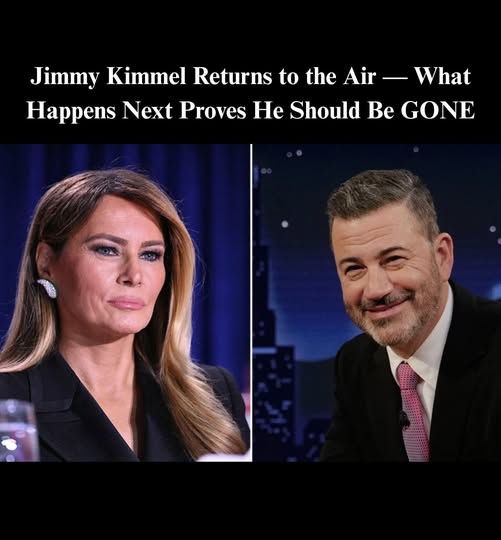
Jimmy Kimmel didn’t step back from the controversy. As the country was still processing the shock of an attempted assassination connected to the White House Correspondents’ Dinner, a joke he had made about Melania Trump—the now widely discussed “expectant widow” line—quickly became something much larger than a late-night remark. What might have remained a debate about humor suddenly turned into a national flashpoint, where politics, safety, and public language collided in a way that felt difficult to untangle.
The reaction was immediate and intense. Melania Trump called for consequences, making it clear that the comment was not viewed as harmless or acceptable. Donald Trump and his supporters echoed that sentiment, framing the joke as part of a broader issue with how public figures are treated in media. On the other side, critics of Trump pointed back to his own history of rhetoric, suggesting that the conversation could not be isolated to a single moment or a single individual. Supporters of Kimmel emphasized the importance of free speech and the role of satire, arguing that humor—especially political humor—has always included sharp or uncomfortable elements.
Then another development added a new layer to the situation. The alleged shooter’s manifesto became public. With that, the entire conversation shifted again. Words that had already been controversial were now being reconsidered in light of a real-world act of violence. The context had changed, and with it, the way people interpreted everything that had been said before.
In the days following the incident, two distinct narratives unfolded at the same time. One centered on a late-night monologue—something intended for entertainment, built on exaggeration and commentary. The other involved an actual security threat, a situation with real consequences and real fear. When those two narratives intersected, the result was a level of tension that neither could fully contain on its own.
Kimmel addressed the situation publicly, maintaining his position while also acknowledging the seriousness of what had happened. He described the remark as a “light roast,” placing it within a familiar comedic framework—one that often relies on exaggeration, irony, and personal references. He clarified that the joke was not intended to suggest harm or violence, but rather to comment on public perceptions, including the age difference between Melania and Donald Trump and the nature of their relationship as it is often portrayed in media.
At the same time, he did not fully retract the comment. His response reflected a balance between defending the intent behind the joke and recognizing the impact of the broader situation. He expressed regret toward those who had been directly affected by the attack—journalists, attendees, and others present—but he rejected the idea that his words had any connection to the actions of the suspect.
Meanwhile, investigators and prosecutors began outlining details about the individual involved, Cole Allen. According to reports, he had arrived prepared, carrying weapons and motivated by a written manifesto that expressed strong opposition to Donald Trump and members of his administration. The description presented was one of intent and planning, shaped by personal views that extended beyond any single public statement or event.
This added another dimension to the debate. It raised questions about how individual actions relate—or don’t relate—to broader public discourse. While some argued that the environment of political language can influence behavior, others emphasized the importance of distinguishing between speech and personal responsibility. The connection between the two is often discussed, but rarely agreed upon.
As the situation continued to unfold, what remained was a sense of unease. The boundaries between humor, criticism, and real-world consequences appeared less clearly defined than before. What is intended as satire can be interpreted in multiple ways, especially when events shift the context in which it is received.
For some, the incident reinforced concerns about the tone of public conversation, suggesting that language has become more intense, more personal, and more difficult to separate from real-world tensions. For others, it highlighted the importance of preserving space for expression, even when that expression is uncomfortable or controversial.
Between those perspectives lies a more complicated reality. One where humor, politics, and public reaction are constantly interacting, shaping and reshaping how events are understood.
In the end, the situation leaves behind a question that does not have a simple answer:
Where is the line between sharp satire and a broader environment that is already under strain—and who decides when that line has been crossed?