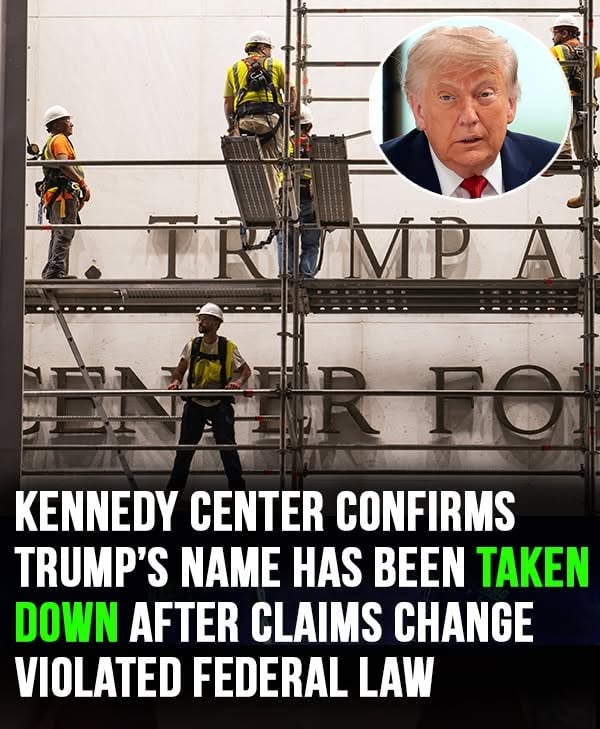
The crowd gasped as workers pulled down the tarps and the giant letters began disappearing one by one.
For some gathered outside the Kennedy Center, it felt like a long-awaited correction. For others, it looked like political revenge dressed up as legal procedure. Television cameras rolled, protesters shouted, supporters cheered, and social media exploded as one of Washington’s most symbolic cultural institutions became the center of another national battle over Donald Trump’s legacy.
What began as a dispute over a name quickly evolved into a larger fight over history, power, and who gets to leave a permanent mark on America’s public institutions.
The controversy traces back to a decision that placed Trump’s name on part of the Kennedy Center complex, sparking immediate criticism from historians, arts advocates, and former patrons. Opponents argued that the center was established as a living memorial to President John F. Kennedy and should remain focused on that mission rather than becoming a platform for contemporary political branding.
Supporters viewed the criticism very differently. To them, honoring Trump reflected the influence he continues to hold over American politics and culture. They argued that removing his name represented an attempt to erase accomplishments and silence millions of Americans who continue to support him.
The conflict intensified as legal challenges moved through the courts. Attorneys debated federal statutes governing the Kennedy Center, while advocacy groups on both sides organized petitions, rallies, and fundraising campaigns. What might have seemed like a simple naming dispute became a national argument over symbolism and authority.
When the final ruling arrived, reactions were immediate and fierce.
Outside the Kennedy Center, some spectators applauded as workers removed the signage. Others booed and accused officials of political bias. The atmosphere felt less like a cultural event and more like a campaign rally, with both sides treating the outcome as a major victory or devastating defeat.
Longtime supporters of the Kennedy Center praised the decision, arguing that the institution’s purpose should remain connected to Kennedy’s legacy and the performing arts rather than modern partisan conflicts. Many said public memorials should belong to the nation as a whole, not to any individual political movement.
Trump supporters responded with equal intensity. Many described the ruling as an attack on their values and their political identity. Some vowed to continue fighting through appeals and public pressure campaigns, insisting the issue was far from settled.
Legal experts noted that the ruling focused primarily on the interpretation of federal law rather than personal opinions about Trump himself. Yet in today’s political climate, few people viewed it through a purely legal lens. Every development was immediately absorbed into the larger national debate surrounding Trump and his place in American history.
The dispute highlights a deeper question that extends far beyond a single building in Washington. Who decides how public institutions remember political figures? Should cultural landmarks remain neutral spaces, or is every major institution inevitably drawn into political battles?
Those questions remain unresolved.
The marble walls of the Kennedy Center still stand overlooking the Potomac River. Concerts continue. Performances go on. Visitors still walk through the same halls they did before the controversy erupted.
Yet something has changed.
For some Americans, the removal of Trump’s name represents a defense of tradition and institutional integrity. For others, it symbolizes exclusion and political double standards. The physical letters may be gone, but the arguments surrounding them show no sign of disappearing.
In the end, the fight was never really about a sign.
It was about legacy.
It was about memory.
And it was about a nation still struggling to decide how its most divisive political figures will be remembered long after the crowds, cameras, and court battles have faded away.