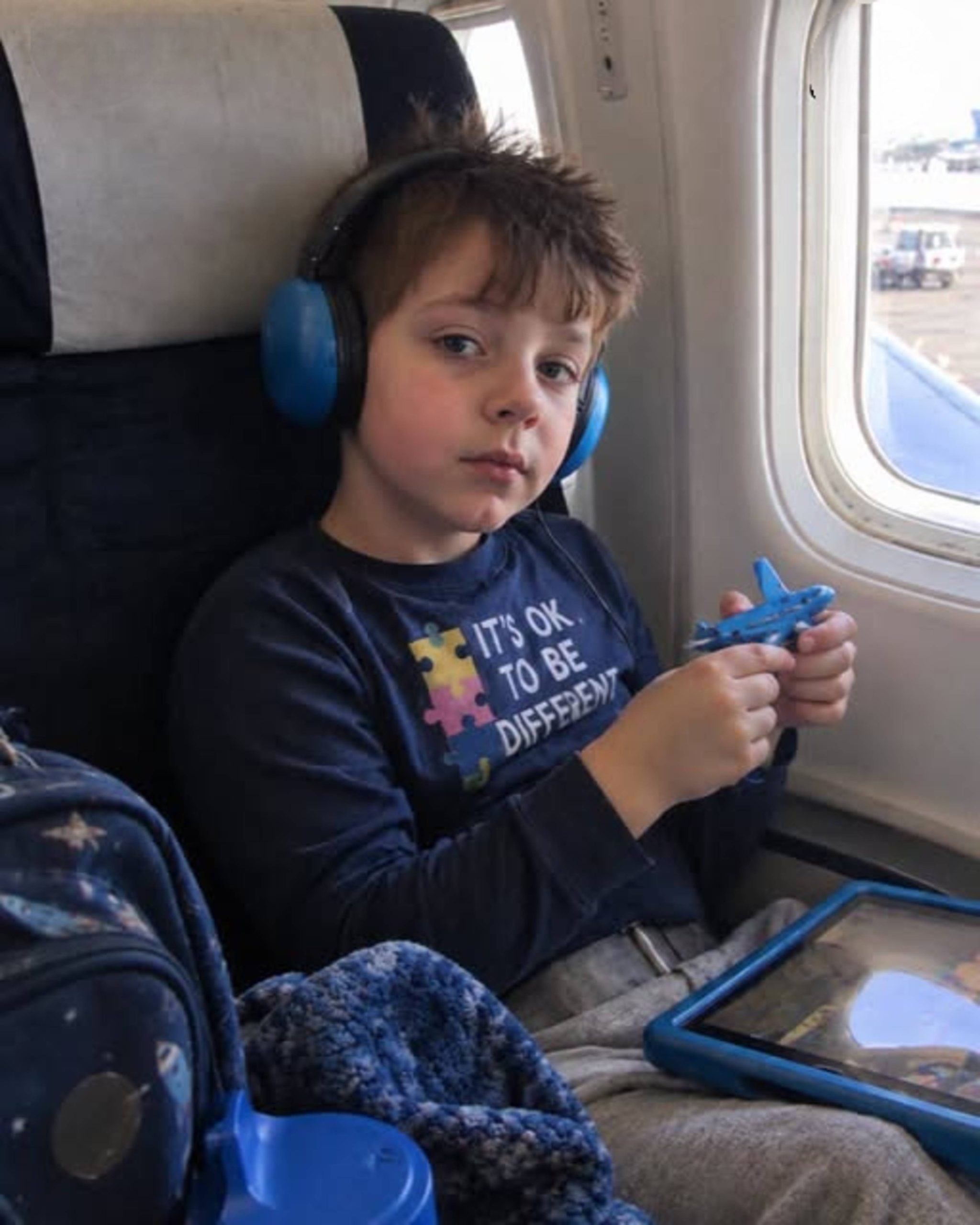
A passenger snapped at my autistic grandson during his first flight, but things took a strange turn when a flight attendant picked up his old toy airplane. Why did she suddenly ask to see my boarding pass?
It was my grandson Benjamin’s first flight.
He was seven years old, autistic, and had spent nearly his entire life finding comfort in routines, familiar objects, and knowing exactly what would happen next. So when my daughter asked me to help prepare him for his first flight, we treated it almost like a project.
We talked about airplanes for weeks.
We watched videos of takeoffs.
We looked at pictures of airports.
I explained that there would be loud noises, long lines, strange smells, and lots of people walking around.
Benjamin listened carefully to every word.
Sometimes he asked the same question five or six times.
“Will the airplane fall?”
“No, sweetheart.”
“Will the clouds touch the window?”
“You’ll be able to see them.”
“Will my blue plane come with me?”
“Everywhere you go.”
That last answer seemed to matter most.
I packed his headphones, his favorite crackers, two familiar books, a small blanket, and the little blue airplane he’d carried almost everywhere since he was five.
The toy was old now.
The paint had chipped along one wing.
There was a tiny scratch across the nose, and one of the wheels no longer turned properly.
But Benjamin didn’t care.
To him, it wasn’t just a toy.
It was his safe thing.
Whenever the world became too loud or confusing, he held that little airplane tightly in his palm and rubbed his thumb over the chipped blue paint.
I booked him a window seat because he’d spent months asking what clouds looked like from above.
When we finally boarded, he was nervous but excited.
He kept looking at the other passengers.
He counted the rows.
He checked the seat number three times.
Then, after we settled in, he pressed his forehead against the window.
“Cloud,” he whispered.
A few minutes later, he pointed.
“Wing.”
Then another cloud appeared.
“Cloud.”
I smiled.
“That’s right.”
For the first twenty minutes, everything went better than I’d dared to hope.
Benjamin watched the ground disappear beneath us.
He stared at tiny roads and houses.
He pressed his fingers against the glass as if he could somehow touch the clouds.
Then the plane dropped.
It wasn’t a dangerous drop, just the kind of sudden movement that happens during turbulence.
But Benjamin didn’t know that.
His entire body stiffened.
My stomach jumped.
The overhead bins rattled.
The seat belt sign chimed.
Benjamin jerked away from the window.
He looked at me with wide eyes.
“Grandma?”
“I’m right here.”
Another bump came.
This one was stronger.
Benjamin immediately clapped his hands over his ears.
His breathing became quick and shallow.
Then he began rocking back and forth in his seat.
“Blue plane,” he whispered.
I reached for his hand.
“You’re okay.”
“Blue plane.”
“I have it.”
“Blue plane, blue plane, blue plane.”
His fingers squeezed mine so hard that my knuckles hurt.
I pulled the little toy from his lap and placed it in his hands.
He wrapped both hands around it.
For a moment, he seemed to settle.
Then a man across the aisle turned around.
He was probably in his forties, wearing a dark jacket and expensive-looking watch.
He stared directly at Benjamin.
“Keep it down or get out!”
For a second, I honestly thought I’d misheard him.
The engines were loud.
Benjamin was frightened.
The man leaned closer.
“I said keep him quiet.”
Benjamin rocked faster.
I felt something inside me tighten.
I leaned toward the man.
“He’s seven,” I said quietly. “He’s autistic. He’s scared, and he’s doing his best.”
The man rolled his eyes.
“Then maybe he shouldn’t be flying.”
Those words stayed with me.
Not because they were loud.
Not because they were cruel.
But because they were said so casually.
As if my grandson’s right to sit on an airplane had somehow disappeared because his fear made someone uncomfortable.
I’d spent weeks worrying about everything.
Would Benjamin tolerate the airport?
Would he handle security?
Would the engine noise overwhelm him?
Would he panic during boarding?
Would he understand the seat belt?
Would he eat?
Would he sleep?
Would the strangers around him be patient?
I’d prepared for almost everything.
Headphones.
Snacks.
Books.
Toy.
Extra clothes.
Even a little card explaining that Benjamin was autistic in case he became overwhelmed and couldn’t communicate clearly.
What I hadn’t prepared for was a grown man deciding my grandson’s fear was an inconvenience he had the right to punish.
I opened my mouth to answer.
Before I could say another word, a flight attendant hurried over.
She was a woman in her fifties with silver streaks in her dark hair.
Her expression was calm, but her eyes immediately moved from Benjamin to the man across the aisle.
“Is everything okay?”
I explained quietly.
“My grandson is autistic. It’s his first flight. We hit turbulence, and he’s frightened.”
The flight attendant crouched slightly so she was closer to Benjamin’s eye level.
She didn’t touch him.
She didn’t demand that he stop rocking.
She simply smiled.
“Hi, Benjamin.”
He didn’t answer.
His eyes remained fixed on the little blue airplane.
She noticed it immediately.
“That’s a beautiful airplane.”
Benjamin stopped rocking for half a second.
He looked at her.
“Blue.”
“Yes,” she said. “It’s blue.”
She pointed gently toward the toy.
“Is that your airplane?”
Benjamin nodded.
“Had it since five.”
The flight attendant smiled.
“That’s a long time.”
Benjamin looked down at the toy again.
Then another small bump shook the plane.
He squeezed his eyes shut.
The flight attendant stood.
“It’s okay,” she said softly. “We’re going to take care of you.”
Then she turned toward the passenger.
“Sir, I need you to remain respectful.”
The man crossed his arms.
“I just want some peace.”
“I understand,” she replied. “But another passenger’s disability is not something you get to criticize.”
The man muttered something under his breath.
The flight attendant didn’t argue.
Instead, she looked back at Benjamin.
“Would you like me to show you something?”
Benjamin hesitated.
She reached into the small compartment near her seat and pulled out a laminated card.
It had pictures of clouds, wings, and an airplane.
Benjamin immediately leaned forward.
“Wing.”
“That’s right.”
She showed him the picture.
“This is what we’re doing right now.”
Benjamin studied it.
Then, slowly, his breathing began to settle.
I felt my shoulders relax.
“Thank you,” I whispered.
The flight attendant smiled.
“Of course.”
She stood to leave.
Then something happened that I still can’t explain.
Benjamin’s little blue airplane slipped from his hands.
It fell onto the floor.
The flight attendant bent down to pick it up.
The moment she saw the underside of the toy, her expression changed.
It was subtle.
But I saw it.
Her smile disappeared.
She turned the toy over in her hand.
She looked at the bottom.
Then she looked at Benjamin.
Then at me.
“Where did he get this?”
I blinked.
“It’s his. He’s had it since he was five.”
She turned the airplane over again.
Her fingers moved along the chipped plastic.
“Are you sure?”
“Yes.”
She looked suddenly serious.
“Ma’am, may I see your boarding pass?”
My heart skipped.
I stared at her.
“My boarding pass?”
“Yes.”
“Why?”
She didn’t answer immediately.
Instead, she looked toward the front of the plane.
Then back at the little blue airplane in her hand.
“Please,” she said quietly. “I need to check something.”
I reached into my bag and pulled out my phone.
The flight attendant scanned the boarding pass.
Her eyes moved across the screen.
Then she looked at Benjamin.
“What is his full name?”
I hesitated.
“Benjamin Carter.”
The flight attendant’s face went pale.
She looked at the toy again.
Then she whispered something I almost couldn’t hear.
“Oh my God.”
“What?”
She lowered her voice.
“I need to speak with you privately.”
My heart began pounding.
“Is something wrong?”
She glanced toward the passenger across the aisle, then back at me.
“No,” she said. “Not with Benjamin.”
She paused.
“It’s about that airplane.”
She held it out to me.
On the bottom, beneath years of scratches and faded paint, was a tiny set of letters and numbers.
I had never noticed them before.
The flight attendant pointed to them.
“Where did you say he got this?”
“My daughter bought it for him when he was five.”
She shook her head slowly.
“That can’t be right.”
“Why?”
Her eyes filled with something that looked almost like recognition.
“Because I’ve seen this airplane before.”
I stared at her.
“Where?”
She looked toward the cockpit.
“On another flight.”
My mouth went dry.
“When?”
She took a breath.
“Five years ago.”
Benjamin was five then.
I looked at the little blue airplane in her hand.
“Are you saying this belonged to someone else?”
She nodded.
“But that’s not the strange part.”
“What is?”
She looked directly at me.
“The last passenger who carried this airplane onto a flight was a little boy.”
My heart began pounding.
“What little boy?”
She swallowed.
“His name was Benjamin.”
Everything around me seemed to go silent.
I looked at my grandson.
He was sitting quietly now, holding his headphones in one hand and staring at the clouds.
The flight attendant’s voice became barely more than a whisper.
“The boy I remember was seven years old.”
I stared at her.
“Benjamin is seven.”
She nodded.
“That’s why I asked to see your boarding pass.”
For several seconds, neither of us spoke.
Then she reached into the pocket of her uniform and pulled out a folded piece of paper.
“I kept this for years,” she said.
“What is it?”
She unfolded it carefully.
It was an old incident report.
There was a date at the top.
Five years earlier.
Underneath was a note about a child who had become separated from his family during an emergency evacuation at the airport.
The child had been frightened.
He had been carrying a small blue airplane.
And according to the report, the child’s name was Benjamin Carter.
I looked at my grandson.
Then back at the flight attendant.
“But that’s impossible.”
She nodded slowly.
“I know.”
My hands began shaking.
Because five years earlier, Benjamin hadn’t been missing.
He had been living with us.
Or at least, that’s what we’d always believed.
And suddenly, the little blue airplane we’d treated as an ordinary toy wasn’t ordinary at all.
It was a clue to something that happened before Benjamin came into our family.
Something nobody had ever told me.
And the passenger who had complained about my grandson suddenly became very quiet.
Because he had been watching the entire conversation.
Then he stood up.
And when the flight attendant saw his face, she dropped the old report.
“Wait,” she whispered.
“I know you.”
The man across the aisle went completely still.
And for the first time since the flight began, I realized the strange turn wasn’t about Benjamin at all.
It was about how many people on that airplane knew something about my grandson that I didn’t.