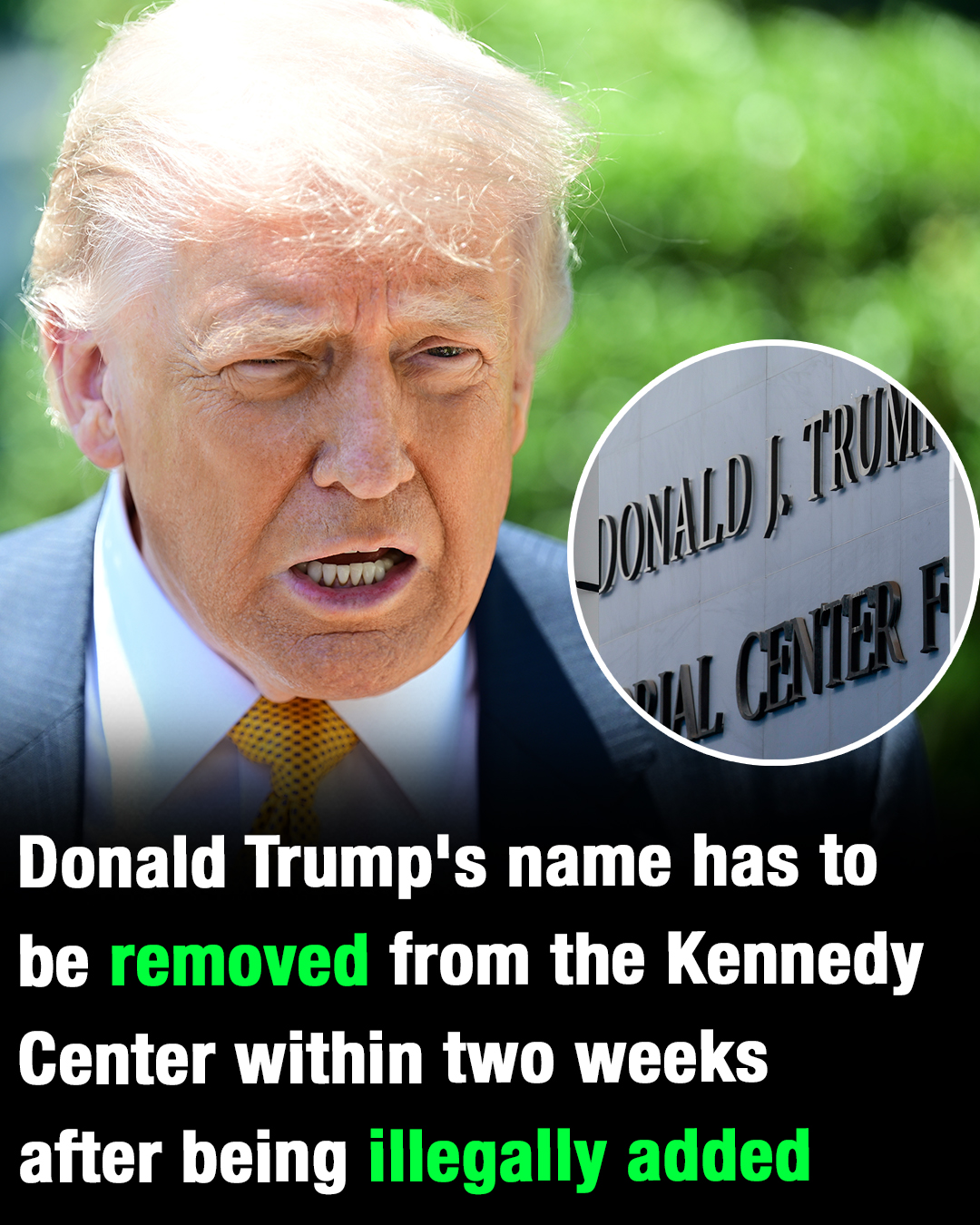
Trump’s name is coming down — and the decision is sending shockwaves through politics, the legal world, and the ongoing battle over America’s most recognizable public institutions.
What began as a controversial renaming effort has now evolved into a dramatic courtroom defeat, one that reaches far beyond a simple sign mounted on a building. At the center of the dispute stands one of the nation’s most respected cultural landmarks, a federal judge’s powerful ruling, and a debate about who truly has the authority to reshape the symbols that define American history.
For months, critics argued that the rebranding of the Kennedy Center under Trump’s influence was never legally justified. Supporters defended the move as a legitimate exercise of leadership and institutional authority. Opponents viewed it as something entirely different: an attempt to attach a living political figure’s name to a monument dedicated to a very different chapter of American history.
Now, a federal court has weighed in.
According to the ruling, the designation known as the “Trump Kennedy Center” lacked the legal foundation necessary to stand. Judge Christopher Cooper’s decision concluded that only Congress possesses the authority to officially rename the institution, regardless of votes, resolutions, or administrative actions taken elsewhere.
The ruling immediately transformed what many had viewed as a symbolic dispute into a constitutional question about power, procedure, and the limits of executive influence.
At the heart of the controversy were allegations that the renaming process moved forward under highly questionable circumstances. Critics pointed to reports of rushed meetings, restricted debate, muted microphones, and procedural tactics that allegedly prevented meaningful opposition from being heard. While supporters insisted proper procedures had been followed, opponents argued the process was designed to create the appearance of unanimous support while limiting scrutiny.
Those concerns became central to the broader legal challenge.
Representative Joyce Beatty, one of the most outspoken critics of the rebranding effort, argued that the issue was never simply about a name. In her view, it was about preserving legal safeguards designed to prevent public institutions from being reshaped according to the preferences of powerful individuals.
For months, many observers dismissed her objections as political messaging.
Today, her position appears considerably strengthened.
Judge Cooper’s ruling effectively validated the argument that procedural shortcuts cannot replace congressional authority. The decision emphasized that even influential political figures and powerful governing bodies must operate within the boundaries established by law.
The implications stretch far beyond a single building.
Legal scholars note that the case reinforces an important principle: public monuments and federally established institutions belong to the nation, not to any individual administration. Names attached to those institutions carry historical, cultural, and legal significance that cannot simply be altered through informal agreements or temporary political influence.
That principle has become increasingly important in an era where public symbols often serve as battlegrounds in broader cultural and political conflicts.
For supporters of the Kennedy legacy, the decision represents more than a legal victory.
It is viewed as a restoration.
Many see the ruling as a reaffirmation of the institution’s original mission and historical identity. To them, the Kennedy Center was created to honor President John F. Kennedy’s contributions to American culture and public service, and altering that identity required a level of authority that was never properly obtained.
The decision has therefore been welcomed by those who feared that the institution’s historic purpose was being overshadowed by contemporary political branding.
For Trump supporters, however, the ruling is likely to be interpreted very differently.
Many argue that the legal challenge was motivated by politics rather than principle. Some view the case as part of a broader pattern of opposition directed toward Trump long after his presidency. Others contend that public institutions routinely reflect changing leadership and priorities, making the controversy larger than it needed to be.
Those competing interpretations ensure that the debate surrounding the decision is unlikely to end with the court’s ruling.
Meanwhile, practical changes are already expected to follow.
Signage, official documents, promotional materials, and other references associated with the disputed name may now require revision. Workers tasked with implementing the decision will oversee the gradual removal of branding connected to the ruling.
Yet the physical changes may prove less significant than the symbolic ones.
The case serves as a reminder that even in a deeply polarized political climate, legal authority remains subject to constitutional limits. Influence, popularity, and power can shape public conversation, but they do not automatically override statutory requirements established by Congress.
As the nation absorbs the implications of the ruling, the Kennedy Center once again finds itself at the center of a larger conversation about history, identity, and the ownership of public memory.
Who gets to decide how national symbols are preserved?
Who has the authority to redefine institutions that belong to the American public?
And where is the line between leadership and overreach?
Those questions remain far larger than any name on a building.
For now, however, the court has provided one clear answer.
The Kennedy Center will return to its original identity, and the dispute serves as a powerful reminder that in the United States, even the most influential political figures cannot permanently rewrite public institutions without the authority granted by law.
The signs may come down.
The arguments almost certainly will not.
But the ruling stands as a declaration that the nation’s monuments, cultural landmarks, and historical institutions ultimately belong not to any single individual, but to the legal framework and democratic processes that govern them.