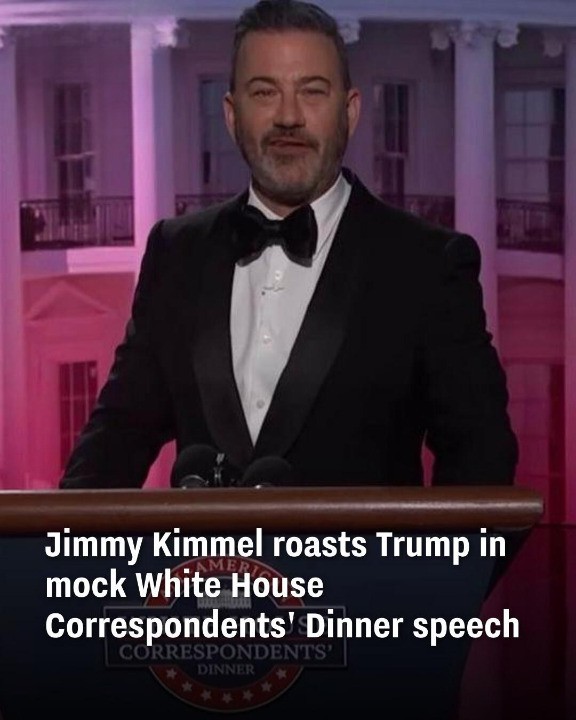
Tension has long existed at the nexus of high-stakes politics and late-night entertainment, but Jimmy Kimmel recently turned this conflict into a theatrical art form. Even though the annual White House Correspondents Dinner is frequently a night of jokes and celebrations of press freedom, the way these customs are observed has significantly changed in the present political environment. If the current president refused to take part in the customary roasting, Kimmel, who memorably stood at the platform in 2012, declared that the roast would have to be made available to the public via late-night television. This led to a painstakingly constructed mock monologue that not only ridiculed the administration but also surgically destroyed the whole notion of the contemporary presidency.
The obvious absence of Donald Trump from the official gala circuit, where comedians usually have free reign to make fun of the leader of the free world, was the elephant in the room that Kimmel addressed at the beginning of his program. According to the comic, this avoidance results from a basic incapacity to comprehend self-deprecating humor or outside criticism. Kimmel claims that the present government routinely fails the traditional dinner format, which is a test of character. Kimmel was able to perform a set that was far more biting than anything permitted at a sanctioned press event by circumventing the official limits of the actual dinner by establishing a parallel universe version of the event on his own stage. His failure to attend was framed as a calculated withdrawal from the line of fire, and he strongly relied on the idea that the president’s skin is quite thin.
The diatribe swiftly shifted from generalizations to character attacks that targeted important members of the inner circle. Kimmel used his trademark sardonic humor to cast doubt on the veracity of Vice President JD Vance’s public persona. The comedian depicted an administration made up of people who are constantly applying for jobs for which they are not fully qualified. The divisive adviser Stephen Miller was also targeted by Kimmel’s scathing remarks regarding Miller’s public persona and his alleged involvement in the creation of the administration’s most contentious policies. This was a deliberate attempt to utilize satire as a vehicle for political accountability, leveraging the ridiculousness of the circumstance to draw attention to what Kimmel sees as the ridiculousness of the government itself. It wasn’t just comedy for laughs.
Kimmel’s analysis of the official entertainment selected for the actual White House Correspondents Dinner was one of the most talked-about parts of the routine. He made fun of the choice of mentalist Oz Pearlman, implying that a magician was picked especially because their performance entails deception and trickery rather than the painful realities that a comedian might reveal. Kimmel made a joke about how much more at ease the government is with things going away or being concealed behind a curtain than they are with a stand-up comedian pointing out their shortcomings. This analogy functioned as a metaphor for the administration’s overall media strategy, which frequently prioritizes controlling perception above confronting fact.
The story then turned to Melania Trump, who has frequently been the subject of intense media attention and mystery. In his monologue, Kimmel discussed her public appearances as well as the different documentaries that have tried to explain her role in the East Wing. A remark on the media frenzy around the first family was interwoven with the humor. Kimmel implied that the Trump family’s public persona is a meticulously constructed performance that frequently crumbles at the tiniest bit of humorous pressure by using exaggerated scenarios. He used viral media incidents that have shaped the public’s opinion of the First Lady as punchlines to highlight the gap between the family’s personal and public responsibilities.
As the monologue went on, Kimmel addressed a number of political issues with an intensity rarely seen on network television. He went through a long list of complaints that included everything from domestic scandals to mistakes in foreign policy, all of which he combined into a coherent story of ego and incompetence. The satire was unrelenting, delivering words that would have been significantly trimmed or banned in any other setting by leveraging the setting of a formal dinner. Kimmel gave himself the artistic and legal justification to push the limits of political debate by framing the act as a parody. The audience’s enthusiastic reaction served as a reminder of the power comedy possesses in a divided society where traditional journalism frequently feels biased or repetitious.
The ultimate punch in Kimmel’s satirical arsenal came at the end of the piece, which culminated in a pretend award ceremony. These honors were harsh criticisms of the administration’s most prominent shortcomings rather than prizes for accomplishment or service. The presentation carried on the evening’s subject, which was the use of humor as a weapon against political authority. The thin skin of the leadership, the sycophancy of the staff, and the general sense of turmoil that he believes characterizes the contemporary moment were all topics Kimmel used to tie together in this final chapter. It was a political theatrical master class intended to make the audience laugh and reflect on the status of the country.
Beyond the humor, the monologue had a deeper significance in the ongoing conflict between the executive branch and late-night hosts. Kimmel has evolved from a mere performer to an outspoken critic who uses his position to sway public opinion. This faux dinner was a daring declaration that an administration that shies away from traditional scrutiny will not quiet the media or the creative community. Even if the president declined to attend, Kimmel made sure that the custom of the presidential roast persisted by inventing his own version of the occasion.
In the end, the tale of Kimmel’s fictitious monologue is one of satire’s tenacity. Comedy offers a universal language that may cut through the clutter at a time where facts are constantly contested and information is usually fragmented. Politicians may shun the stage, but they cannot avoid the limelight, as Kimmel’s performance served as a reminder. Millions of individuals who might not have even watched the original broadcast saw the monologue after it was extensively circulated on social media. It started a discussion on the media’s function in a democracy and the significance of using all available tools to hold those in positions of authority accountable.
As the segment’s credits rolled, it became evident that Kimmel had achieved his goals. He demonstrated that attention is the most valuable currency in the arena of contemporary politics by creating a media moment that eclipsed the actual event he was mocking. A segment that will probably be remembered as one of the most important moments in Kimmel’s career was created by the combination of biting political humor, references to media scandals, and vicious roasts of high ranking politicians. The mock supper became into the most significant meal of the year, and the clown took on the role of commentator.