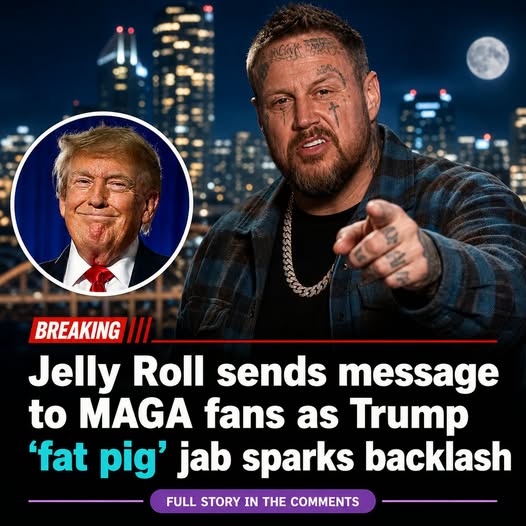
Jelly Roll didn’t just poke the bear.
He set the whole circus on fire.
One brutal joke at Donald Trump’s expense turned a late-night monologue into a political brawl. Fans cheered. Critics raged. Social media erupted. And instead of backing away when the backlash arrived, the country star doubled down.
Then he twisted the knife with one final line that left Trump supporters fuming.
Jelly Roll’s guest-hosting stint on *Jimmy Kimmel Live!* quickly became much more than a celebrity filling in behind a late-night desk.
It became a referendum on how much heat a president should be able to take.
From the moment he stepped into the spotlight, Jelly Roll made it clear that viewers were not going to get a carefully sanitized performance.
He wasn’t interested in safe, middle-of-the-road jokes designed to offend absolutely nobody.
He wanted to say what he thought was funny.
And Donald Trump quickly became one of his biggest targets.
The jokes went after Trump’s weight.
They mocked his “own race” comment.
Jelly Roll also took aim at Trump’s famously elaborate motorcade, joking about what he described as a “lap of honor.”
Each joke landed differently depending on who was watching.
Some viewers erupted in laughter.
Others immediately reached for their phones.
And before the monologue was even over, the political argument had already begun.
Supporters of Trump accused Jelly Roll of crossing a line.
Fans who disliked Trump celebrated the fact that someone was willing to say it directly.
The comedian-turned-country-star hybrid had managed to do something late-night television does particularly well: turn a joke into a political identity test.
Are you laughing?
Are you offended?
Are you defending the president?
Are you criticizing him?
Within minutes, people weren’t even discussing the joke itself anymore.
They were discussing Jelly Roll.
And that’s when the backlash really started.
But Jelly Roll didn’t appear interested in retreating.
He didn’t issue a carefully worded statement about respecting everyone’s opinions.
He didn’t suddenly explain that it was “just comedy.”
Instead, he defended the basic idea behind what he had done.
His argument was simple.
If you’re the president of the United States, you’re going to be the subject of jokes.
You don’t get immunity from satire simply because you’re powerful.
And Jelly Roll’s attitude was essentially that political leaders should be able to take criticism, jokes, and even ridicule without demanding that everyone else remain silent.
That position only intensified the debate.
Critics told him he had crossed a line.
Jelly Roll’s response was not to redraw the line.
It was to make it clearer that he intended to stand where he was.
He told offended viewers, in effect, that they didn’t have to listen if his views bothered them.
It was blunt.
It was unapologetic.
And it was unmistakably Jelly Roll.
That may be what made the moment resonate so strongly.
He has never been the kind of celebrity who fits neatly into one box.
His public image has always been built around being open about his past, his struggles, his mistakes, his family, and the people who helped him become who he is.
He doesn’t present himself as polished perfection.
He presents himself as someone who has been through things.
Someone who knows what it feels like to be judged.
Someone who understands that people can change.
That history makes his willingness to provoke a political argument particularly interesting.
He wasn’t standing there as a traditional political commentator.
He was a country artist who had suddenly been handed a late-night television platform.
And he used it.
He didn’t attempt to disguise his opinions behind endless disclaimers.
He didn’t ask permission to make the joke.
He made it.
Then he stood behind it.
For some viewers, that was refreshing.
For others, it was infuriating.
But the night took an unexpected turn when Jelly Roll stopped talking about Trump.
Because after torching the president, he suddenly shifted into something much more personal.
Dolly Parton.
The tone changed almost instantly.
The comedian disappeared.
The grieving country kid emerged.
Jelly Roll began talking about Dolly’s music and the memories attached to it.
He remembered hearing her songs at his family’s kitchen table.
That detail mattered.
Because Dolly wasn’t being discussed as an abstract celebrity.
She was being remembered as part of a childhood.
Part of home.
Part of family.
Part of the background music of ordinary American life.
For Jelly Roll, Dolly wasn’t simply a country legend.
She represented something deeply personal.
She was the kind of artist whose music could exist in a kitchen just as easily as it could exist on a massive concert stage.
Her songs belonged to parents.
Grandparents.
Children.
Working people.
Country fans.
People who didn’t even consider themselves country fans.
And Jelly Roll captured that universality when he called her “the last American that everyone liked.”
It was an extraordinary line because it captured something many people had been feeling since her death.
Dolly had occupied an increasingly rare cultural space.
She could be loved by people who disagreed about almost everything else.
Her fans weren’t all from the same political party.
They weren’t all from the same generation.
They didn’t share the same religion, background, income, or worldview.
Yet they could all listen to Dolly.
That made her different.
And it made the contrast with the earlier Trump jokes even more striking.
In one part of the monologue, Jelly Roll was deliberately dividing the room.
In the other, he was remembering someone who seemed capable of bringing the room together.
That contrast became the defining feature of the night.
First came the fire.
Then came the grief.
First came the political comedian.
Then came the country kid remembering the songs that played at home.
It showed two very different sides of Jelly Roll.
And neither side seemed fake.
He could be brutally funny.
He could be politically provocative.
He could tell people he wasn’t going to apologize for his opinions.
And he could still become visibly sentimental when talking about an artist who had meant something to his family.
That’s what made the performance more complicated than a simple anti-Trump monologue.
If the entire night had been about politics, it would have been easy to dismiss it as another celebrity-versus-Trump spectacle.
But the Dolly tribute revealed something else.
It revealed why Jelly Roll had connected with so many people in the first place.
He understands the emotional power of music.
He understands that certain songs aren’t just songs.
They’re memories.
They’re kitchens.
They’re car rides.
They’re family gatherings.
They’re the voices of people who aren’t around anymore.
They’re moments from childhood that you can suddenly revisit simply by hearing the first few notes.
Dolly’s music carried that kind of emotional weight for him.
And suddenly, the same man who had been joking about a president’s weight was talking about a woman whose music had helped shape his understanding of home.
That emotional whiplash was powerful.
It also explained why his comments about Dolly felt so sincere.
He wasn’t treating her as a political symbol.
He was treating her as someone whose music had been part of his life.
And perhaps that is why his description of her as “the last American that everyone liked” landed so heavily.
Because in an increasingly divided country, the idea of someone who could still bring almost everyone together feels almost nostalgic.
Dolly had her critics.
She had people who disagreed with her.
She had moments that became politically controversial.
But for generations of listeners, she remained one of the few celebrities whose appeal seemed to cross almost every boundary.
Jelly Roll understood that.
And he seemed to mourn the loss of that shared cultural space.
The irony was impossible to miss.
His monologue itself had become the kind of political battlefield Dolly’s image had often managed to transcend.
Fans were arguing.
Critics were arguing.
Trump supporters were angry.
Trump opponents were celebrating.
And somewhere in the middle of all of it, Jelly Roll was talking about Dolly Parton and remembering sitting around a kitchen table with his family.
That may have been the most revealing moment of the entire night.
Because beneath the controversy was a simple truth.
Jelly Roll wasn’t trying to be everyone’s favorite.
He was trying to be himself.
That meant accepting that some people would cheer him and others would walk away.
It meant understanding that his jokes would upset people.
It meant refusing to apologize simply because the internet demanded one.
But it also meant allowing himself to be vulnerable when the subject changed.
The tough guy who had just been taking political shots could suddenly sound like a kid remembering home.
That contrast is what made the appearance memorable.
Not because every joke landed.
Not because everyone agreed.
And certainly not because the political argument was resolved.
It wasn’t.
If anything, the appearance showed how impossible it has become for major celebrities to say almost anything without becoming part of a larger political fight.
But Jelly Roll seemed comfortable with that reality.
He wasn’t trying to escape the controversy.
He leaned into it.
And when the criticism came, he essentially told people that if they couldn’t handle his opinions, they didn’t have to keep listening.
That may sound harsh.
But it was consistent with the personality he has built throughout his career.
He has never pretended that everyone would understand him.
He has never hidden the rougher parts of his story.
And he has never presented himself as a perfectly polished celebrity.
His appeal comes partly from the fact that he seems willing to let people see the contradictions.
The anger.
The humor.
The vulnerability.
The mistakes.
The gratitude.
The grief.
On that late-night stage, all of those sides appeared within the same monologue.
He could roast a president.
He could defend the right to make political jokes.
He could shrug off criticism.
Then he could turn around and talk about Dolly Parton with genuine tenderness.
That isn’t necessarily inconsistency.
It may simply be humanity.
People can be provocative and sentimental.
They can be politically opinionated and deeply nostalgic.
They can laugh at one moment and grieve the next.
Jelly Roll showed all of that in one night.
And perhaps the most fitting part was that he didn’t try to make the two sides agree.
He didn’t turn the Dolly tribute into another political argument.
He simply remembered her.
He remembered the music.
He remembered his family.
He remembered what it felt like to hear those songs at home.
And for a few moments, the political shouting disappeared.
There was just a country singer remembering another country legend.
A son remembering a kitchen table.
A fan remembering a voice.
And millions of viewers remembering why Dolly Parton had meant so much to so many people.
The controversy may be what got the headlines.
The jokes may be what made social media explode.
But the Dolly tribute may ultimately be what people remember.
Because beneath the politics was something much harder to manufacture.
Emotion.
Jelly Roll didn’t apologize for the comedian he had been.
He didn’t hide the country kid he still was.
He brought both into the same room.
And that was perhaps the real story of the night.
He proved that a person can light a political fire with one sentence and then, moments later, become quiet remembering a song from childhood.
The internet may have wanted a villain.
The audience got something more complicated.
A comedian.
A provocateur.
A country star.
A grieving fan.
And a man who clearly understood that sometimes the loudest thing you can say is simply that you miss someone.
Dolly’s music gave him that language.
And for one strange, explosive night on late-night television, Jelly Roll used it to remind everyone that beneath all the political noise, there are still songs that belong to all of us.