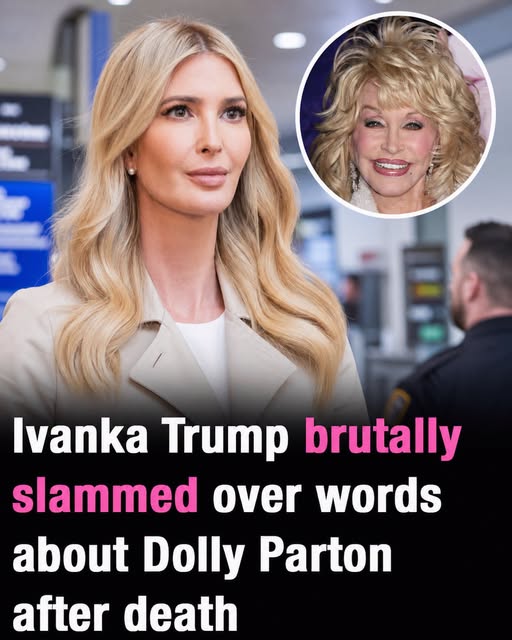
Ivanka Trump thought she was sharing a tender goodbye to one of America’s most beloved cultural figures. Instead, her tribute to Dolly Parton became the spark for a much larger argument—one that quickly spread across social media and forced people to confront a difficult question: who gets to claim the legacy of an icon after she is gone?
Dolly Parton’s death at 80 left millions of people grieving, but the mourning was never simply about losing a country music legend. For generations of fans, Dolly represented something much larger. She was a symbol of generosity, resilience, humor, humility, and a particular kind of kindness that seemed to reach people regardless of where they came from.
So when Ivanka quoted Dolly’s famous words, “I don’t criticize and condemn; I love and accept,” intending them as part of a heartfelt farewell, the reaction was immediate. Instead of receiving universal sympathy, she faced criticism from people who believed the message did not belong alongside the political identity associated with the Trump family.
Critics argued that Dolly’s words had been stripped from the complicated life that gave them meaning. To them, quoting a message about acceptance was not enough. Dolly had spent decades turning those ideals into action, supporting causes and communities that many of her admirers considered central to her legacy.
Her relationship with marginalized communities, her support for charitable causes, her generosity toward children and families, and her willingness to embrace people who felt like outsiders had become inseparable from the public image she created. Dolly often spoke about loving people without demanding that they become someone else first.
That was precisely why the tribute struck such a nerve.
For many fans, the issue wasn’t whether Ivanka was allowed to admire Dolly. Of course she was. The question was whether a single quotation could suddenly make someone part of a legacy built over decades of choices, sacrifices, and personal actions.
Social media turned the moment into a referendum on Dolly herself.
Some fans pointed to Dolly’s longstanding reputation for welcoming people who felt rejected elsewhere. Others highlighted her support for literacy, childhood education, disaster relief, and countless charitable efforts. Still others invoked her connection with LGBTQ+ fans and the communities that had embraced her music and message for generations.
The argument quickly became bigger than Ivanka’s post.
It became a debate over what happens to a public figure’s values after death. When an icon belongs to everyone, does admiration give anyone the right to interpret that icon however they want? Or does the person’s lifetime of actions provide a standard by which those interpretations should be judged?
For Dolly’s most devoted supporters, the answer was clear. They did not want her legacy reduced to a collection of inspirational quotes that could be pulled out whenever convenient. They wanted people to remember the woman behind the words—the woman who repeatedly used her wealth, influence, and platform to help people who had little of their own.
That is what made the backlash so intense.
Dolly had built an unusual kind of fame. She managed to become enormously successful without completely separating herself from the poor Appalachian childhood that shaped her. She could stand beside presidents and billionaires while still speaking the language of ordinary people. She could become a global superstar without pretending she had never known hardship.
And perhaps most importantly, she made kindness part of her brand long before kindness became a political battleground.
Her message was rarely about demanding that everyone agree. It was about finding room for people who were different, frightened, struggling, or simply searching for somewhere to belong.
That history made her death emotionally charged. Fans were not merely saying goodbye to an entertainer. They were mourning a figure whose public persona had become a kind of refuge.
So when Ivanka’s tribute appeared, some readers saw sincerity. Others saw something very different: a political family attempting to stand in the glow of a beloved figure whose values they believed were fundamentally incompatible with the Trump brand.
The reaction was harsh, sometimes personal, and often unforgiving.
But beneath the anger was something revealing.
People were fiercely protective of Dolly because they believed she had spent her life protecting others.
She had created a world where outsiders could feel welcome, where poverty did not have to mean shame, and where success did not require abandoning compassion. Her influence came not only from the songs she recorded, but from the way she repeatedly reminded people that generosity could coexist with enormous success.
That is why the controversy surrounding a single tribute became so much larger than the tribute itself.
Dolly’s legacy cannot be owned by one political party, one family, or one group of fans. Millions of people will interpret her differently, and they will continue to find different pieces of themselves in her story.
But admiration is not the same as understanding.
And for the people who pushed back against Ivanka’s words, that distinction mattered deeply. They believed Dolly’s legacy should be measured not by who quotes her after her death, but by who actually carries forward the values she spent her lifetime demonstrating.
The internet may eventually move on from the controversy. The posts will disappear beneath newer arguments, and the outrage will fade.
Dolly’s work will not.
Her songs will still play. Her stories will still be told. Her philanthropy will continue helping people. And generations of people who once felt like outsiders will still hear her voice reminding them that they have a place in the world.
In the end, that may be the strongest answer to the controversy.
Dolly Parton never needed anyone’s permission to become an icon.
And no one needs permission to love her.
But her legacy was built over a lifetime—and it will always be bigger than a single tribute, a political name, or a carefully chosen quotation.