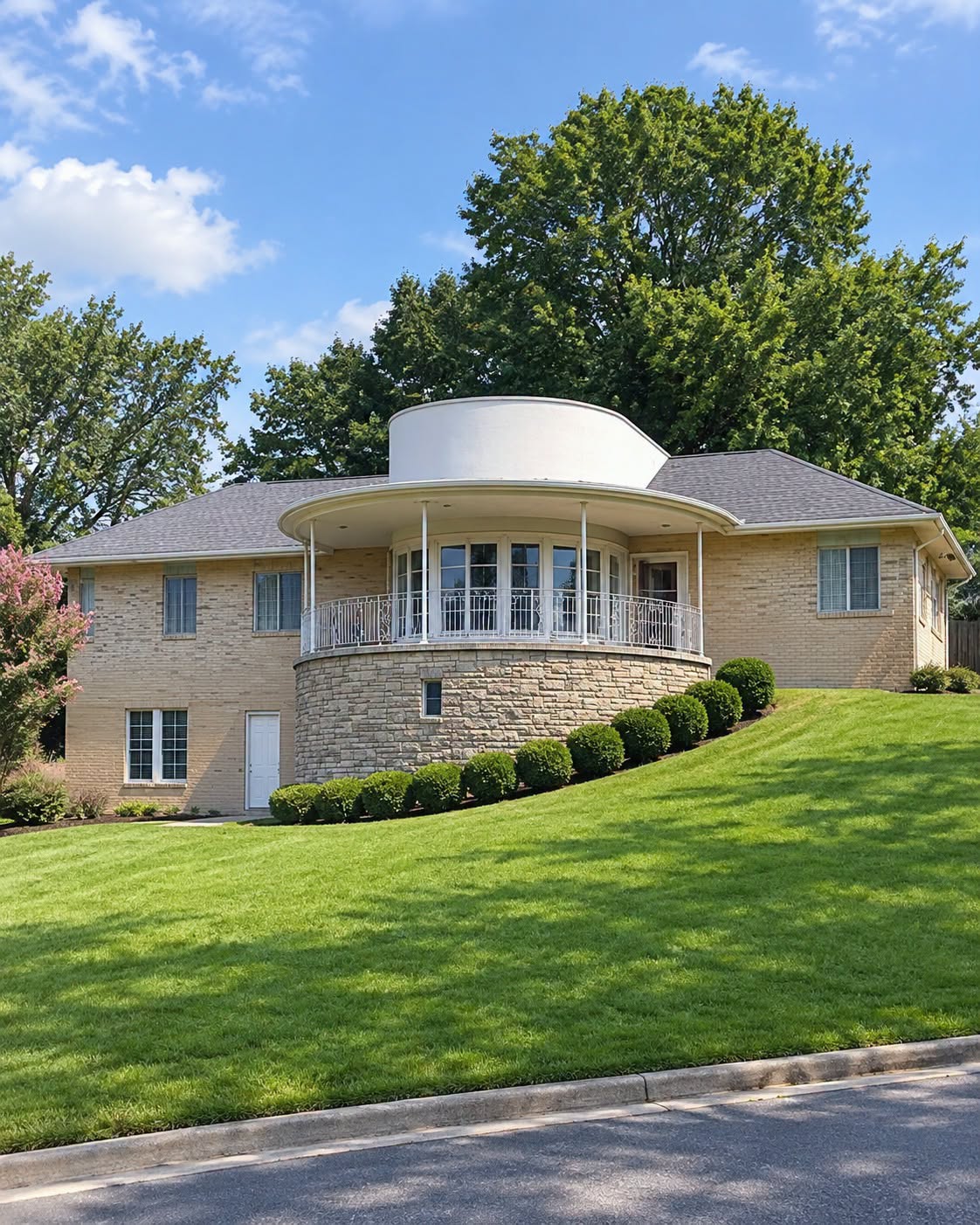
With three bedrooms, three bathrooms, and an unmistakable silhouette, this hillside residence offers something that ordinary listings rarely deliver: genuine architectural personality. From the outside, its rounded walls, expansive windows, and distinctive cylindrical section create a futuristic appearance that immediately separates it from conventional homes.
Geometric details throughout the design also suggest Art Deco influences, giving the property a character that feels connected to another era while still appearing surprisingly modern. It is the kind of house that can make someone stop scrolling through listings and look twice—not because it is polished or luxurious, but because it has an identity of its own.
Inside, however, the reality is considerably less finished.
The unfinished appearance makes clear that this is not a move-in-ready residence. It is a renovation prospect, and that distinction matters. The generous rooms and abundant natural light may provide an exciting foundation, but transforming that foundation into a comfortable home could require substantial work.
For the right buyer, the unfinished interior may actually be part of the appeal. Instead of inheriting someone else’s renovation choices, a new owner could potentially rethink the spaces while preserving the unusual architectural features that make the property special. The challenge would be knowing which elements can be restored economically and which could become major financial burdens.
The $65,000 asking price is therefore only the beginning of the decision.
A low purchase price can look tempting, especially when a property has architectural features that would be difficult or expensive to reproduce from scratch. But the cost of acquiring an unusual house is only one part of the equation. Before committing, a buyer would need thorough professional assessments of the structure, foundation, roof, windows, electrical system, plumbing, heating and cooling equipment, and other mechanical components.
The condition of those systems could dramatically change the financial picture.
A buyer would also need to investigate permits, zoning requirements, insurance availability, utility connections, drainage, and any restrictions affecting renovation. Even relatively straightforward improvements can become complicated when a property has unusual construction or has been left unfinished for an extended period.
The roof and windows deserve particular attention. Architectural features that make a house visually distinctive can sometimes be expensive to repair or replace, especially when they involve unusual shapes or custom materials. Preserving the original character may require specialized contractors and materials that are not as readily available as standard modern alternatives.
That is why professional inspections and realistic renovation estimates would be essential before treating the property as a bargain.
The numbers could reveal an opportunity—or a warning.
If the structure is fundamentally sound and the major systems can be restored within a manageable budget, the property could offer something difficult to find in today’s housing market: a home with genuine individuality. Instead of spending years trying to make a generic house feel unique, an owner could begin with a structure that already possesses a strong visual identity.
But if major structural, roofing, utility, or mechanical problems are discovered, the $65,000 price could quickly become misleading. A cheap house can become an expensive project when every major system needs attention.
Still, for an owner with sufficient resources, patience, and a willingness to embrace unconventional design, the possibility is compelling.
The goal would not simply be to renovate the property into another modern house. The greater opportunity would be to bring it back to life without erasing the details that make it memorable.
Rounded walls, unusual geometry, dramatic windows, and the home’s distinctive silhouette could become its greatest strengths rather than obstacles to modernization.
In the end, this is less a purchase for someone seeking convenience than an opportunity for someone seeking character.
It asks for imagination, careful budgeting, and a willingness to live with uncertainty during the renovation process. But for the right person, the reward could be deeply personal: taking an overlooked architectural curiosity and turning it into a functioning home while allowing its original personality to survive.
The real question is not whether the house is cheap.
It is whether its potential is worth the work required to reveal it.