I thought my nineteenth birthday would be remembered for something simple, warm, and deeply personal—the first blueberry pie I had baked completely on my own, following every step just the way my grandmother had taught me over the years. I had imagined that moment so clearly: placing the pie in front of her, seeing her smile with quiet pride, maybe even hearing her say that I had finally gotten it just right. Instead, that day became marked by something entirely different, something I could never have prepared for. It became the day I lost her.
One moment, I was walking quickly toward the living room, still carrying that small sense of excitement, eager to share what I had made. The next, everything stopped. I found myself standing beside her chair, unable to move, staring at her as the realization slowly, painfully settled in. She was gone. Just like that—without warning, without a chance for goodbye. The shift from joy to loss was so sudden that it didn’t feel real.
What followed felt like a blur that stretched endlessly. People began arriving, filling the house with voices, footsteps, and hushed conversations that echoed through rooms that no longer felt the same. The familiar warmth of our home faded into something distant and unrecognizable. In the middle of all that noise and movement, I held on tightly to the only thing that still felt steady—the house itself and the memories woven into every corner of it. It was the one place where I could still feel her presence, even if she was no longer there.
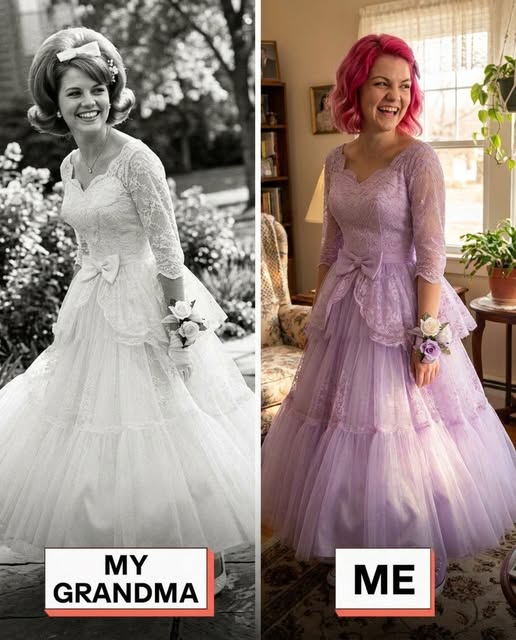
That’s why, when I came across her old prom dress tucked carefully in the back of the closet, it felt like more than coincidence. The fabric was a soft blue, untouched by time, as if it had been waiting quietly for that exact moment to be found. Running my fingers over it, I felt a strange sense of comfort, like a connection that hadn’t been broken. Wearing it to her funeral didn’t feel like a decision—it felt necessary. It was the closest I could come to keeping her with me one last time, to carrying a piece of her into that final goodbye. What I didn’t know then was that the dress held more than memories. Hidden within it was something that would challenge everything I thought I understood about her.
The dress needed slight adjustments to fit me properly, so I took it to a local tailor that Mrs. Kline had recommended without hesitation. The shop itself was quiet, filled with the faint scent of fabric, polished wood, and a lingering trace of lilac perfume. It should have felt comforting, even nostalgic, but something about it stayed with me in a way I couldn’t explain. The tailor, Mr. Chen, treated the dress with careful attention, examining it slowly, almost thoughtfully. His quiet focus should have been reassuring, but instead it made me uneasy, as if he noticed more than he was saying.
Then, as he worked along the hem, his hands paused. The shift was subtle, but unmistakable. Hidden deep within the stitching was a small, folded note, aged and slightly yellowed, as though it had been placed there long ago with intention. My heart began to race as I took it from him, my hands unsteady as I unfolded it. I expected something sentimental—a memory, a loving message, maybe a small piece of her past.
But the words I read were nothing like that.
“If you’re reading this, I’m sorry. I lied to you about everything.”
The sentence didn’t just surprise me—it unsettled me completely. I read it again, then again, trying to make it make sense, trying to connect it to the person I knew so well. It didn’t sound like her. It didn’t feel like her. And yet, the possibility it suggested began to take root in my mind. Once that doubt appeared, it spread quickly. Every story she had ever told me, every memory we shared, suddenly felt less certain, as if something important had been hidden beneath it all.
Overwhelmed and searching for reassurance, I went straight to Mrs. Kline. She welcomed me in with warmth and sympathy, her words gentle and understanding—but something about her reaction felt almost too prepared, as if she had already anticipated what I would say. She spoke about grief, about how it can distort the way we see things, making even the truth feel unfamiliar. Then she suggested, carefully but clearly, that perhaps my grandmother had been keeping secrets, that maybe there was more I had never known.
Not long after, she brought up the house again. Her tone was casual, but her message was direct—maybe it would be better for me to sell it, to let go, to move on. In that moment, exhausted and emotionally drained, the idea almost made sense. It felt easier than holding on to something that suddenly seemed uncertain.
But later that night, lying awake in a space that didn’t feel like home, I began to notice the details I had overlooked. The garment bag the dress had been in—it wasn’t something my grandmother would have owned. The lilac scent—it was the same in both the tailor’s shop and Mrs. Kline’s house. And then there was their behavior. Neither of them had seemed truly shocked by the note. Instead, they seemed more interested in what it might lead me to do.
The realization came slowly, piece by piece, until it finally became undeniable. When I overheard Mrs. Kline speaking on the phone, confirming that the note had been meant to confuse me so she could gain access to the house and search for something hidden there, everything fell into place. The doubt, the pressure, the carefully placed suggestion—it had all been intentional.
The lie had never belonged to my grandmother. It belonged to them.
That night, I returned to my grandmother’s house with a sense of clarity I hadn’t felt since before everything happened. I no longer questioned who she was. Instead, I understood something new—she hadn’t been hiding the truth from me out of deception, but out of protection. There was something she had kept safe, something important enough to guard even in silence.
In the weeks that followed, with the help of a lawyer, the truth was finally uncovered. My grandmother had quietly built and preserved a valuable collection over the years—vintage jewelry, rare clothing, handwritten letters, and deeply personal keepsakes that told stories she had never shared publicly. It wasn’t just a collection of valuable items; it was a carefully protected legacy. She had planned to organize it properly, to decide what should happen to it, but she hadn’t been given the time.
In the end, the collection was handled through a legal auction, ensuring everything was managed the right way. The outcome changed my life in a way I hadn’t expected. The financial security it provided became the foundation for my future, covering my education and giving me stability at a time when I felt like everything had been taken from me.
When it was all over, I held onto one thing—the prom dress. Folded carefully in my arms, it no longer felt like just a piece of clothing. It carried everything that had happened, everything I had learned.
I finally understood what my grandmother had left behind. It wasn’t a lie. It wasn’t even just the collection. It was something far more lasting. She had given me a way forward, even in her absence. She had protected what mattered until I was ready to understand it.
And in the end, her final lesson stayed with me more than anything else—that love doesn’t always reveal itself loudly or immediately. Sometimes, it works quietly in the background, protecting, guiding, and waiting patiently until the truth is ready to be seen.