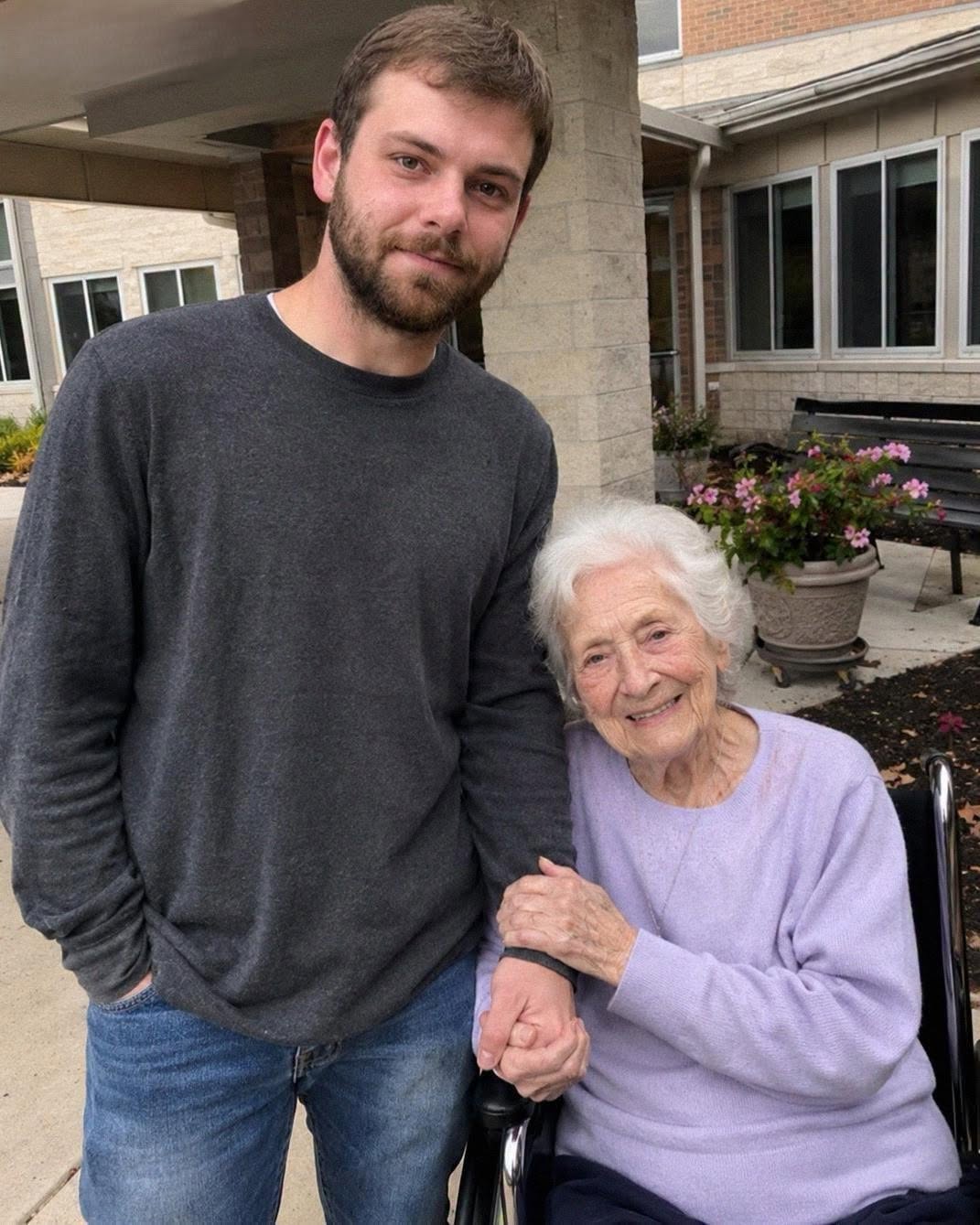
I never imagined my lowest point in life would lead me to pretend to be someone else’s son. At the time, I was barely keeping my own life together. My mother’s medical treatments had buried me beneath endless bills, every paycheck disappeared almost as soon as it arrived, and I spent each night wondering how much longer I could survive. Then an unexpected offer changed everything. A stranger handed me an envelope filled with cash and asked me to do something I never thought I would consider. All I had to do was visit an elderly woman living with dementia, call her “Mama,” and play the role of the son who had stopped coming to see her. It sounded cruel, dishonest, and deeply unsettling. But desperation has a way of making impossible decisions seem reasonable. I accepted, convincing myself it was only temporary and that it was simply another job.
Every weekend, I walked through the doors of the nursing home and made my way to Room 214, carrying guilt that felt heavier each time I visited. The halls smelled of disinfectant mixed with fading flowers, and the quiet echoed with the loneliness that often fills places where people spend their final years waiting for loved ones who rarely arrive. Rosie always sat beside the window, patiently watching the hallway as though she still believed someone would eventually walk through the door for her. The first time I softly said, “Mama, it’s me,” I expected confusion or hesitation. Instead, her face immediately brightened. She smiled with genuine joy, reached for my hand, and held it so tightly that every ounce of my carefully prepared performance suddenly felt painfully real.
From that moment forward, everything became far more complicated than I had anticipated. Rosie never questioned where I had been or demanded explanations about the years we had supposedly lost. Instead, she worried about me. She wanted to know whether I had been eating properly, whether I was getting enough sleep, and whether I was taking care of myself. They were simple questions, yet they reached places inside me I hadn’t realized were still hurting. Since my own father disappeared years earlier and my mother’s illness consumed our lives, nobody had cared for me in quite that way. What began as an arrangement built on money slowly transformed into something that neither of us had expected. Before long, I found myself visiting even when I wasn’t being paid. I stopped by during lunch breaks, brought her fresh tulips on Wednesdays, chocolates on Thursdays, and stayed just to talk because being with her made both of us feel a little less alone.
Somewhere along the way, I stopped pretending. I was no longer memorizing conversations or playing a character. I genuinely looked forward to seeing her. In caring for Rosie, I slowly discovered that I was healing parts of myself I hadn’t even known were broken. The role I accepted out of desperation gradually became one of the most meaningful relationships of my life.
Then came the phone call I had always feared.
One quiet morning, the nursing home informed me that Rosie had peacefully passed away in her sleep.
For several long moments, I simply sat there unable to move. The grief surprised me with its intensity. I had entered her life pretending to be someone else, yet somehow I had lost someone who felt like family. Before ending the call, the nursing home director gently explained that Rosie had left something specifically for me and asked if I could come to the facility in a few days.
When I arrived, the director placed a sealed envelope into my hands before looking at me with an expression that suggested she had carried an important secret for quite some time.
Then she quietly told me the truth.
Rosie had known from the very beginning that I wasn’t her biological son.
She recognized it during my very first visit.
Her memory sometimes wandered because of dementia, but according to the director, her heart had never been fooled. She understood exactly who I was. Even knowing the truth, she deliberately chose to welcome me into her life because my presence meant more to her than waiting endlessly for the son who had abandoned her.
With trembling hands, I opened the letter she had written.
In neat but slightly shaky handwriting, she addressed it “To the boy who wasn’t born mine.”
She explained that while her mind occasionally betrayed her, her heart never stopped recognizing kindness. She wrote that family isn’t always determined by blood but by the people who remain present when everyone else disappears. She no longer wished for the son who shared her last name. She wanted the one who kept showing up.
Inside the envelope rested a small brass key.
It belonged to a safety deposit box.
Rosie included only one request. Whatever I found inside, half of it had to be used to improve the lives of the other residents living in the nursing home. She wanted those forgotten men and women—the ones who spent their days staring hopefully at empty doorways—to experience comfort, joy, and dignity during whatever time they had left.
Unfortunately, peace didn’t last long.
Just days later, a furious knock rattled my front door.
Standing outside was Tim—Rosie’s biological son.
His face burned with anger, frustration, and guilt he barely managed to conceal. He accused me of manipulating his mother, stealing her affection, and tricking her into changing her wishes. Lawsuits, threats, and accusations followed almost immediately. Ironically, the man who hadn’t visited his own mother for years suddenly found endless energy to fight over what she left behind.
The legal battle became exhausting.
Tim’s attorneys painted me as a heartless fraud who had taken advantage of a vulnerable elderly woman. But as evidence emerged, an entirely different story unfolded. Court records revealed that Tim himself had originally arranged for someone else to visit Rosie in his place. He had effectively hired another person to perform the role he no longer wanted to fulfill. What began as an attempt to discredit me slowly became an uncomfortable examination of his own choices.
During one hearing, the judge asked Tim a simple question.
“When was the last time you visited your mother?”
The courtroom fell silent.
After several painful seconds, Tim admitted he had stopped visiting because watching dementia change her was more than he could bear. He confessed that she no longer looked like the mother he remembered.
His grief was real.
But grief alone couldn’t erase years of absence.
One of Rosie’s closest friends at the nursing home, Margaret, took the witness stand. Looking directly at the judge, she described how Rosie always referred to me in exactly the same way.
“He’s the boy who chose to stay.”
Those words changed everything.
The judge ultimately honored Rosie’s wishes, recognizing that she had knowingly made her own decisions and that genuine care could not simply be measured by biology.
When I finally unlocked the safety deposit box, I discovered savings, bonds, and one priceless photograph.
It showed a much younger Rosie smiling as she held baby Tim in her arms.
Looking at that picture, I realized she had never stopped loving her son.
She had simply reached the heartbreaking point where she needed someone willing to love her back.
I followed every instruction she left behind. Half of everything she entrusted to me went toward improving life for the nursing home’s residents. The funds helped create special outings, better recreational activities, comfortable furnishings, and countless small moments of happiness for people who had spent far too many years feeling forgotten.
Even now, I continue visiting the nursing home every Saturday.
I still sit near the same window where Rosie once waited.
Margaret and I drink coffee together, talk about ordinary things, laugh over old memories, and sometimes simply enjoy the peaceful silence that no longer feels empty.
Last week I brought fresh tulips and placed them beside the window, just as Rosie always loved.
Standing there, I finally understood the greatest gift she had ever given me.
It wasn’t the money, the inheritance, or even the letter.
It was the lesson that family is not defined by shared DNA or matching last names.
Family is built by the people who choose to remain present, especially when staying becomes difficult.
Rosie may have hired me to play the part of a devoted son, but in the end she gave me something infinitely more valuable.
She showed me that the greatest act of love is often the simplest one of all—to keep showing up.
And that lesson has stayed with me far longer than any paycheck ever could.