I was alone by the pool when I saw it move—and my blood ran cold.
At first, I thought it was nothing more than a piece of trash floating near the edge. Maybe a dead leaf, a bit of grass, or something that had blown into the water overnight. Then it twisted.
I stopped immediately.
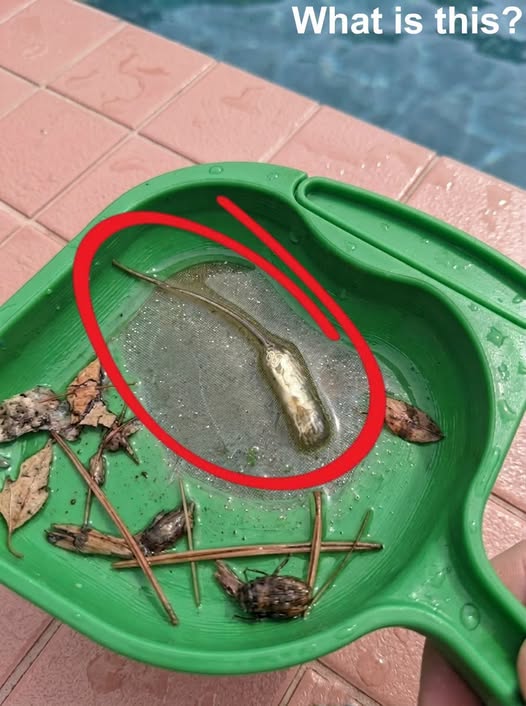
The creature had a swollen, grub-like body with an impossibly long, thin tail trailing behind it. It drifted through the water as though it belonged there, moving just enough to confirm that whatever I was looking at was definitely alive.
My mind immediately jumped to the worst possibilities.
A parasite? Some invasive creature? Something dangerous that had somehow gotten into the pool? The more closely I looked, the less familiar it became. That long tail was the part that bothered me most. It seemed completely out of proportion with the rest of the body, almost like a worm attached to another creature.
I grabbed the pool net and carefully scooped it from the water.
Sitting there in the mesh, it somehow looked even stranger. Its thick body moved slightly while the long, threadlike structure extended behind it. I didn’t want to touch it, so I kept the net away from me and immediately started searching online.
That was when my imagination really took over.
For nearly an hour, I compared photographs and read descriptions of different aquatic insects, worms, parasites, and larvae. Every disturbing image seemed to create another possibility. Some looked vaguely similar but not quite right. Others came with alarming descriptions that made me wonder whether I should drain the entire pool.
Nothing matched perfectly, and somehow that made the situation even more unnerving.
I began thinking about everyone who had been swimming there. Had this thing been in the water the entire time? Were there more hiding somewhere? Could there be eggs? Was the pool contaminated?
The questions became increasingly dramatic while the creature itself simply remained in the net.
That long “tail” kept drawing my attention. It looked almost as though the animal was trying to breathe through it, which turned out to be surprisingly close to the truth.
Eventually, I found an image that finally matched.
It was a rat-tailed maggot.
The name wasn’t particularly reassuring at first.
But when I read further, the mystery quickly became far less frightening. Rat-tailed maggots are larvae of certain hoverflies. Their bizarre appearance comes largely from the extremely long structure extending from the rear of the body.
And that “tail” isn’t really a tail in the way I had imagined.
It functions as a telescoping breathing tube.
The larva can live in stagnant, muddy, or oxygen-poor water while extending this tube toward the surface to access air. Suddenly, the strange design that had looked so horrifying became remarkably logical. The creature wasn’t some malformed parasite. It was simply equipped for the environment in which it develops.
Even the swollen body made more sense.
Rat-tailed maggots typically develop in wet environments containing decaying organic material. Their unusual respiratory system allows them to survive in conditions where oxygen levels in the water may be low.
The more I learned, the more my fear turned into fascination.
That bizarre body wasn’t evidence of something going terribly wrong. It was an adaptation. What looked like an alien tail was actually an elegant biological solution to a simple problem: how do you breathe when the water around you doesn’t contain enough usable oxygen?
The answer was essentially to carry your own snorkel.
Finding one in or around a pool can still be a useful reason to inspect the water and make sure maintenance, circulation, and sanitation are being handled properly, especially if standing or organic-rich water is present nearby. But discovering a single strange larva doesn’t automatically mean some terrifying infestation has taken over.
Once I understood what I was looking at, the panic disappeared almost immediately.
I carefully removed it from the pool and dealt with the water as I normally would, still feeling slightly embarrassed by how quickly my imagination had escalated from “strange bug” to “unknown biological threat.”
But I was also relieved.
For an hour, that creature had been terrifying simply because I couldn’t give it a name. Every unfamiliar feature became evidence of danger because my brain had nothing else to compare it with.
The moment I identified it, everything changed.
The long tail became a breathing tube.
The strange body became a fly larva.
The “monster” became an ordinary animal with an extraordinary adaptation.
It was a surprisingly useful reminder that nature doesn’t always design creatures according to what humans consider normal or attractive. Some animals look bizarre because they have evolved to solve problems we rarely think about.
And sometimes the difference between horror and curiosity is nothing more than understanding what you’re actually seeing.
That morning, the strangest creature I had ever found in my pool went from something I was almost afraid to approach to something genuinely fascinating.
Sometimes the scariest things become ordinary the moment you finally learn their name.