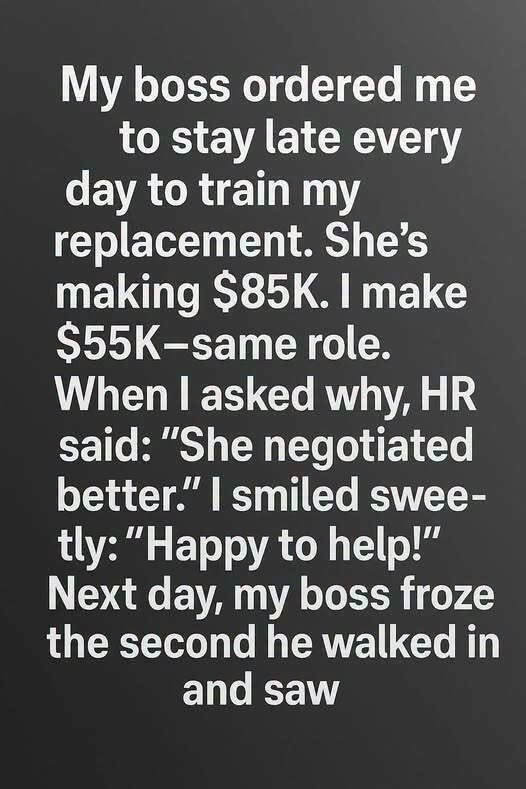
The betrayal hit harder than I ever imagined. After years of loyalty, overtime, and consistently going above and beyond, I discovered that my employer had already decided I was replaceable. The final blow came when my manager casually informed me that I would be responsible for training the person taking over my position—a new hire who would earn **$30,000 more per year** than I had ever been paid. I sat there stunned, trying to process how the company I had devoted so much of myself to could value a stranger more highly than the employee who had kept things running for years. When Human Resources dismissed my concerns with little more than a polite shrug, something inside me changed forever. Instead of arguing, I quietly decided it was time to change the way I played the game.
For years, I had been the employee everyone relied on. If a deadline was slipping, I stayed late. If a system failed, I fixed it. If someone called in sick, I covered the work without complaint. My job description had quietly expanded far beyond what I had originally been hired to do, yet my paycheck barely reflected any of those additional responsibilities. I convinced myself that hard work would eventually be recognized and rewarded. Instead, my willingness to do more simply became the new expectation, while promotions and higher salaries always seemed to go to someone else.
Learning how much my replacement would be earning forced me to see everything differently. The issue wasn’t simply the salary difference—it was realizing that the company had always known the true value of the position. They were perfectly willing to pay significantly more for the role; they simply hadn’t been willing to pay it to me. That realization hurt more than any rejection ever could. It exposed years of underappreciation hidden behind compliments about my dedication and reliability.
Rather than reacting emotionally, I began documenting everything. Every project I managed, every responsibility outside my official role, every emergency I handled, and every system I maintained went into detailed records. I also reviewed my employment agreement line by line, comparing my actual daily workload to the duties listed in my official job description. The difference was astonishing. What I had been hired to do occupied only a small portion of my workday. Everything else had gradually been added without additional compensation, formal recognition, or updated expectations.
When it came time to train my replacement, I arrived carrying two neatly organized folders. The first contained my official job description—the tasks the company actually paid me to perform. The second documented everything I had voluntarily taken on over the years to keep the department functioning smoothly. As we reviewed them together, I watched her expression slowly change. She quickly realized the position she had accepted wasn’t simply a well-paying opportunity. It came with countless invisible responsibilities that no one had mentioned during the hiring process.
To her credit, she appreciated the honesty. Instead of expecting me to continue hiding the reality of the workload, she thanked me for being transparent. We both understood that the real problem wasn’t either of us—it was a workplace culture that quietly relied on employees giving far more than they were ever compensated to provide.
From that moment forward, I stopped performing unpaid work. I completed every responsibility outlined in my contract professionally and on time, but I no longer volunteered for tasks that fell far outside my role. I stopped solving every crisis before management even noticed there was a problem. I no longer answered late-night emails, worked unpaid overtime, or rescued projects that had been poorly planned by others. Every issue I declined to absorb landed exactly where it belonged—with the people responsible for managing the department.
At first, management seemed confused by the sudden changes. Deadlines began slipping, unanswered questions accumulated, and problems that I had quietly prevented for years suddenly became impossible to ignore. My manager repeatedly asked why things weren’t running as smoothly as before. The answer was remarkably simple: they were finally seeing what the department actually looked like without one employee carrying responsibilities that had never officially belonged to them.
As my final week approached, I felt a sense of peace that had been missing for years. Instead of feeling guilty for leaving, I realized I had nothing left to prove. I had already given more than enough. My resignation wasn’t driven by anger or revenge—it was an act of self-respect. I accepted a new position where my skills, experience, and contributions would be recognized rather than quietly exploited.
Walking out of the office for the last time, I didn’t feel bitterness. I felt freedom. The greatest lesson I carried with me wasn’t about salaries or promotions. It was the realization that loyalty should never require sacrificing your own worth. Hard work deserves fair compensation, and dedication should never become an excuse for exploitation. Sometimes the most powerful thing an employee can do isn’t working harder—it’s finally recognizing their own value and refusing to give away more than they’re respected for. In reclaiming my time, my boundaries, and my confidence, I discovered that the quiet power of doing exactly what you’re paid to do can change everything.