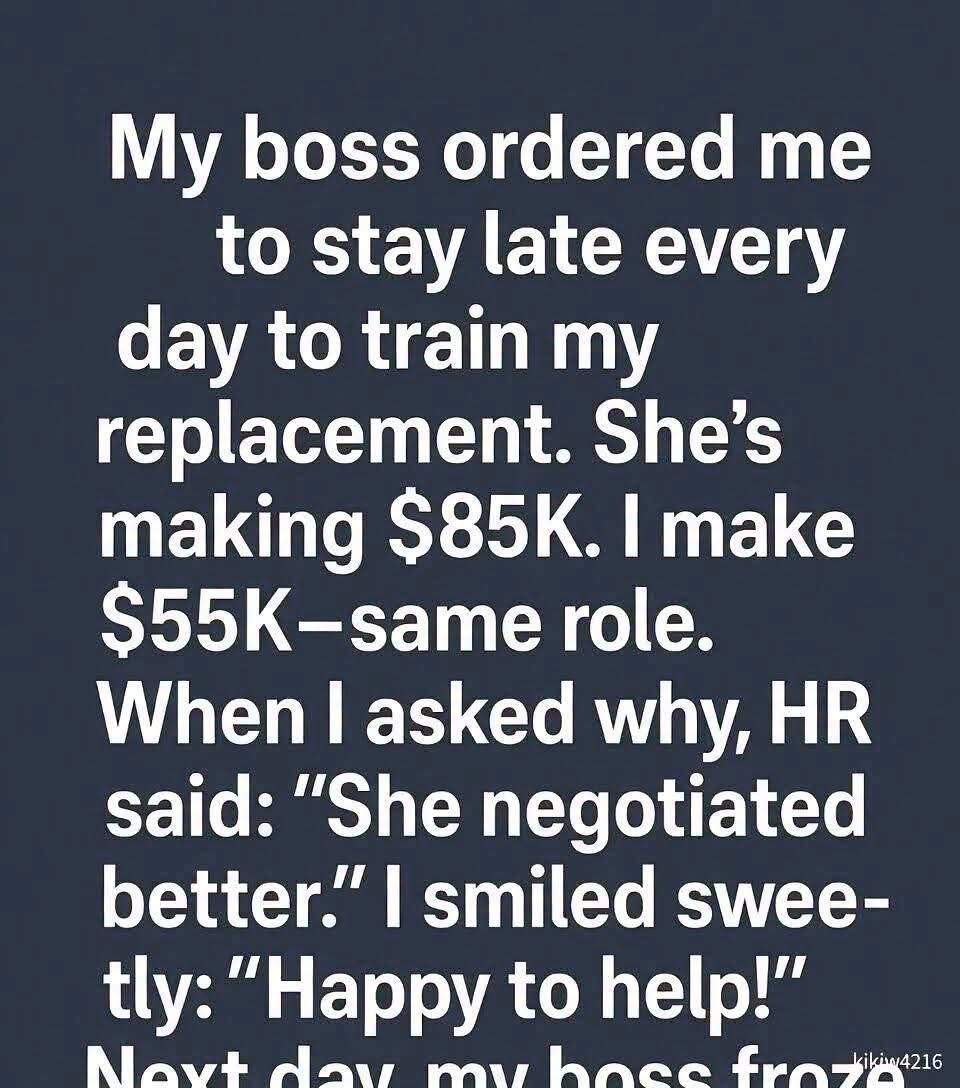
I Was Asked to Train My Higher-Paid Replacement — So I Taught My Boss an Unexpected Lesson
For nearly eight years, I was the person everyone at the company turned to when something went wrong.
If a major client had a problem, they called me. If a report contained an error, I was the one who found it. If a new employee couldn’t understand the company’s complicated systems, my boss would send them to my desk.
I knew the business inside and out. I had helped build relationships with our most important clients, solved problems that other employees couldn’t handle, and stayed late more times than I could count.
I never considered myself irreplaceable. I simply believed that hard work, loyalty, and experience meant something.
Then, one Tuesday morning, my boss called me into his office and changed everything.
He smiled as I sat down.
“We’re bringing someone new onto the team,” he said. “He’s going to take over some of your responsibilities. I’d like you to train him over the next few weeks.”
I nodded, waiting for the rest.
Then he mentioned the new employee’s salary.
It was nearly 40 percent higher than mine.
For a moment, I thought I had misunderstood him.
This person hadn’t even started working for the company, yet he would be earning significantly more than someone who had spent almost eight years helping it succeed.
I asked my boss whether my salary would be reviewed.
He leaned back in his chair.
“His experience is different,” he explained. “And we need to be competitive to attract the right talent. I hope you understand.”
I understood perfectly.
The company was willing to pay more for someone new than it was willing to pay to keep someone who already knew how everything worked.
Still, I kept my expression neutral.
“When does he start?” I asked.
“Monday. I want him fully up to speed as quickly as possible.”
“Of course,” I replied. “I’ll prepare a training plan.”
My boss smiled, apparently relieved that I hadn’t made things difficult.
He had no idea what I was thinking.
The First Week: Showing Him Everything
When the new employee arrived, I welcomed him warmly.
His name was Michael. He was intelligent, polite, and clearly experienced in his field. He hadn’t done anything wrong, and I wasn’t going to make his life difficult simply because management had decided to pay him more.
I showed him our systems, introduced him to the team, and explained the company’s daily procedures.
I walked him through client histories, reporting schedules, internal processes, and the small details that never appeared in the official manuals.
Some of the information was easy to teach. Other things had taken me years to learn.
For example, I knew which clients needed a phone call before receiving an email. I knew which reports regularly contained errors and how to identify them before they became expensive problems. I knew which departments needed extra time to complete requests and which deadlines were flexible in practice, even when they appeared strict on paper.
Michael took notes and asked thoughtful questions.
By the end of the first week, he had begun to understand why the job required so much experience.
One afternoon, he looked at me and said, “Honestly, I don’t know how you keep all of this in your head.”
I laughed.
“Eight years of making mistakes and learning from them.”
He shook his head.
“They’re lucky to have you.”
I smiled, but I didn’t tell him what my boss had said about my salary.
It wasn’t Michael’s fault.
The real problem was the person who had decided that my experience was worth less simply because I was already there.
The Question My Boss Didn’t Expect
Two weeks into the training process, my boss stopped by my desk.
“How’s Michael doing?” he asked.
“He’s learning quickly,” I replied. “He’s getting comfortable with the systems.”
“Excellent. I knew you could get him ready.”
He started to walk away, but I stopped him.
“Before we finish the transition, I’d like to discuss my own position.”
His smile faded slightly.
“Sure. What’s on your mind?”
I had prepared for this conversation carefully.
I brought a document outlining my responsibilities, the clients I managed, the projects I had completed, and the additional duties I had taken on over the years.
I also included examples of problems I had prevented and improvements I had introduced.
Then I placed a second page on the desk.
It contained a straightforward comparison between my responsibilities and the role Michael had been hired to perform.
“I’d like my compensation to reflect the responsibilities I’ve been carrying,” I said. “Especially now that we’ve established the market rate for this position is significantly higher than my current salary.”
My boss glanced at the pages.
“We don’t usually make adjustments like that,” he replied.
“Why not?”
He seemed surprised by the question.
“Well, budgets are complicated. There are internal salary structures to consider.”
“I understand. But you were able to make room in the budget for Michael.”
He paused.
I continued calmly.
“I’m not asking for special treatment. I’m asking for a fair review based on the work I do and the value I bring to the company.”
For the first time since this situation began, my boss didn’t have an immediate answer.
He promised to discuss it with human resources.
I thanked him and returned to my desk.
I wasn’t expecting a miracle. But I had finally made it clear that I understood what was happening.
The Unexpected Lesson
Over the next two weeks, Michael became increasingly independent.
He could handle routine reports, communicate with clients, and manage most of the daily tasks without my assistance. I answered his questions honestly and made sure he had the information he needed.
At the same time, I began documenting my own work more thoroughly.
I organized the procedures I had created, recorded the status of ongoing projects, and made sure the team could access the information necessary to operate smoothly.
I also updated my résumé.
For years, I had assumed that loyalty to one company would eventually be rewarded. Now I understood that loyalty and professional growth weren’t necessarily the same thing.
I began exploring other opportunities, updating my professional profile, and speaking with people in my industry.
I didn’t announce any of this at work.
I simply stopped assuming that my future depended on my boss recognizing my value.
Then, one Thursday afternoon, I received a call from a recruiter I had spoken with earlier that week.
A company in the same industry was looking for someone with my experience. The position offered a higher salary, better benefits, and a clearer path toward management.
After several interviews, they made me an offer.
The salary was substantially higher than what I was earning.
I read the offer twice before allowing myself to believe it.
For the first time in years, I felt genuinely appreciated before I had even started the job.
I accepted.
The Meeting That Changed Everything
The following Monday, I requested a meeting with my boss.
He looked concerned when I entered his office with a folder in my hand.
“Everything all right?” he asked.
“Yes,” I said. “I’ve made a decision about my future.”
I placed my resignation letter on his desk.
He stared at it.
“You’re leaving?”
“Yes. I’ve accepted another position.”
He looked genuinely surprised.
“But Michael is still getting up to speed. We were counting on you to help him through the next phase.”
“I understand,” I replied. “I’ve documented the procedures, completed the training plan, and made sure he has the resources he needs.”
He looked down at the letter again.
“Is this about the salary situation?”
“That was part of it,” I said. “But it’s bigger than that. I want to work somewhere that recognizes my contribution and gives me room to grow.”
He leaned back and sighed.
“We could discuss an adjustment. Perhaps there’s something we can do.”
I appreciated the offer, but I had already made my decision.
“I raised that concern before accepting another position,” I explained. “At the time, we couldn’t find a solution. I’ve now found an opportunity that works for me.”
There was a long silence.
Finally, he asked, “What would it take to get you to stay?”
I thought about the years I had spent working late, solving problems, helping colleagues, and trusting that my contribution would eventually be recognized.
“I think the time to have that conversation was before I started looking elsewhere,” I said.
I stood up, thanked him for the opportunities I had been given, and left the office.
For the first time in eight years, I didn’t feel guilty about putting my own future first.
What Happened After I Left
My final weeks were professional and uneventful. I completed my handover, answered Michael’s remaining questions, and made sure the team had what it needed.
Michael thanked me personally before my last day.
“I’ve learned a lot from you,” he said. “I hope the next place appreciates what you bring.”
I wished him well.
A few months later, I heard through former colleagues that the transition had been more difficult than management expected. Michael was capable, but learning a job and understanding the history behind years of decisions were two different things.
The company eventually had to reconsider how it distributed responsibilities across the team.
I didn’t celebrate its difficulties. I had no desire to see Michael struggle, and I didn’t want my former colleagues to suffer.
But I did recognize the lesson.
A company can hire someone new, offer them a higher salary, and expect them to learn a complicated role. What it cannot do is assume that the experience, judgment, and institutional knowledge of an established employee have no value.
Those things take time to develop.
And when experienced employees feel consistently undervalued, they may eventually take that experience somewhere else.
The Lesson I Learned
Looking back, I don’t regret training Michael. He deserved a fair chance to succeed, just as I deserved to be treated fairly.
My mistake was believing that working hard and staying loyal would automatically lead to recognition.
They didn’t.
What changed my life wasn’t an argument, a dramatic confrontation, or an attempt to sabotage my replacement.
It was the decision to stop waiting for someone else to determine my worth.
I documented my accomplishments. I asked for fair compensation. I explored my options. And when a better opportunity came along, I had the confidence to accept it.
My boss wanted me to teach my replacement how to do my job.
I did exactly that.
But in the process, I learned something far more valuable: you can be loyal to your work without sacrificing your own future.
Sometimes, the most unexpected lesson a boss learns is that the employee they take for granted is also the employee who knows when it’s time to leave.