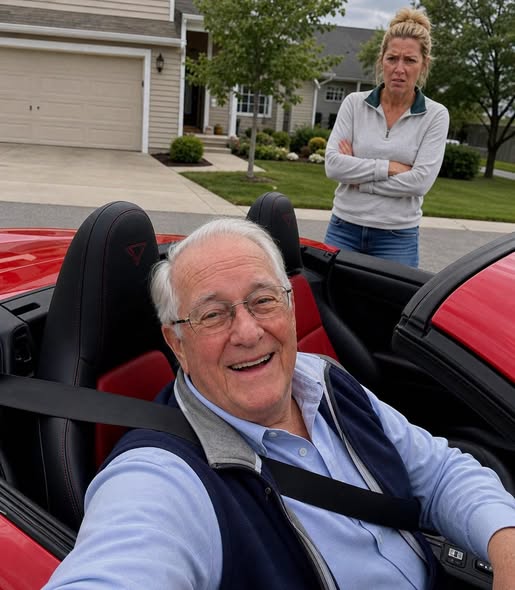
Harold thought the worst moment of his life had already happened. He had stood beside the grave, watched the coffin carrying his wife disappear beneath the earth, and felt as though something inside him had been buried with her. After decades of shared mornings, familiar arguments, private jokes, holidays, disappointments, and ordinary routines, Margaret was suddenly gone.
He believed nothing could possibly hurt more than that.
He was wrong.
The real shock came only minutes later, when he overheard his children quietly talking about their mother’s jewelry.
At first, Harold couldn’t believe what he was hearing. He had expected tears. He had expected memories. He had expected his children to stand beside him and talk about their mother—the woman who had raised them, loved them, worried about them, and spent most of her life putting their needs ahead of her own.
Instead, they were discussing what belonged to whom.
A bracelet.
A necklace.
A ring.
Then came questions about the will.
The house.
The savings.
The property.
Harold stood there listening, stunned by how quickly grief seemed to have been replaced by calculation. His wife had barely been laid to rest, yet his children were already talking about the things she had left behind.
What hurt most wasn’t the money.
It was the realization that they seemed to be looking past him.
Margaret’s death had left Harold alone, but his children appeared to see him not as a grieving husband and their father, but as the person standing between them and an inheritance.
In the weeks that followed, the pattern became impossible to ignore.
Their conversations increasingly sounded like legal consultations. They asked about accounts, investments, property, and paperwork. They wanted to know what had been changed and what remained untouched.
Sometimes they barely asked how Harold was sleeping.
Sometimes they didn’t ask at all.
The house itself seemed to understand his grief better than his children did.
Margaret’s chair remained empty.
Her things were still where she had left them.
The television murmured in the background because Harold couldn’t tolerate complete silence.
At the kitchen table, he still occasionally turned toward the chair where she used to sit, only to remember that she wasn’t coming back.
Those were the losses he had expected.
What he hadn’t expected was to feel like a stranger inside the family he had spent his entire life building.
Eventually, something inside Harold changed.
He realized he could continue sitting quietly while everyone else planned what would happen to his belongings, or he could remind them of something they seemed to have forgotten.
**He was still alive.**
Margaret’s death had not ended his life.
It had changed it.
And Harold wasn’t prepared to spend whatever time remained simply waiting for his children to decide what they believed they were entitled to.
So he made decisions of his own.
The car.
The trips.
The changes to the will.
From the outside, some of those choices may have looked like revenge. But Harold didn’t see them that way.
He wasn’t trying to punish his children.
He was trying to reclaim ownership of his own life.
For years, he and Margaret had saved carefully. They had postponed certain dreams because there was always something more important. A bill. A family expense. A repair. A child’s need.
They had spent so much time preparing for the future that they had occasionally forgotten the future was supposed to be lived.
Then Harold discovered something Margaret had left behind that changed the way he thought about everything.
A secret engraving.
**“Young and reckless again.”**
It was the kind of message that could have seemed silly under different circumstances. But after Margaret’s death, it felt like a final conversation between them.
She wasn’t telling him to forget her.
She wasn’t telling him to stop grieving.
She was reminding him that their life had never been meant to become nothing more than an estate plan.
They had once been young.
They had taken chances.
They had laughed at things that no longer seemed funny.
They had traveled.
They had made mistakes.
They had built a family.
And they had dreamed about what they might do when they finally had time for themselves.
Harold began to realize that honoring Margaret didn’t mean sitting in the house surrounded by memories until his own life slowly disappeared.
Maybe honoring her meant living.
So he began making plans.
Not extravagant plans designed to make his children jealous.
Real plans.
The kind of plans Margaret would have understood.
He considered the places they had always talked about visiting. He looked at the car they had once dreamed about owning. He opened the old photographs and allowed himself to remember not only the final years, but the beginning.
And when it came time to reconsider the estate, Harold made another difficult decision.
He would not simply divide everything according to what his children expected.
A significant portion of the money would go toward causes Margaret had cared about.
It wasn’t punishment.
It was purpose.
Their money had represented years of work and sacrifice, and Harold wanted at least part of it to continue doing something meaningful after both of them were gone.
His children were furious.
They accused him of being unfair.
They questioned his judgment.
They argued that the money should stay within the family.
But Harold finally said something he had avoided saying for years:
**“I’m still here.”**
The anger eventually exposed something deeper.
Their obsession with the inheritance wasn’t entirely about greed.
It was also about fear.
They had lost their mother, and beneath all the arguments about money was the terrifying realization that their father would someday be gone too.
The inheritance represented something they could understand and control.
Grief was harder.
The possibility of losing both parents was harder.
So they focused on numbers because numbers were easier than emotions.
That didn’t excuse the way they had treated Harold.
Cruelty was still cruelty.
But for the first time, Harold could see that their behavior had come from somewhere more complicated than simple selfishness.
And instead of shutting the door forever, he did something unexpected.
He invited them to talk.
Not about the estate.
Not about jewelry.
Not about property.
About Margaret.
About what they missed.
About what they were afraid of.
About the things they wished they had said while she was still alive.
The conversations were painful.
There were accusations.
There were tears.
There were long silences.
But eventually, there was honesty.
And honesty was something their family had been missing for a very long time.
They began remembering Margaret not as the woman who had left behind a house and jewelry, but as the mother who had cooked their meals, stayed awake when they were sick, attended their milestones, worried about their futures, and loved them even when they didn’t make it easy.
Harold also admitted his own mistakes.
He had spent years assuming that providing for his children was enough.
Perhaps he hadn’t always told them what he felt.
Perhaps he had allowed financial security to become a substitute for emotional closeness.
Maybe everyone in the family had been guilty of loving one another without always knowing how to show it.
That realization didn’t erase the hurt.
But it created a possibility.
One evening, they stood together in the driveway.
The deep-green car was idling nearby.
Margaret’s bracelet rested inside the glove compartment, catching the light whenever the door moved.
For a moment, nobody spoke.
They were all thinking about the woman who should have been there.
Then Harold looked at his children and understood something that had taken him years to learn.
Inheritance could be transferred.
Property could be divided.
Money could disappear.
Jewelry could be worn by someone else.
But time couldn’t be passed down.
And love couldn’t be postponed indefinitely.
They had spent too much of their lives assuming there would always be another holiday, another conversation, another apology, another chance to say what mattered.
Margaret’s death had proven otherwise.
Harold couldn’t bring her back.
He couldn’t rewrite the moments his children had missed.
But he could choose what happened next.
He could continue living.
And they could choose whether to spend the years they had left fighting over what would eventually be inherited—or actually build something worth inheriting.
The answer wouldn’t fix everything overnight.
It didn’t need to.
For the first time, they were facing one another without pretending.
And perhaps that was the real inheritance Margaret had left behind.
Not the house.
Not the jewelry.
Not the savings.
But the reminder that **love cannot be backdated**.
You cannot wait until someone is gone to suddenly become the family you should have been while they were alive.
You cannot postpone every meaningful conversation and assume there will always be time.
And you cannot measure a person’s life by what they leave behind.
Standing beside that deep-green car, with Margaret’s bracelet quietly resting in the glove compartment, Harold understood that his wife’s story was not finished simply because hers had ended.
Neither was his.
He still had time.
And for the first time in a long time, he intended to use it.