I Refused to Argue With a Woman Over a Shopping Cart, but When I Finished Shopping, I Found My Car Damaged
I never imagined that an ordinary trip to the supermarket would turn into one of the most frustrating experiences of my life. I had gone out to buy a few groceries, hoping to finish my errands quickly and return home. I wasn’t looking for trouble, and I certainly wasn’t expecting to become involved in an argument with a stranger.
But sometimes, a small disagreement reveals far more about a person’s character than you could ever expect.
It all started with a shopping cart.
At first, the incident seemed insignificant. A woman wanted the cart I was using, and when I politely explained that I wasn’t finished with it, her attitude changed almost immediately. What should have been a simple, forgettable encounter became an uncomfortable confrontation that I wanted nothing more than to avoid.
I decided not to argue. I had no interest in ruining my day over something so trivial.
Little did I know that when I returned to my car, I would discover something that made me question whether walking away had been the right decision.
The Argument That Started Over Nothing
The supermarket was crowded that afternoon. People were rushing through the aisles, children were asking their parents for treats, and the checkout lines were longer than usual.
I had just collected a few items when I noticed a woman approaching me near the entrance to another aisle.
She looked at the shopping cart beside me and said, “I’m taking that.”
I was surprised by the way she said it. There was no question or polite request, just an assumption that I would immediately hand it over.
“I’m sorry,” I replied calmly. “I’m still shopping.”
She frowned.
“There are never enough carts here,” she said. “You can just take another one later.”
I explained that I had already placed several groceries inside and was nearly finished. I wasn’t trying to be difficult. I simply didn’t understand why she believed she had the right to take something I was still using.
Instead of accepting my answer, she began complaining about how inconsiderate people were becoming.
I could have responded with the same attitude, but I knew it wouldn’t accomplish anything. We were strangers, and neither of us had anything to gain by turning a shopping cart into a public argument.
“Look,” I told her, “I’m not going to argue with you about this.”
I turned back toward the shelves and continued shopping.
For a moment, I thought that would be the end of it.
The woman muttered something under her breath before walking away. I didn’t follow her, and I didn’t bother looking back.
I wanted to finish my shopping and get on with my day.
But as I pushed my cart toward the checkout, I noticed that she was still nearby, watching me from a distance.
There was something about the expression on her face that made me uncomfortable, although I couldn’t have explained exactly why.
I tried to forget about it.
After all, I had done nothing wrong.
I Finished Shopping and Returned to My Car
By the time I paid for my groceries, I had almost stopped thinking about the encounter.
I packed my bags carefully, checked that I had everything, and headed toward the parking lot.
The afternoon was getting colder, and I was looking forward to getting home. I had already started thinking about what I would make for dinner when I reached my vehicle.
Then I stopped.
Something was wrong.
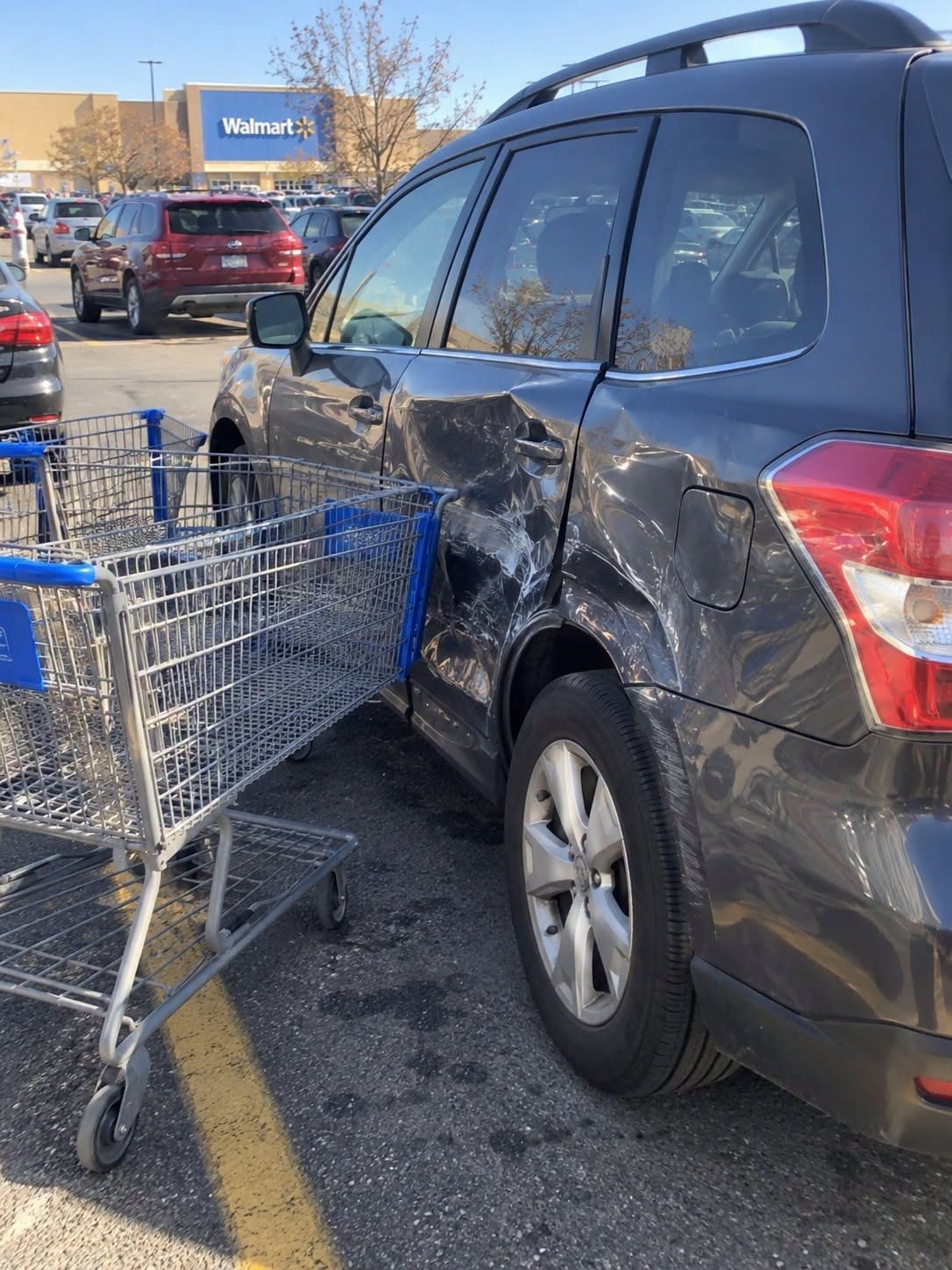
As I approached the driver’s side, I noticed a long, ugly scratch running along the paintwork. At first, I thought it might have been an old mark I had never noticed before.
But when I moved closer, I saw that the damage was fresh.
The paint had been scraped away in several places, leaving a visible line across the side of the car.
I stood there in disbelief.
My first thought was that another driver might have accidentally hit my vehicle while parking. The lot was busy, and accidents happened.
Then I noticed something else: the damage appeared deliberate rather than consistent with a typical minor parking collision.
My stomach tightened.
I looked around the parking lot, hoping someone might have seen what happened. A few people were loading groceries into their vehicles, while others were walking toward the store.
Nobody seemed to be paying attention to me.
I placed my shopping bags on the ground and examined the damage again.
The car had been perfectly fine when I arrived.
Now someone had damaged it while I was inside.
And suddenly, I remembered the woman.
Could It Have Been the Same Woman?
I couldn’t stop thinking about our argument.
Had she followed me into the parking lot? Had she become so angry over a shopping cart that she decided to damage my property?
The possibility made me furious, but I also knew that suspicion wasn’t proof.
I hadn’t seen anyone touch my car. I had no direct evidence connecting the woman to the damage, and I didn’t want to accuse someone without knowing what had happened.
Still, the timing was difficult to ignore.
I took out my phone and photographed the scratches from several angles. I also checked the surrounding vehicles, wondering whether another car might have left paint marks or whether there were any obvious signs of a collision.
Nothing immediately explained what I was seeing.
For a moment, I considered going back into the supermarket to look for the woman.
But I stopped myself.
If she had nothing to do with the damage, confronting her would accomplish nothing. And if she had deliberately damaged my vehicle, an angry argument in the parking lot would not solve the problem either.
I needed information, not another confrontation.
The Decision That Changed the Situation
I went back inside the supermarket and approached the customer service desk.
I explained what had happened, beginning with the damage to my car and then describing the uncomfortable encounter I had experienced earlier.
I was careful to distinguish what I knew from what I suspected.
The employee listened and asked me where I had parked. I provided the location and the approximate time I had entered the store.
The employee then explained that the store might have security cameras covering parts of the parking area, although the staff would need to determine whether the relevant space was visible.
I asked whether the footage could be preserved in case I needed it for an insurance claim or a police report.
The employee said they would pass the information to the appropriate manager.
That response gave me a small sense of relief.
I couldn’t undo the damage, but at least I was taking sensible steps to establish what had happened.
I also contacted the appropriate local authorities to ask about reporting the incident and documenting the damage. Depending on the circumstances, the police or my insurer could advise me on what information was needed.
For the first time since discovering the scratches, I felt that I was doing something constructive instead of simply replaying the argument in my head.
What the Security Footage Might Reveal
As I waited for further information, I kept thinking about how quickly an ordinary day could turn into a stressful situation.
I had refused to argue with a stranger because I didn’t believe the disagreement deserved my time or energy.
I still believed that walking away from unnecessary conflict had been the right choice.
But I also understood that remaining calm didn’t mean ignoring what happened afterward.
If security footage was available, it might help establish whether anyone had approached my vehicle during the time I was shopping. It could also help determine whether the damage resulted from an accidental collision or something more deliberate.
I didn’t know what the footage would show, and I wasn’t going to assume that it would confirm my suspicions.
All I could do was document the damage, report the incident appropriately, and let the evidence speak for itself.
That was far more useful than confronting someone based on anger alone.
A Shopping Cart Was Never Worth This Much Trouble
Later that evening, after I had returned home, I found myself thinking about the original disagreement.
It had been such a small thing. A shopping cart, a few impatient words, and a stranger who didn’t like being told no.
Yet the experience had left me dealing with damaged property, uncertainty, and the possibility of an expensive repair.
I wondered whether I should have handled the initial encounter differently. Perhaps I could have said something more reassuring or offered to help her find another cart.
But then I reminded myself that I had already responded calmly and respectfully. I wasn’t responsible for another person’s reaction to a reasonable boundary.
At the same time, I couldn’t know whether the woman had anything to do with the damage. It would have been unfair to treat my suspicion as a confirmed fact.
That distinction mattered.
Anger can make it tempting to connect two events simply because they happened close together. But if I wanted the truth, I had to be willing to wait for evidence rather than settle for the explanation that felt most obvious.
The Lesson I Took Away From the Experience
The incident taught me that avoiding an argument and protecting yourself are not mutually exclusive.
I could refuse to engage in a pointless confrontation while still documenting damage, asking for assistance, and taking appropriate action when something went wrong.
I also learned that I didn’t need to prove anything to a stranger in a supermarket parking lot. I didn’t need to win the argument, deliver the perfect comeback, or make someone admit they were wrong.
My priority was to protect my property and find out what had happened.
Sometimes, the strongest response is not the loudest one. It is the response that keeps you calm, preserves the facts, and gives you the best chance of resolving the problem.
As for the scratches on my car, they were a frustrating reminder that other people’s actions can disrupt our lives in unexpected ways.
But they didn’t have to determine how I responded.
I could choose patience over confrontation, evidence over assumptions, and practical action over revenge.
I had refused to argue with a woman over a shopping cart. When I discovered my damaged car, I realized that staying calm wasn’t the same as doing nothing. It meant choosing a response that could actually help me find the truth.