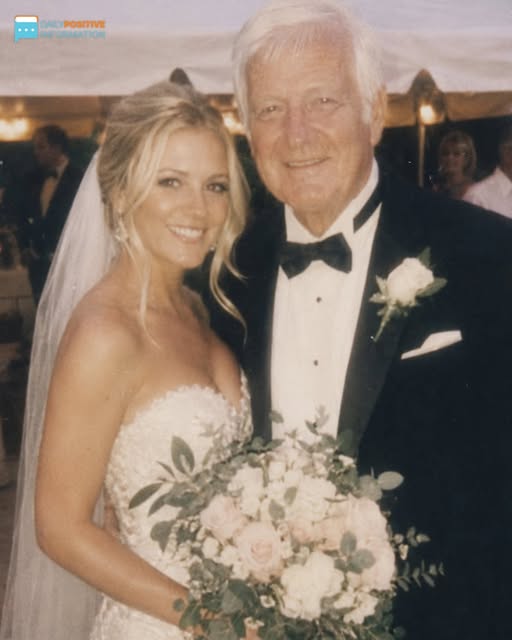
Camille spent the rest of that afternoon wandering through the cottage while Arthur sat on the porch watching the lake.
The place was modest.
One bedroom.
A narrow kitchen.
A living room with faded floral curtains and bookshelves bowed slightly in the middle from decades of use.
Nothing about it looked expensive.
Nothing about it looked impressive.
And somehow, it felt more valuable than any mansion she had ever stepped inside.
She stopped beside a small window overlooking the water.
The glass distorted the view slightly.
The floor creaked beneath her feet.
The entire cottage felt lived in.
Loved.
Protected.
When she returned to the porch, Arthur was smiling at her.
“You like it.”
“I do.”
His eyes softened.
“Sophia always said the cottage could tell when someone belonged here.”
Camille laughed.
“Houses don’t decide things.”
“No?”
“No.”
Arthur looked toward the lake.
“I think sometimes they do.”
The conversation stayed with her long after they returned home.
Months passed.
Arthur’s health declined slowly at first.
Then all at once.
The walks became shorter.
The naps became longer.
Medical appointments multiplied.
The children started appearing more frequently.
Not because they were worried.
Camille noticed they always asked the same questions.
Had Arthur updated his will?
Was everything organized?
Did he have financial documents that needed attention?
One afternoon, after Deborah left, Arthur sat quietly in his favorite chair.
“You know what bothers me?” he asked.
Camille looked up from her book.
“What?”
“They never ask if I’m afraid.”
The room fell silent.
Arthur stared at the window.
“They ask about the house. The accounts. The investments.”
His smile was tired.
“But nobody asks whether I’m afraid of dying.”
Camille crossed the room and took his hand.
“Are you?”
He considered the question carefully.
“A little.”
Then he squeezed her fingers.
“But not because of me.”
She understood immediately.
“You’re worried about what happens after.”
“Yes.”
His voice dropped lower.
“You spent your whole life waiting for someone to tell you that you didn’t belong.”
Tears filled her eyes.
“Arthur—”
“Let me finish.”
She nodded.
“You think I don’t notice how you hesitate before hanging pictures? How you apologize for taking up space in your own home?”
He smiled sadly.
“You still live like someone might ask you to leave.”
Camille couldn’t answer.
Because it was true.
Even after years together.
Even after marriage.
Some frightened part of her remained packed and ready.
Arthur looked at her for a long moment.
“I’m going to fix that.”
She thought he meant reassurance.
A promise.
A conversation.
She didn’t realize he meant something else entirely.
Three weeks later, he was admitted to the hospital.
And two days after that, he placed the cardboard box into her hands.
Now, after the funeral, she sat alone in their bedroom staring at it.
Outside, guests were leaving.
Arthur’s children were already discussing lawyers downstairs.
She could hear fragments of conversation drifting upward.
“Dad wasn’t thinking clearly.”
“She manipulated him.”
“We’ll sort everything out.”
Camille closed her eyes.
Then she opened the box.
At first she thought it was empty.
Then she noticed a manila folder lying flat against the bottom.
Her hands trembled as she lifted it out.
Inside were documents.
Property records.
Transfer forms.
Legal certificates.
She read the first page once.
Then again.
Then a third time.
Her breath caught.
The cottage.
The little lakeside cottage.
It belonged to her.
Not recently.
Not after his death.
Arthur had transferred ownership nearly a year earlier.
Her name stood alone on every document.
No trust.
No shared ownership.
No conditions.
No challenges possible.
The property was hers.
Legally.
Completely.
At the very bottom of the folder rested a sealed envelope.
Her name was written across the front.
She opened it carefully.
Inside was a single handwritten letter.
My darling Camille,
If you are reading this, then Deborah is probably angry, Alfred is probably calculating, and Norman is pretending not to care.
Some things never change.
You told me once what you wanted more than anything.
Not money.
Not luxury.
Not security in a bank account.
You wanted a place where nobody could tell you to leave.
I listened.
The cottage belonged to Sophia before it belonged to me.
It was her sanctuary.
Now it is yours.
Not because you earned it.
Not because you deserve it.
But because it is already where your heart rests.
The children will inherit more than enough.
They will be comfortable.
They will survive.
But comfort was never what you lacked.
You lacked certainty.
So I am giving you certainty.
Nobody can remove you.
Nobody can outvote you.
Nobody can decide you are temporary.
This place is yours for as long as you want it.
I wish I could see your face while you read this.
I suspect you are crying.
You always cry when someone is kind to you.
That has always broken my heart a little.
Live there.
Plant flowers.
Leave books open on tables.
Hang pictures wherever you want.
Spread out.
Take up space.
And when you sit on that porch looking at the lake, remember something.
You were never a thief.
You were never an opportunist.
You were never what they said.
You were simply the woman I loved.
Forever,
Arthur
Camille pressed the letter against her chest.
For a long time, she sat in silence.
Not because she was mourning.
Not entirely.
But because for the first time in her life, she understood what Arthur had given her.
Not wealth.
Not an inheritance.
Not revenge against his children.
He had given her something far rarer.
A home that nobody could take away.
Downstairs, voices continued arguing about money.
Lawyers.
Assets.
Percentages.
Camille folded the letter carefully.
Then she smiled through her tears.
Because while they fought over what Arthur left behind…
He had already given her exactly what she had spent her entire life searching for.
Deborah stood in the cottage doorway for several long seconds after Camille’s words.
“I was trying not to disappear myself.”
The sentence seemed to settle somewhere neither of them expected.
Outside, the lake moved gently against the shore.
Inside, neither woman spoke.
Finally, Deborah looked away from the photograph.
“I hated you,” she admitted.
Camille gave a small smile.
“I know.”
“No, I mean really hated you.”
She laughed once, bitterly.
“I spent two years convincing myself you were waiting for him to die.”
Camille didn’t respond.
Deborah walked farther into the room.
She noticed the repaired railing outside the window.
The yellow kitchen walls.
The flowers growing beside the porch steps.
Signs of a life being built rather than inherited.
“When Mom died,” Deborah said quietly, “Dad disappeared for a long time.”
Camille listened.
“He was there physically. But not really there.”
Her eyes moved to the photograph again.
“I thought loving you meant he loved her less.”
The confession seemed painful to make.
Camille shook her head.
“No.”
Deborah laughed softly.
“I know that now.”
Silence returned.
Then Deborah set the box of books on the coffee table.
“He talked about you.”
Camille looked up.
“What?”
“In the last months.”
Deborah swallowed.
“He said you made him feel useful again.”
Tears immediately filled Camille’s eyes.
Deborah noticed and looked away.
“Dad wasn’t easy to impress.”
“No,” Camille whispered.
“He wasn’t.”
Another long pause stretched between them.
Then Deborah reached into her purse.
“There was one more thing.”
She placed a folded envelope on the table.
“The attorney found it tucked inside one of Dad’s desk drawers.”
Camille recognized the handwriting immediately.
Arthur.
Her heart stumbled.
“He wrote it a few weeks before he died.”
“Why didn’t John give it to me?”
“He didn’t know it existed.”
Deborah stepped back toward the door.
“You should read it alone.”
For the first time since Arthur’s funeral, there was no anger in her voice.
Only tiredness.
And maybe understanding.
Camille waited until Deborah left.
Then she sat beside the window and carefully opened the envelope.
Inside was a single page.
My darling Camille,
If you are reading this, then I was right about one thing.
You stayed.
Most of your life has been spent preparing to leave places before someone could ask you to.
You packed yourself into smaller versions of who you were.
You apologized for taking up room.
You stood near exits.
You called it being practical.
I called it heartbreak.
I hope by now you’ve learned something.
You belong wherever you decide to stay.
Not because someone grants permission.
Not because your name appears on a deed.
Not because a husband leaves instructions.
You belong because you exist.
I wish I had convinced you of that while I was alive.
Perhaps the cottage will succeed where I failed.
Go sit on the porch.
Drink tea.
Read books.
Talk to Sophia if you want.
I still do.
And whenever that old fear returns and tells you that you are temporary, look at the lake and remember something.
Nobody owns the horizon.
Yet it belongs to everyone willing to look at it.
Including you.
Forever yours,
Arthur
Camille lowered the letter slowly.
Outside, evening sunlight turned the lake gold.
For the first time in her life, there was nowhere else she needed to be.
No room she was waiting to be asked to leave.
No landlord.
No fiancé.
No relative.
No closed door.
Just a small cottage.
A quiet lake.
And a home that finally felt like her own.
As the sun disappeared behind the trees, Camille carried her tea to the porch and sat in Arthur’s favorite chair.
The silence around her wasn’t lonely.
It wasn’t empty.
It was peaceful.
And for the first time she could remember, peace felt permanent.