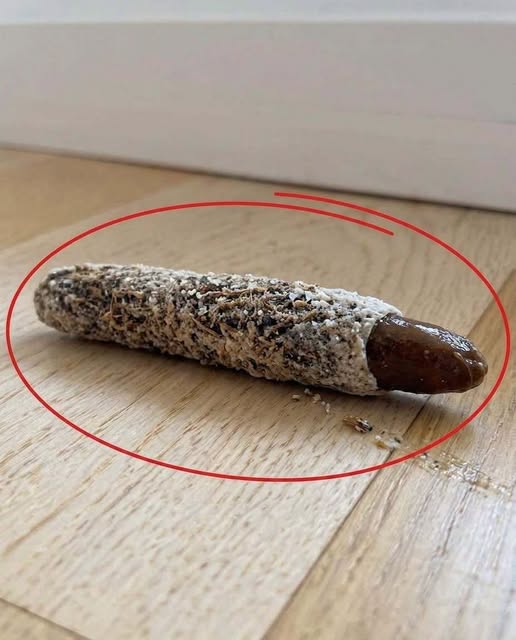
It looked completely harmless at first. Just a dull, dusty little tube lying on the floor, the kind of thing most people would sweep up or vacuum without giving it a second thought. But the longer I stared at it, the stranger it seemed. The shape was too organized. The texture looked almost woven together, and there was something oddly deliberate about the way the tiny fibers and particles formed a narrow protective shell. I leaned closer, trying to decide whether it was simply a clump of lint or something else entirely. Then someone quietly asked, “What if it came from an animal?” Suddenly, something I had almost thrown away became a mystery I needed to solve.
By the time I realized it wasn’t ordinary household debris, I was already completely invested. I picked it up carefully and examined it from different angles. The strange tube seemed to have a definite structure, almost as though every grain of dust, strand of hair, and tiny fiber had been deliberately selected and attached. It did not look manufactured, yet it also seemed far too organized to have formed accidentally.
My first thought was that perhaps it was part of an insect nest. Then I wondered whether something had hatched from it. The possibilities became increasingly uncomfortable the longer I looked. Finding an unfamiliar object inside your home has a way of making your imagination work overtime, especially when you begin wondering whether something might still be living inside it.
Research eventually led me to a fascinating explanation. The mysterious object appeared to be the protective case created by a case-bearing moth larva, commonly associated with what many people call a plaster bagworm. The tiny larva constructs a portable shelter around itself using materials it finds in its environment. Dust, hair, lint, fibers, and other tiny household particles can all become building materials.
Suddenly, the strange appearance made perfect sense.
What I had mistaken for random debris was actually a carefully assembled shelter.
The larva carries this little case as it moves, remaining protected inside while continuing to develop. Instead of building a permanent nest and remaining there, it effectively takes its home along with it. The case provides camouflage and physical protection, allowing the tiny creature to blend surprisingly well into the dusty corners and surfaces of a house.
That explained why it had been so easy to overlook. The materials used to construct the case were essentially the same materials already scattered around the environment. Against a wall, floor, baseboard, or dusty corner, the little structure could disappear into the background. Unless it moved—or someone happened to look closely—it might easily be mistaken for lint.
The discovery changed my initial reaction completely.
At first, the object had seemed unsettling because I did not understand what I was looking at. The unfamiliar shape made my mind jump toward danger. But once I understood how it had been constructed, the fear was replaced by curiosity. Something incredibly small had gathered ordinary fragments from my home and transformed them into a structure perfectly suited to its survival.
There was something almost impressive about it.
Materials I considered useless—dust, tiny fibers, loose hairs, forgotten fragments—had become valuable building supplies to another living creature. What looked like dirt from my perspective was shelter from another.
Of course, finding one indoors does not mean it needs to become a permanent roommate. Keeping floors, closets, baseboards, and quiet corners clean can reduce the lint, hair, fibers, and other material these larvae may use or feed around. Regular vacuuming and reducing humidity can also make indoor environments less inviting to many household insects.
But the experience left me thinking about something larger than pest control.
We move through our homes believing we understand everything around us. We recognize the furniture, appliances, walls, and objects because they exist at a scale we naturally notice. Yet underneath that familiar world is another one filled with tiny organisms living lives that can remain almost completely invisible to us.
A corner we consider empty may not actually be empty.
A piece of dust may not simply be dust.
And something we nearly sweep into the trash may contain an entire biological story.
What had initially seemed creepy gradually became quietly awe-inspiring. The little case was not some mysterious object designed to frighten me. It was an example of adaptation—a tiny creature using whatever its environment provided to protect itself.
Afterward, I found myself paying more attention to the small details around the house. Not with paranoia, but with curiosity. I realized how quickly we label unfamiliar things as dangerous simply because we do not understand them. Sometimes investigation confirms that caution is necessary. Other times, knowledge transforms something frightening into something fascinating.
That dusty little tube did exactly that.
It reminded me that nature does not stop at the front door. Tiny lives continue in cracks, corners, gardens, walls, and floors whether we notice them or not. Their world overlaps with ours constantly, even if we rarely stop long enough to see it.
And perhaps that was the strangest part of the discovery.
The object had been lying there in plain sight, looking like something completely insignificant.
But it wasn’t trash.
It was architecture.
It was protection.
It was a tiny mobile home constructed from the forgotten pieces of mine.
Sometimes the strangest discoveries are not warnings of danger at all. Sometimes they are simply invitations to look a little closer—and reminders that even something as ordinary as dust can become a home.