My name is Thomas. I’m thirty-seven, a neurosurgeon who practically lives out of a hospital locker and a single suitcase. My life is measured in four a.m. chart notes and tightly packed surgical schedules. I save nearly everything I earn—a habit formed from growing up surrounded by overdraft fees and the constant phrase, “we’ll figure it out next month.”
I was the child who learned to translate adult panic into calm reassurance. At ten years old, I would tell my crying mother, “it’s going to be okay,” while she stared at overdue rent notices piling up on the table. I became familiar with the taste of fear early on, and I learned how to be useful—how to fix things, how to steady situations, how to become the person everyone depended on.
Two weeks ago, my parents celebrated their fiftieth wedding anniversary. After fifty years filled with sacrifice, struggle, and constantly making do with less than they needed, I wanted to give them something meaningful—something that felt like a real victory. I wanted them to have a place where the air smelled like salt instead of stress, where the floors didn’t creak from age and neglect, where the view wasn’t dominated by stacks of unpaid bills on a kitchen table.
I found that place three months earlier while scrolling through real estate listings during a rare quiet moment between surgeries. It was a small blue house overlooking the water, slightly crooked but undeniably inviting. It had a white deck wrapping around two sides, two palm trees standing like sentries in front, and windows that captured the light in a way that made you want to pause and simply breathe. The listing called it “cozy” and “charming”—real estate shorthand for small and old—but I saw beyond that. I imagined my mother sipping her morning coffee on that deck. I pictured my father finally sleeping past six a.m. without waking at every small noise.
Four hundred twenty-five thousand dollars. I finalized the purchase within three weeks, placing it in their names through a carefully structured trust. I arranged all the utilities, had the house professionally cleaned, stocked the refrigerator with their favorite foods, and tucked a note into the silverware drawer that read: “For late mornings and loud laughter. Love, T.”
I didn’t tell anyone else about the house. Especially not my sister, Julia.
The plan was simple, almost surgical in its precision. I would drive down on their anniversary with a cake and a bottle of sparkling cider, hand them the keys, and watch their expressions change when they realized this wasn’t a rental or a temporary escape—it was theirs. Completely and permanently theirs.
But that’s not how things unfolded.
On the morning of their anniversary, I drove down the coastal highway with a rare sense of uncomplicated happiness filling my chest—a feeling I don’t experience often, given that I usually spend my time anticipating complications and preparing for worst-case scenarios. The ocean was impossibly clear, the sky wide and bright. When I pulled into the driveway, something immediately felt wrong. A black SUV I didn’t recognize was already parked there. The front door was wide open.
I grabbed the cake from the passenger seat and walked quickly toward the house, my medical instincts already running through possible emergencies. Maybe my father had fallen. Maybe something had gone wrong with the utilities. Maybe there had been a break-in.
I stepped through the doorway and stopped cold.
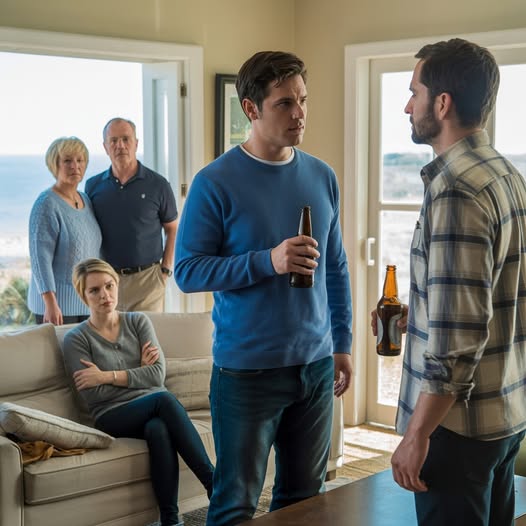
My mother stood in the kitchen holding a dish towel as if it were a white flag. Her eyes were red and swollen from crying. My father sat hunched in a dining chair, his shoulders caving inward, his hands trembling visibly against his knees. Moving boxes were scattered everywhere—lining the hallway, stacked against walls, blocking doorways. Loud voices echoed from deeper inside the house. A children’s cartoon blared from the television in the living room, which I hadn’t even had the chance to set up yet.
“Mom?” I managed, my voice sounding distant and unfamiliar even to me.
That’s when he appeared—Kyle, my brother-in-law. Barefoot, holding a beer bottle loosely in one hand, wearing a stained football jersey. He positioned himself directly in front of my father—my elderly, shaking father—pointed aggressively toward the front door, and shouted with startling hostility, “This is my house now. Get out!”
From the couch, partially hidden behind a pile of boxes, my sister Julia laughed. It wasn’t nervous or awkward—it was genuine amusement. “Oh my god, relax, Dad. We’re just settling in. Stop being so dramatic about everything.”
The plastic lid of the cake container pressed sharply into my palm. Inside me, everything went very, very quiet—the kind of silence that comes right before a crisis, when training takes over and emotion is set aside for later.
To understand this moment, you need to understand the pattern that led to it.
Julia is two years younger than me. Growing up, she was always cast in softer, more romantic roles—the artist, the free spirit, the dreamer who just needed more time, more support, one more opportunity to find her path. My parents sacrificed endlessly for her and defended her constantly. I did what I knew how to do—I filled in the gaps, covered what was missing, paid for what couldn’t otherwise be afforded.
It started with small things. Textbooks for one semester. Then tuition when her scholarship disappeared. Then a down payment for her first apartment, “just until Kyle’s startup takes off.” When that startup inevitably failed, the financial burden still somehow found its way back to me. Over the years, I paid for braces for her oldest child, financed a used minivan after her loan was denied, co-signed a lease following an eviction I wasn’t even supposed to know about. My Venmo history reads like a bleak journal: “Julia electric bill,” “Kyle interview clothes,” “rent—last time, I promise.”
Each transfer felt like control, like I was smoothing out the rough edges of our family’s life, preventing crises through sheer financial intervention. I was completely wrong.
My parents contributed too, in quieter but equally draining ways. My mother would load groceries into Julia’s car and call it “cleaning out the pantry.” My father let Kyle “practice” handyman work that always ended up costing more to repair properly later. The family narrative never changed: “You know your sister. Not everyone can be like you, Thomas. Not everyone has your advantages.”
My advantages. As if I hadn’t worked three jobs through college. As if I hadn’t spent my twenties in windowless libraries and exhausting hospital rotations while Julia drifted between creative pursuits and unrealistic business ideas.
When I found the beach house and decided to buy it for my parents, I approached it with the same precision I use in surgery. I created a trust that named my parents as lifetime beneficiaries with exclusive occupancy rights. I prepaid property taxes twenty years ahead. I covered the homeowners association fees through 2045. I replaced every lock and held the new keys in my hand like something fragile and invaluable—a lifeline for two people who had spent decades under financial strain.
I told my parents about the house one week before their anniversary. We drove there together on a foggy morning that slowly gave way to bright sunlight. My father ran his hand along the wooden banister as if it might disappear. My mother opened every cabinet in the kitchen and exhaled again and again, like she was relearning how to breathe. We sat together on the deck, listening to seagulls over the water.
“It’s yours,” I told them. “Legally and permanently. No one can take it from you.”
My father tried to respond, but his voice broke. My mother managed to say, “It smells like lemons and fresh air and possibility.”
I stayed overnight on an air mattress in the empty guest room, feeling a rare sense of contentment. The next morning, I drove back to the city for an emergency surgery on a six-year-old with a tumor. I left the house with my parents, completely certain they were safe, certain they finally had something secure.
Everything unraveled faster than I could have anticipated.
On their second day there, Julia called my mother. “Are you at a beach? Whose house is that?” My mother, who has never been able to lie convincingly, replied weakly, “Oh, we’re just visiting a friend from your father’s old job.”
By that same evening, Julia had figured out the exact address from a blurry sunset photo my father had posted on Facebook with the caption: “View from our porch. Blessed.”
The next day, she showed up with Kyle, their two children, an overly energetic dog, and a level of entitlement you could feel from the driveway—a mix of desperation, resentment, and indignation at being excluded.
Later, my mother told me over the phone, her voice small and defeated, “They said they just wanted to see it, to celebrate with us. Then they suggested staying for the weekend. I didn’t know how to say no, Thomas. They brought the children.”
“It’s not a vacation rental, Mom,” I said carefully, already feeling a familiar sense of dread settle in.
“I know, sweetheart. We’ll sort it out when you come this weekend.”
But by Saturday morning, my father texted: “There seems to be some confusion about the house. Julia keeps calling it the ‘family home’ and talking about reservations. Can you come soon?” Then came a call I missed because I was in surgery. Then came a Facebook post from Julia, taken in my parents’ kitchen: “Home sweet home. New chapter! #manifestingabundance #beachlife #blessed.”
The comments flooded in from people who didn’t know the reality. “You deserve this!” “Finally!” “So happy for you!” One comment from Kyle made my jaw tighten: “Finally, a place where the kids can be themselves without anyone complaining.”
The spot in my palm where I usually grip a scalpel began to itch. From the hospital parking lot, I texted my father: “Don’t sign anything. Don’t agree to anything. Stay calm. I’m coming. Love you.”
I drove there straight after finishing in the operating room, still in my scrubs, rehearsing calm, reasonable words. We’ll reset expectations. We’ll have a conversation. We’ll set boundaries. I walked through that open door ready to negotiate.
Instead, I walked in on Kyle in the middle of a rant, his voice already raised: “You two are old. These stairs aren’t safe for people your age. You’re going to fall and break something. This is clearly a family house, and we’re family, so we’ll manage it properly. You can visit during the off-season.”
My mother tried to say, “But Thomas gave it to us…”
Kyle cut her off with a dismissive gesture. “He gave it to you. You’re giving it to us. Same thing. Family helps family.”
Julia didn’t even get up from the couch. She just smirked. “Stop being so dramatic. We’ll handle bookings and maintenance. You two couldn’t manage a place like this anyway.”
“Bookings?” my father whispered.
Kyle gestured broadly toward the ocean. “Prime location, peak season coming. I listed it on Airbnb this morning. Easy income. You can stay in the downstairs room during the off-season.”
I looked at my father’s trembling hands. This was the man who once worked three jobs and still showed up to my school events in a stained uniform, refusing to miss them entirely. And now he was being told to step aside in his own home by someone who had never held a steady job.
I placed the anniversary cake on the counter. It looked absurd among fast-food wrappers and Julia’s scattered belongings. When I spoke, my voice was calm and precise—the same tone I use in the operating room.
“Who told you this is your house?”
Kyle rolled his eyes. “Family money means family house. Don’t make it weird, Thomas.”
Julia added lightly, “We’re not asking, we’re informing you of the new setup.”
My mother’s face crumpled. “Thomas, please explain—”
Kyle pointed toward the door again. “He can explain from outside. We need to talk.”
Julia laughed. “Relax, you’re scaring him. Dad knows we love him.”
My father said nothing. He just looked at me, humiliated and desperate. Something inside me settled with absolute finality.
“Everyone into the living room,” I said quietly but firmly. “Now.”
The kids paused their cartoon. The dog stopped chewing a pillow. Kyle scoffed but followed anyway.
I stood by the fireplace, my pulse steady, my hands controlled. From my bag, I took out a folder and placed five documents neatly on the table.
“This,” I said, tapping the first page, “is the deed, recorded last week. The property belongs to the Seaview Life Trust. The lifetime beneficiaries are Sam and Ruth”—I gestured toward my parents—“and they have exclusive occupancy rights. That means they live here. No one else.”
Kyle frowned at the document. “What does that even mean?”
“It means,” I said clearly, “you don’t get a key, Kyle. You don’t get access. You don’t get to be here.”
He laughed. “Okay. Try to stop me.”
I tapped the second document. “Trust instrument. I’m listed as the successor trustee. That gives me the legal authority and responsibility to maintain this property for my parents’ comfort and safety. It also gives me the obligation to remove anyone who interferes with that comfort and safety. That’s not a suggestion. It’s a legal responsibility.”
Julia’s tone shifted, turning overly sweet and patronizing. “Thomas, you cannot be serious right now. We’re helping them. They need us.”
I slid the third page forward—a full-color screenshot printed that same morning. “This is the Airbnb listing you posted six hours ago without permission, using photos of my parents’ private property. The description says ‘Entire Home.’ The house rules clearly state ‘No owner on site.’ The calendar shows every weekend blocked through August. And the payout account ends in digits that match yours, Kyle.”
Kyle shifted slightly, suddenly less comfortable. “So what? Your parents could use the money. We’d give them a share.”
I placed the fourth document on the table—a printed screenshot of a group text thread from the previous night that Julia didn’t know Dad had forwarded to me. Her message read: “We’ll get Tom on board eventually. He always caves if Mom cries enough. I’ll guilt him about those med school loans he loves to mention. God, I’m so excited to finally have a beach house base. Kyle and I deserve this.”
Julia reached for the paper, but I covered it calmly with my hand.
Then I set down the fifth document—a laminated copy of the HOA rules and regulations. I traced my finger along a highlighted clause: “Section 7.3: No short-term rentals of any kind permitted. Violations are subject to immediate legal action and daily fines.”
“Here’s what’s going to happen,” I said, keeping my voice steady and controlled. “You’re going to pack your things. Today. Right now. You’re going to delete that Airbnb listing. You’re going to contact every person who booked and issue full refunds. You’re going to apologize to Mom and Dad for frightening them in their own home. And when you leave, you’re going to place the house key on this table.”
Julia blinked several times, then laughed—a sharp, unsteady sound. “Or what, Tommy? What exactly are you going to do?”
“Or,” I replied calmly, “I’ll carry out my legal responsibility as trustee to protect this property and its rightful occupants.”
Kyle stepped closer, puffing his chest in what he clearly thought was intimidating. “Duty this, asshole.”
Mom’s voice trembled. “Kyle, please don’t—”
I don’t raise my voice. I don’t shout. I prefer precision. So I placed my phone face-up on the coffee table. The screen showed a drafted email to the HOA board with all attachments ready to send. Another email addressed to their legal counsel. A third to the county recorder’s office with the Airbnb link attached and a formal request to flag the property for illegal use. And an open text thread with a locksmith named Victor, whose last message read: “Parked outside. Ready when you are.”
Kyle looked at the phone, and some of the aggression drained from his posture. “You wouldn’t actually do that. You’re bluffing.”
“I’m not bluffing,” I said evenly. “I already called him. He’s been waiting in his van for twenty minutes.”
Julia turned to Mom, her voice suddenly desperate. “Mom, tell him! Tell him this is insane! We’re family! You can’t do this to family!”
Mom didn’t look at her. She looked at me, her voice shaking but firm. “Thomas, do what you need to do.”
Kyle’s face flushed red with anger. He pointed at Dad again. “Old man, I said get out of—”
I stepped between them, close enough that he had to tilt his head slightly to meet my eyes. My hands were completely steady. “Point at my father again,” I said quietly, “and the only door you’re walking through is the one Victor is about to lock from the outside.”
Silence filled the room. Even the television had gone to commercial.
Julia made one final attempt, her voice soft and wounded. “You’re cruel, Thomas. You’re choosing a house over your own family.”
I took a slow breath. “I’m done being your wallet, Julia. That’s not cruelty. That’s a boundary.”
Kyle muttered, “We’ll see about that,” and lunged toward the documents. I calmly gathered them, turned to my father, and asked clearly, “Dad, do you want to stay in your own living room?”
He swallowed and nodded. “Yes.”
“Then anyone who doesn’t live here needs to pack. Now.”
No one moved. Then the doorbell rang—Victor, right on time.
The process of getting them out took three long hours of reluctant, resentful packing. Victor replaced the deadbolt and added a security chain while Kyle threw what could only be described as a quiet tantrum outside—muttering angrily, kicking the curb, slamming the SUV’s trunk over and over. The dog barked nonstop. The kids moved quietly, embarrassed, stuffing clothes into bags and occasionally glancing at me like they expected me to explode.
I didn’t. I sat at the kitchen table with Mom and made tea, my hands steady.
“I didn’t want to bother you,” she said softly, staring into her cup. “I thought we could fix it somehow. They came in so quickly, Thomas. They said it would be easier if they handled everything. Less stress for us.”
“The difficult parts are what make something ours,” I said gently. “Taking care of it, making decisions—that’s what makes it a home.”
She nodded, guilt flickering across her face—for not stopping it sooner, for feeling relieved, for needing help.
Dad stood by the window, looking out at the ocean. “I should have been stronger,” he said quietly. “I should have told them to leave.”
“You called me,” I said. “That was the strong part.”
In the living room, I opened my laptop and canceled every unauthorized booking. “Listing removed. Full refund issued. Apologies for the inconvenience.” For the one guest who threatened a negative review, I attached the HOA regulations.
Julia cycled through different approaches as reality set in. First: “We were just excited for them! I wanted the kids to spend more time with their grandparents!” Second: “It’s logical! You’re never here, they’re getting older, we have the energy to maintain it!” Third, when nothing worked: “You think money makes you the parent now? You just buy things so you don’t have to actually show up.”
“I bought a house for our parents,” I replied calmly. “I didn’t buy permission for you to take it.”
She flinched at the word “take,” then hardened. “You’ll regret this.”
“I hope you remember it,” I said. “Maybe it’ll help you make better choices.”
Kyle refused to hand over the key, dangling it with a smirk. It didn’t matter—Victor had already installed a new keypad lock. I stepped past him, entered a temporary code, and reprogrammed it to a number Dad chose while Kyle watched his leverage disappear.
“You think you’re clever with your legal tricks?” Kyle snapped. “I know people.”
“I know the county clerk personally,” I replied evenly. “And your people will tell you the same thing—a properly executed trust wins every time.”
When they finally packed the last box, Julia paused at the door. “You could have just talked to me like an adult,” she said.
“I’ve been talking to you for ten years,” I answered. “You just never listened.”
Her expression tightened. “You’ll regret this when they really need help and you’re not around.”
I glanced at Mom in the kitchen and Dad finally sitting calmly in his chair. “I am around,” I said quietly. “For them.”
They drove away, leaving behind silence. And in that silence, the house seemed to settle—the air lighter, calmer. The ocean could be heard again. My parents’ breathing was steady.
I cleaned each room, gathering the remnants they left behind. In the guest room, I found a printed “business plan” Kyle had made—projected rental profits far exceeding the HOA fines. In the margin, Julia had written: “Tom won’t say no if Mom cries. He never does.”
I set the paper down carefully.
Mom kept apologizing. I kept saying, “It’s just a mess. Messes can be cleaned.”
That evening, we ate dinner on the deck—simple takeout, nothing fancy. Mom told stories. Dad laughed freely. My phone buzzed nonstop with messages from Julia and Kyle, but I ignored them.
That night, I secured the house—alarm system, cameras, documents organized and labeled.
The next morning, as I prepared to leave, Mom stood in the doorway. “I’m sorry it came to this,” she said.
“I’m not,” I replied. “This should have happened a long time ago.”
The following week, Julia tried to control the narrative online—accusations, emotional posts, blame. I didn’t respond. I sent one email: formal, clear, final. Any further interference would result in legal action.
Two days later, Kyle tried to relist the house. I reported it. The listing was removed within minutes.
I didn’t feel victorious—just tired, like I was cleaning the same mess again and again.
Then came small moments. Dad saying he slept through the night. Mom sending a photo of her feet on the deck with the caption: “Light.”
Julia called once more, asking for help, trying to pull me back in. I refused. Calmly, clearly.
“Boundaries are how I can still be your brother without losing myself,” I told her.
Months passed. Then came a letter—not an apology, but an explanation. I read it in silence and filed it away with everything else. Evidence.
Later, Dad had a minor stroke. Recovery was good, but it shook everything. While they stayed near the hospital, the beach house sat empty.
One night, a security alert came through. Motion detected. It was Kyle—with a crowbar.
I called the police.
They caught him within minutes. Evidence was clear. He’d come to break in, with a list of items to take.
Julia called, hysterical, begging for help. I didn’t give it.
“He made his choice,” I said.
The legal consequences followed. Restraining orders. Probation. Silence afterward.
When Dad recovered, I brought them home. The house was still there, unchanged, waiting.
“It waited for us,” he said.
“It did,” I answered.
I stayed for a while, fixing small things, helping them settle back in. One evening, Dad asked, “Who takes care of you?”
I didn’t have an answer.
Because being the one who fixes everything comes with a cost—time, peace, relationships you never get to build. You become the safety net, and eventually you realize no one is holding you up.
But slowly, that’s changing.
On my thirty-eighth birthday, we sat on the deck, eating cake, watching the sunset. No emergencies. No chaos. Just quiet.
Later, I stood outside, looking in. My parents were calm, safe, at peace. The ocean moved steadily in the background.
And in that moment, everything made sense.
Love isn’t protecting someone from the consequences of their behavior. It isn’t sacrificing yourself to keep chaos alive. Love is structure. Safety. Boundaries that hold.
I am not their bank. I am not their escape route. I am not responsible for fixing what others choose to break.
I am a surgeon. I am a son. And I am learning to make space for my own life.
The house stands. The doors lock. The air is calm.
My parents are safe.
And finally, so am I.
A gift should not cost you who you are. And a boundary is not cruelty—it is what allows love to exist without destroying everything around it.
The house has light. The doors are secure. My parents are safe.
And that is what winning looks like.