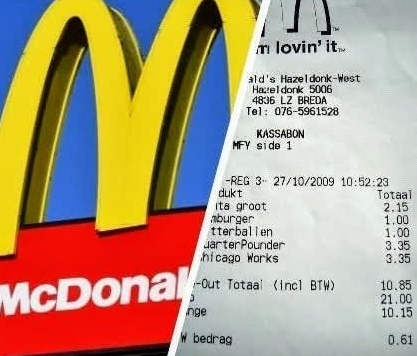
When your fries arrive cold, your burger tastes stale, and the soda is flat, it’s tempting to think it’s just bad luck, an off day, or an accident in the kitchen. But in most fast-food chains, including giants like McDonald’s, this is rarely random. There’s a method to the routine, a rhythm of kitchen and counter operations that often prioritizes speed over perfection, and over time, mistakes slip in unnoticed. The staff is trained to handle a constant stream of orders as efficiently as possible, often juggling multiple trays, registers, and drive-thru tickets all at once. But hidden in plain sight, there’s a subtle lever that can change everything almost instantly: a simple, seemingly mundane request—asking for your receipt.
That tiny slip of paper is more than proof of purchase. It’s a signal, a quiet trigger that sets off a chain reaction behind the counter. The moment you request it, even if casually, employees register it. In their minds, you might not just be a regular customer; you might be someone who matters in a very different way. You could be a mystery shopper, or as insiders call them, a “Gapbuster.” And to the untrained eye, it looks like a regular order. To those who know, it’s a potential audit, a hidden evaluation, and possibly a report that could affect their paychecks, schedules, and even job security.
Mystery shoppers are trained to blend seamlessly into the crowd. They arrive unannounced, place orders like any normal customer, and observe everything—the cleanliness of the tables, the friendliness of the staff, the speed and accuracy of the order, and even the temperature and freshness of the food. They often jot down notes immediately, sometimes while standing casually at a table or even at the counter. They might pay no more than a normal customer, but their evaluation can reach management and directly influence bonuses, disciplinary actions, or recognition for employees. And most of the time, the only hint staff get is subtle: the customer asking for a receipt, watching quietly, paying extra attention to every detail.
When you ask for that slip of paper, it quietly changes the energy behind the counter. Employees suddenly become hyper-aware, checking your order with more scrutiny, making sure that each fry is crisp, each burger hot, and each drink correctly filled. They might remake a sandwich if it looks tired, swap fries that have cooled, or polish a tray before sliding it down to you. Their smiles might be slightly wider, their movements a fraction more deliberate, and their communication with coworkers sharper. You’ve become, without ever needing to raise your voice or write a complaint, an invisible overseer, a living standard of excellence they hope to impress.
There’s also a psychological layer here. Workers in fast food are often under immense pressure: the clock is always ticking, rushes hit unpredictably, and mistakes are easy to make. A customer quietly signaling that someone is watching triggers their performance instinct. Suddenly, the mundane becomes important, the ordinary becomes meticulous, and the atmosphere shifts from routine to careful attention. You’re not just ordering food—you’re invoking a subtle but powerful accountability mechanism. Even without knowing it, the staff is responding to the possibility that someone’s evaluation will follow every action, every gesture, every bite of food they prepare.
Over time, the impact is tangible. Orders that might have otherwise been forgotten, served cold or incorrectly, are corrected. Fries come out piping hot, burgers assembled with care, and drinks properly filled. Service, which might have felt routine or indifferent moments ago, now carries a light of attentiveness, a hint that the staff is putting in an extra layer of effort. The act of asking for a receipt doesn’t just ensure you get your money’s worth—it elevates the entire interaction, creating a micro-environment of quality and attention in a space often defined by speed and efficiency.
Even more interesting is how this small gesture affects the staff beyond a single transaction. Knowing that someone might be paying attention encourages a culture of diligence that can ripple through a shift. Colleagues check each other’s work, team communication improves, and the overall quality of service subtly rises. All of this occurs without confrontation, without complaints, and without overt pressure—simply because a single, unassuming customer signaled that they were observing.
So the next time your fries feel cold or your burger seems uninspired, consider this quiet tool. Asking for your receipt is not just an administrative formality; it’s a lever of accountability, a reminder that even in a high-speed, high-volume environment, small signals can produce outsized results. It doesn’t require judgment, confrontation, or even suspicion. You don’t need to identify yourself as a mystery shopper. The act alone, small and civil, carries weight.
By the time your tray arrives with hot fries, a perfectly assembled burger, and an accurately filled drink, you’ve already influenced behavior, improved service, and quietly shaped the staff’s attention. The receipt in your hand is more than a piece of paper—it’s proof of a tiny intervention, a quiet nudge that elevated an ordinary exchange into something more deliberate, precise, and considerate. In the fast-paced world of fast food, that small slip of paper wields more power than most customers ever realize, turning routine service into excellence, one order at a time.