Few things are more frustrating than staring at a sealed can of food when you’re hungry and have no can opener. Whether you’re camping, dealing with a power outage, traveling, or facing an unexpected emergency, a simple metal can can suddenly feel impossible to open. Fortunately, a few practical techniques can help you access the food inside using common objects you may already have. While these methods require patience and care, they can be useful when no proper can opener is available. The most important priority is always to avoid injury, since the metal edges created during the process can be extremely sharp.
A can opener is designed to cut through the lid safely.
Without one, the goal becomes weakening the sealed edge until the lid can be lifted away.
Several everyday objects can accomplish this through friction or controlled pressure.
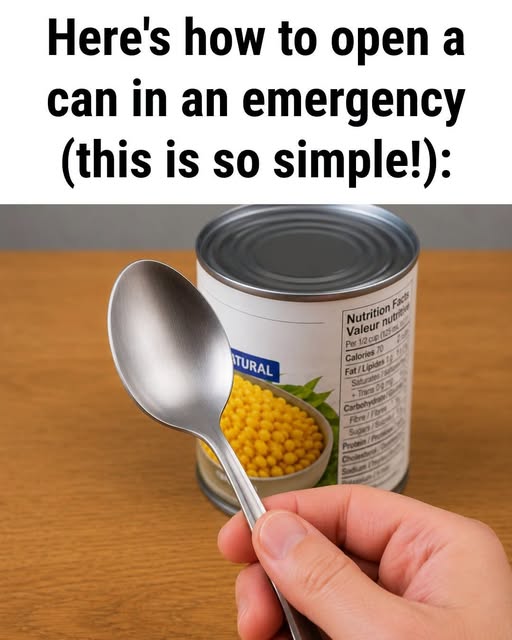
One of the safest emergency methods involves using a sturdy metal spoon.
Hold the can securely on a stable surface.
Grip the spoon firmly by the handle.
Place the tip of the spoon against the inner edge of the lid where it meets the rim.
Rub the spoon back and forth using steady pressure.
Rather than trying to puncture the lid immediately, allow the friction to slowly wear away the thin metal.
After several minutes of consistent movement, the metal will begin to weaken.
Eventually, the spoon can break through the lid.
From there, continue working around the edge until enough of the seal has been opened to carefully lift the lid.
The process requires patience.
Trying to rush often makes the task more difficult.
If a sturdy kitchen knife is available, another method may work.
Only use a knife with a solid, stable blade that provides good control.
Avoid thin or flexible blades that can slip easily.
Place the can on a flat, secure surface.
Position the heel of the knife—the thickest part closest to the handle—against the groove near the edge of the lid.
Apply firm downward pressure while maintaining complete control of the knife.
The objective is to create a small opening.
Continue making additional openings around the rim until the lid loosens.
Because knives can slip unexpectedly, this method should be performed with extreme caution.
Keeping fingers away from the cutting area greatly reduces the risk of injury.
In true survival situations, even rough concrete or a large flat rock can become a useful tool.
Turn the can upside down.
Rub the sealed rim against the rough surface using steady, even pressure.
The friction gradually wears away the folded edge that creates the seal.
Continue until moisture begins to appear around the rim, indicating the seal has become thin enough to break.
At that point, gently squeeze the sides of the can.
In many cases, the pressure will loosen the lid enough to open it.
This technique requires time and persistence but uses no specialized tools.
Regardless of the method used, sharp metal edges become the greatest hazard.
The lid and rim may develop razor-like edges capable of causing deep cuts.
Always handle opened cans carefully.
Whenever possible, use a cloth or gloves to protect your hands while removing the lid.
Food safety is equally important.
If the can has been punctured accidentally before opening, appears swollen, badly dented near the seams, leaking, or shows signs of rust that compromise the seal, it may no longer be safe to eat.
Damaged cans can sometimes allow harmful bacteria to enter.
When there is reason to believe the contents have spoiled, it is safest not to consume them.
Planning ahead remains the easiest solution.
Packing a compact can opener while camping or storing one with emergency supplies eliminates much of the uncertainty.
Many multitools and survival kits include lightweight openers that occupy very little space while providing a much safer option than improvised methods.
Emergency preparedness often comes down to small details.
A flashlight with fresh batteries.
Clean drinking water.
Basic first-aid supplies.
A simple manual can opener.
Items that seem insignificant during everyday life can become invaluable when unexpected situations arise.
Resourcefulness is an important survival skill, but it works best when combined with preparation.
Knowing several safe methods for opening a can without specialized equipment can provide confidence during an emergency, yet prevention remains preferable whenever possible.
Packing the right tools before leaving home is always easier than improvising later.
Still, when circumstances leave you with nothing more than determination and a sealed can of food, these practical techniques demonstrate that patience, careful thinking, and calm decision-making can often overcome challenges that initially seem impossible. Sometimes the most valuable survival tool isn’t a piece of equipment at all—it’s the ability to adapt safely with the resources already within your reach.