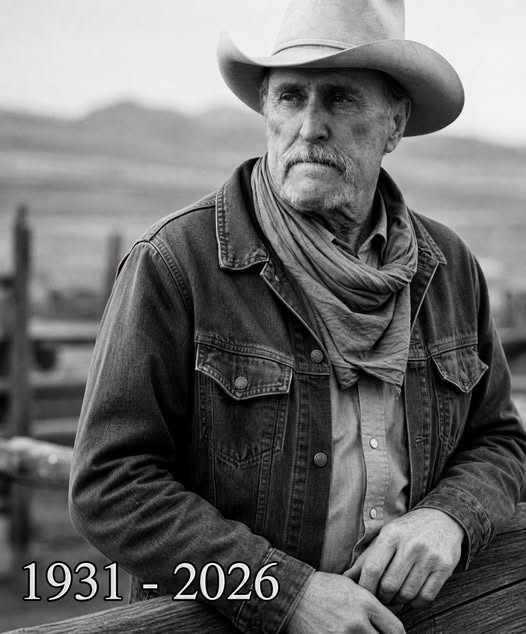
He was the quiet storm of American cinema. For more than half a century, Robert Duvall didn’t simply play characters—he disappeared inside them. From Tom Hagen’s controlled loyalty in *The Godfather* to broken men desperately searching for grace, he developed a style of acting that felt less like performance and more like observation. Now, after his death at 95 on February 15, 2026, at his home in Middleburg, Virginia, Hollywood is grieving the loss of one of the most respected screen actors of his generation.
Duvall’s death closes a chapter in American film history that stretched across nearly seven decades. He was never the loudest presence in a room and never depended on the traditional image of a glamorous movie star. His power came from something quieter. He could stand in the background, say very little, and somehow make the entire scene feel heavier. Audiences sensed that there was always another story happening behind his eyes.
As Tom Hagen in *The Godfather* and *The Godfather Part II*, Duvall demonstrated that restraint could be more powerful than aggression. Hagen was controlled, intelligent, loyal, and dangerous without needing to announce any of those qualities. Duvall made stillness feel like action. A glance, a pause, or a carefully chosen sentence could communicate fear, calculation, affection, and betrayal all at once.
That ability became one of the defining characteristics of his career. Duvall had a rare talent for making complicated people feel completely real. His characters were rarely simple heroes or villains. They were damaged, proud, frightened, stubborn, loving, violent, lonely, or searching for redemption. Often, they carried several of those qualities at once.
In *Apocalypse Now*, he became Lieutenant Colonel Bill Kilgore, a larger-than-life military officer whose strange combination of confidence, brutality, and absurdity produced one of cinema’s most unforgettable performances. Kilgore could be terrifying one moment and almost comical the next. Duvall never played him as a caricature. He made the character feel like a real person who had convinced himself that the chaos around him made perfect sense.
Then came *Tender Mercies*, perhaps one of the clearest demonstrations of how deeply Duvall could disappear into a character. As Mac Sledge, a washed-up country singer trying to rebuild his life, he stripped away almost everything audiences associated with the powerful men he had played before. The performance was quiet, vulnerable, and deeply human. It earned him the Academy Award for Best Actor.
The contrast between Kilgore and Sledge revealed the extraordinary range beneath Duvall’s restrained style. He could dominate a scene without raising his voice, but he could also make silence heartbreaking. His characters often seemed to exist beyond the frame, as if they had lived entire lives before the camera arrived and would continue living after the scene ended.
That quality followed him into *The Great Santini*, where he played an authoritarian Marine father whose strength and cruelty were inseparable from his own damaged sense of identity. The character was difficult to watch because Duvall refused to make him easy to dismiss. Beneath the anger was insecurity. Beneath the authority was fear. Beneath the aggression was a man who didn’t know how to love without controlling.
Again and again, Duvall returned to people like that.
Wounded people.
Complicated people.
People who had made mistakes and weren’t sure whether redemption was still possible.
In *The Apostle*, he played another deeply flawed man struggling with faith, violence, guilt, and the possibility of starting over. He didn’t merely perform the character’s emotional collapse; he made it feel physical, uncomfortable, and painfully believable.
That was Duvall’s gift.
He didn’t ask audiences to admire his characters.
He asked them to understand them.
Across more than 85 films, his roles ranged from gangsters and soldiers to preachers, cowboys, fathers, lawyers, farmers, and broken men searching for another chance. His filmography included *To Kill a Mockingbird*, *M*A*S*H*, *Network*, *The Great Santini*, *Tender Mercies*, *The Apostle*, *Lonesome Dove*, and many others.
He was also famously committed to authenticity. Duvall studied dialects, observed the people who inspired his characters, and immersed himself in the environments where his stories took place. When working on Southern films, he reportedly spent time traveling rural roads and listening carefully to how people actually spoke. His performances often carried that specificity, making characters feel as though they belonged to a particular place rather than simply existing inside a screenplay.
Colleagues came to regard him as an actor’s actor because he approached the craft with unusual seriousness. He wasn’t interested in simply looking convincing. He wanted to understand the person underneath the words. That dedication helped explain why his performances remained memorable even when he wasn’t the central character.
Duvall also resisted the idea that acting required constant display. He understood that people often reveal themselves through what they don’t say. A pause could reveal fear. A glance could reveal resentment. A silence could communicate grief more honestly than a speech.
That philosophy made his work age remarkably well.
Decades after audiences first saw him, his performances still feel alive because they aren’t dependent on trends. There is no exaggerated theatricality that dates them. There is simply a human being struggling with another human being.
His career was also unusually long. He continued working well into his later years, proving that character actors don’t necessarily have to disappear when Hollywood moves on to younger stars. He remained curious about stories and people, continuing to take roles whenever something genuinely interested him.
Yet his importance extends beyond individual films.
Duvall belonged to a generation that helped redefine American screen acting. Alongside performers such as Al Pacino, Gene Hackman, Robert De Niro, and others, he helped establish a style in which naturalism, psychological complexity, and emotional restraint could become as powerful as traditional movie-star charisma.
He didn’t need to look invincible.
He needed to look human.
And that may be why audiences trusted him so completely.
When Robert Duvall appeared on screen, viewers believed there was a life behind the character. They believed the character had memories, regrets, secrets, and desires that existed beyond the story being shown. Even when he played a supporting role, he could make the fictional world feel larger simply by being inside it.
His wife, Luciana Duvall, announced that he died peacefully at home, surrounded by love and comfort. In her tribute, she described his passion for his craft and his dedication to the truth of the human spirit represented by his characters.
That description may be the simplest way to understand his legacy.
Robert Duvall spent his career searching for the truth inside fictional people.
He played men who were powerful and men who were powerless. Men who were violent, men who were broken, men who were proud, and men who were desperate to be forgiven. He found humanity in characters audiences might otherwise have dismissed.
And when the credits rolled, the character disappeared.
But Duvall’s work remained.
The voices remained.
The faces remained.
The silences remained.
The scenes that once seemed like ordinary moments became pieces of film history.
Now Hollywood must reckon with the absence of a man who spent his life making other people believable. The industry has lost one of its great craftsmen, but audiences haven’t lost the characters he gave them. They will continue appearing on screens, in memories, and in conversations between generations of movie lovers.
Robert Duvall didn’t need to be the loudest actor in the room.
He didn’t need to demand attention.
He simply stepped into a role, found the human being buried inside it, and made that person impossible to forget.
At 95, the man is gone.
But the lives he inhabited remain.
And long after the final tribute fades, Robert Duvall’s greatest achievement will still be there in the films themselves—the quiet, extraordinary proof that sometimes the most powerful performance is the one that makes you forget you’re watching an actor at all.