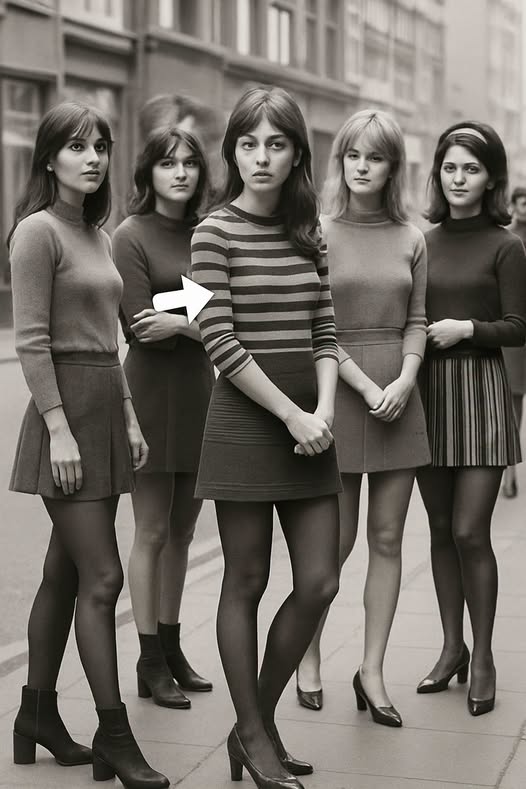
At first, you swear it’s nothing.
Just a faded street scene from another era. A row of young women standing together, frozen in a moment that seems completely ordinary. Their skirts swing at nearly the same height, their hair is carefully arranged, and their expressions carry the distant stillness of an old photograph. It looks like the kind of image your eyes might skim past in a dusty attic box without giving it a second thought.
But something refuses to let you move on.
There is a quiet wrongness hiding inside the frame.
You look again.
Then a little closer.
Your gaze drops toward their legs, and suddenly the ordinary scene begins to feel strangely artificial. Their poses seem too similar. Their movements appear too synchronized. The proportions look almost impossibly consistent, as though someone had taken the same person and carefully placed her into different positions.
For a moment, you think you have solved the mystery.
You haven’t.
Because the real shock is waiting higher up.
You look at their faces, expecting to find small differences—the natural variations you would expect when several people stand together. Instead, the details begin to line up. The eyes. The nose. The mouth. The shape of the face. The expression.
The resemblance is not merely striking.
It is exact.
What initially looks like a group of women slowly reveals itself as something much stranger: the same woman appearing again and again, repeated throughout the scene with extraordinary precision.
And that realization changes everything.
Suddenly, the photograph is no longer simply an old snapshot of young women gathered together. It becomes a visual puzzle. Your brain begins scanning the image differently, searching for the tiny clues that might reveal the trick.
Who are these women?
Why do they look identical?
And perhaps the most fascinating question of all:
**How was this done?**
The answer becomes even more impressive when you remember when such an image could have been created.
There was no Photoshop.
No digital cloning tool.
No computer screen where a photographer could effortlessly duplicate a person, move her across the frame, erase unwanted edges, and correct mistakes with a few clicks.
The illusion had to be built physically.
It required planning, patience, precision, and an almost obsessive attention to detail.
The photographer had to think several steps ahead. The subject had to be positioned, photographed, moved, photographed again, and eventually combined into a single convincing composition. Every exposure had to be considered carefully. Lighting, perspective, shadows, posture, clothing, and the surrounding environment all had to cooperate.
A small mistake could destroy the illusion.
If one figure was slightly too large, the deception could become obvious. If the lighting changed between exposures, the image could look unnatural. If the subject stood at the wrong angle, the repeated identity might be noticed immediately.
The photographer therefore wasn’t simply taking a picture.
They were constructing one.
Time itself became part of the process.
The same person had to effectively become several people, appearing in different positions within what looked like a single moment. Each exposure contributed another piece to the final image, creating the illusion that several individuals had gathered together naturally.
And that is what makes the photograph so unsettling.
Nothing about it screams for attention.
There is no monstrous face in the background. No obvious supernatural figure. No grotesque distortion announcing that something is wrong.
Instead, the image looks almost completely normal.
That normality is what makes the trick work.
Your brain sees a group of women and automatically categorizes them as separate individuals. You don’t initially question whether their faces belong to different people because your mind expects difference to exist.
We are used to seeing groups.
We assume that every face belongs to another person.
We rarely stop to compare every eye, every nose, every mouth.
The photograph exploits that assumption.
It takes something your brain normally does automatically and quietly turns it against you.
At first, you see a crowd.
Then you see a pattern.
Then you realize the pattern is impossible.
And once you notice it, you can never look at the photograph the same way again.
The faces, which initially seemed only vaguely similar, suddenly resolve into a single identity repeated with almost surgical precision. The women aren’t merely sisters who resemble one another. They aren’t a group of people who happen to share similar features.
They are one person, multiplied.
One face occupying several bodies.
One identity rearranged throughout a scene.
The photograph stops functioning as a simple memory and becomes a riddle.
Not **“Who are they?”**
But **“How was this done?”**
That distinction is important because the image reveals something deeper about photography itself. We often treat photographs as evidence—as frozen pieces of reality that prove something happened exactly as we see it.
But photographs have never been reality itself.
They are constructed representations of reality.
Even before digital editing existed, photographers could manipulate what viewers believed they were seeing through exposure techniques, composition, double exposures, darkroom processes, staging, and careful planning.
The tools were different.
The principle was the same.
Control what the viewer sees, and you can influence what the viewer believes.
This particular illusion demonstrates just how far that principle can go.
The photographer didn’t need sophisticated modern technology to create something that feels almost impossible. They needed patience and an understanding of how the camera records a scene.
They also needed restraint.
The trick had to remain subtle.
If the image looked obviously manipulated, the illusion would fail. The goal was not to make viewers immediately suspicious. The goal was to make them accept the scene as ordinary for long enough that the discovery would come as a genuine shock.
That is why the quietness of the photograph is so effective.
Nothing announces the deception.
You have to find it yourself.
And once you do, the entire composition seems to rearrange itself inside your mind.
The photograph becomes a reminder that seeing is not always the same as observing.
Our eyes can take in an enormous amount of information while our brains quietly filter most of it away. We recognize a street, a group, a face, a familiar setting—and then we move on. We don’t necessarily inspect every detail.
That is usually useful.
But in an image like this, it becomes the weakness the illusion depends upon.
The photograph asks you to slow down.
To compare.
To question.
To look at something you thought you already understood and ask whether your first impression was actually correct.
And perhaps that is the final, most elegant cruelty of the trick.
The photographer didn’t need to fool your eyes completely.
They only needed to let your assumptions do most of the work.
You supplied the missing differences yourself.
You assumed separate women because the scene told you there should be separate women. You accepted the photograph because it looked ordinary. You trusted the surface because nothing immediately demanded deeper inspection.
Then, suddenly, you notice the face.
And the illusion collapses.
What seemed like a simple historical photograph becomes an extraordinary demonstration of patience, craftsmanship, and human perception.
It reminds us that reality can be bent without looking obviously broken.
Sometimes the most convincing deception is the one that looks completely normal.
And sometimes, the strangest thing hiding in an old photograph isn’t a ghost, a monster, or a mysterious figure in the background.
It’s the realization that you were looking directly at the answer the entire time—and simply didn’t look closely enough to see it.