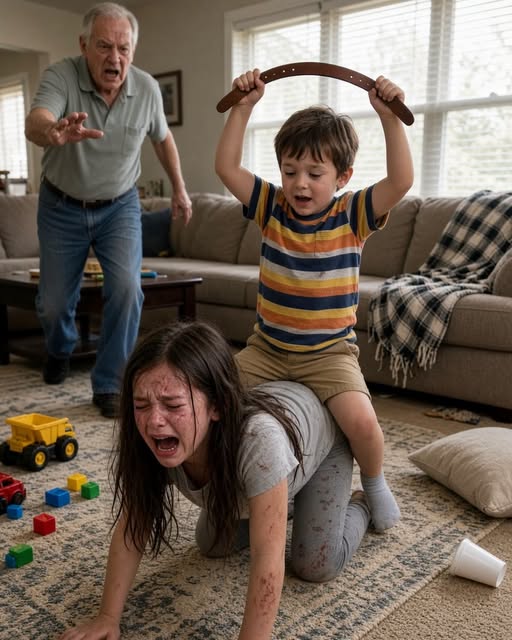
The officer read my father’s message twice before handing the phone back to me.
“You bring her home tonight, or everything you own stays in my house.”
My daughter was still in the hospital bed, her small hand wrapped around two of my fingers. She had finally fallen asleep, but every time someone opened the door, her eyes would flutter as if she expected to see my father standing there.
The officer lowered his voice.
“Don’t respond. We’re going back with you.”
I nodded.
Until that moment, I had been thinking about getting my daughter’s clothes, her school things, the few photographs we had left in my father’s house, and whatever documents I could safely collect. I had been thinking about the practical things because practical things were easier to think about than what had happened on that living-room floor.
But now there was something else.
The family videos.
Eleven clips.
My father had recorded my daughter crawling while my nephew rode on her back. In each clip, the belt was visible. In several, her exhaustion was obvious. When she stopped, his voice ordered her to continue.
And my relatives had watched.
Some had laughed.
Some had said nothing.
One had called it a strict house.
I had spent years believing my father’s control was a private family problem. Now I understood that he had been willing to turn my daughter’s suffering into something other people could watch.
The officer and I returned to the house that afternoon.
My father was waiting in the driveway.
He didn’t look frightened anymore. He looked prepared.
“I told her she couldn’t take anything,” he said before I had even stepped out of the car.
The officer closed his door.
“This isn’t a property dispute right now.”
My father pointed toward the house.
“She has been living here without paying rent. Everything inside belongs to me.”
The officer didn’t argue with him.
“Your property can be dealt with separately. We’re here because of the child.”
My father glanced at me.
“You really brought the police to my house?”
I kept my eyes on the front door.
“I brought them because you hurt my daughter.”
He started talking faster.
He said I was exaggerating. He said the belt had barely touched her. He said children needed discipline. He said my daughter had always been sensitive. He said the videos had been taken out of context.
Then he said something that made me stop.
“She was laughing earlier.”
I looked at him.
“So you admit you filmed it?”
His mouth closed.
The officer stepped forward.
“We already have the videos.”
My father stared at him.
For the first time, he seemed to understand that the recordings were no longer something he controlled.
We went inside with an officer present.
I expected to feel afraid.
Instead, I felt strangely detached.
The same hallway that had once made me lower my voice now looked ordinary. The same living room where my daughter had been forced to crawl contained the same couch, the same television, the same toys scattered near the wall.
Nothing in the room looked capable of explaining what had happened there.
That was the part I couldn’t forget.
Cruelty could happen in an ordinary room and leave the furniture looking untouched.
My daughter’s backpack was in the bedroom.
I put it into a bag.
Her schoolbooks went next. Then her jacket. Her favorite stuffed animal was under the bed, and when I pulled it out, I remembered how she had asked me two weeks earlier whether we could leave Grandpa’s house someday.
I had told her we would.
I had meant it.
I just hadn’t known how soon.
From the hallway, I heard my father speaking with the officer.
Then I heard another voice.
My nephew.
He was standing near the doorway, holding his hands together.
The officer crouched slightly so they were closer to eye level.
“Do you want to tell me anything about what happened?”
The boy looked toward my father.
My father immediately said, “He doesn’t need to say anything.”
The officer looked at him.
“I’m asking him.”
The boy swallowed.
“He told her she had to keep going.”
My father shook his head.
“That isn’t what happened.”
The boy continued.
“He said Grandpa would hit her again if she stopped.”
My father took one step forward.
The officer raised a hand.
“Stay there.”
The boy’s face tightened.
Then he added something I hadn’t heard before.
“Grandpa said Mommy wouldn’t believe her.”
My hands stopped moving.
I looked at my father.
He didn’t answer.
The officer made a note.
I didn’t ask the boy anything else.
There were already adults whose job it was to document what the children said without turning them into witnesses for the family’s arguments.
I finished packing.
Before leaving, I walked into the living room one last time.
The belt was gone.
My father had put it away.
But the room didn’t feel safer.
I stood there for a moment and remembered the way my daughter had gone silent after screaming. I remembered carrying her outside. I remembered my neighbor holding her phone. I remembered my father’s expression changing only when another person saw him.
Then I noticed the television remote on the coffee table.
Beside it was my father’s phone charger.
Nothing unusual.
Nothing important.
Except that my father had spent years insisting that nobody had the right to question what happened inside his house.
And now there were recordings.
There were witnesses.
There were medical photographs.
There was my daughter’s statement.
There was the boy’s statement.
There were messages from relatives telling me not to destroy the family.
And there was my father’s own message demanding that I return.
The evidence wasn’t one dramatic piece.
It was a chain.
My father had created part of that chain himself.
When we reached the hospital again, the social worker asked whether I had somewhere safe to stay.
I said I could stay with a friend temporarily.
She nodded and began helping me work through the practical arrangements.
My daughter woke while we were talking.
She looked at me immediately.
“Are we going back?”
“No.”
“Not even tomorrow?”
“No.”
She looked at the social worker, then back at me.
“Can Grandpa come here?”
I shook my head.
“Not right now.”
She pulled the blanket higher.
Then she asked the question that broke something open inside me.
“Did I do something bad?”
I sat down beside her.
“No.”
She looked at me carefully, as though deciding whether I really meant it.
“You didn’t do anything to deserve that.”
Her eyes filled.
This time she cried.
I let her.
I didn’t tell her to be brave. I didn’t tell her it was over because I couldn’t promise that every consequence would disappear quickly. I only held her hand and stayed there.
Over the next two days, the family messages continued.
One relative said my father had made a mistake.
Another said I should think about his age.
Someone else said the videos were embarrassing for everyone and asked me to stop sending them to people.
I hadn’t sent them anywhere.
The officer already had them.
That distinction mattered.
The family wanted the problem contained inside the family.
But the recordings had already crossed that boundary.
Then my cousin called.
She was the person who had warned me not to delete the group chat.
“I found something else,” she said.
I sat down.
“What?”
“There was another group.”
My stomach tightened.
“What group?”
“The one your father used with the other relatives. The clips weren’t the first messages.”
She sent me screenshots.
I read them slowly.
My father had complained about me moving back into his house after my marriage ended. He had written that I was taking advantage of him. He had written that my daughter needed to learn her place.
But then there were messages about my nephew.
My father had repeatedly praised him as the child who would carry on the family name.
He had contrasted the boy with my daughter.
He had described one child as deserving special treatment and the other as a burden.
That was when I finally understood why the phrase “freeloader” had sounded so familiar.
It wasn’t something he had invented that morning.
He had been using it for years.
The house had never simply been a home he offered us.
He had treated it as leverage.
A bedroom became a debt.
A meal became a debt.
A light left on became a debt.
And eventually, in his mind, my daughter’s obedience became part of the payment.
I saved the screenshots.
I didn’t respond.
The following week, my father stopped calling directly.
Instead, a lawyer contacted me about my belongings.
The message was formal and brief.
It listed the items my father claimed were his property.
My clothes.
My daughter’s school supplies.
Several boxes of photographs.
A small savings envelope I had kept in my bedroom.
And one old laptop.
I read the list twice.
Then I remembered the family videos.
My father had assumed that because the recordings were on his phone, they belonged to him.
But the officer had already preserved copies.
The social worker advised me to keep every message and avoid direct confrontation.
So I did.
I stopped trying to convince my father that what he had done was wrong.
I stopped trying to convince relatives who had already decided protecting the family’s image mattered more than listening to a child.
My job was smaller now.
Protect my daughter.
Tell the truth when asked.
Keep the records.
Let the people responsible for handling the case do their work.
Months later, my daughter still had moments when she became frightened by raised voices.
She also started laughing again.
She asked for pancakes on Saturday mornings.
She argued about bedtime.
She complained about homework.
Ordinary things.
Beautiful, ordinary things.
One evening, she climbed onto the couch beside me and asked if she could choose the movie.
I handed her the remote.
She smiled.
For a second, I thought about that living room at my father’s house.
Then I looked around ours.
It was smaller.
The furniture didn’t match.
We still had boxes that hadn’t been unpacked.
I didn’t have the financial security my father had once used to control us.
But when my daughter stretched out beside me, she wasn’t checking the doorway.
She wasn’t waiting for someone to shout.
She wasn’t afraid that stopping meant being hit.
She was just watching a movie.
And that was enough.
My father had spent years believing that providing a roof gave him authority over the people beneath it.
He had confused support with ownership and obedience with gratitude.
But the day my daughter pointed toward that house and told the truth, the balance changed.
The recordings he made to entertain his family became evidence.
The relatives who had laughed became witnesses to what they had seen.
The threats he sent became part of the record.
And the house he had used to make us feel trapped stopped being the place where my daughter had to prove she deserved to belong.
It became the place we had finally left.