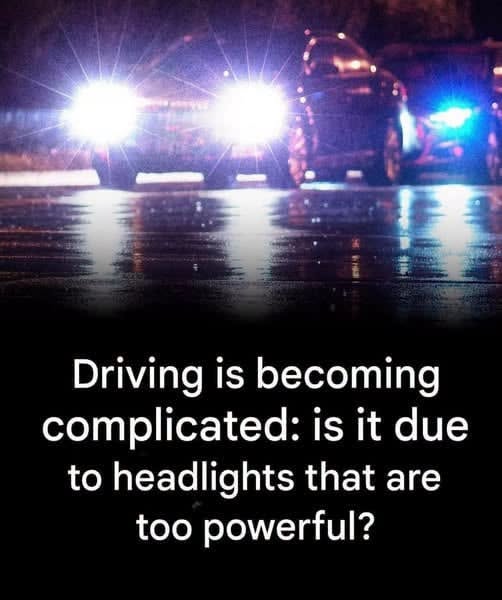
The flash feels like an attack. Your vision suddenly floods with white, the lane lines seem to disappear, and for one terrifying moment, you feel as though you are driving half-blind. You tighten your grip on the steering wheel and hope your hands remember where the road is going while your eyes struggle to recover. Is something wrong with your vision—or has nighttime driving itself become more difficult? Millions of drivers experience this same creeping fear after dark. Modern vehicles promise improved safety and better visibility, yet the headlights coming toward you can sometimes feel harsher, brighter, colder, and far more unforgiving than the lights drivers remember from years ago.
The difference is not simply in your imagination. Automotive lighting technology has changed dramatically. Many newer vehicles use LED headlights that produce a much more concentrated and intense beam than traditional halogen bulbs. Their cooler, blue-white appearance can create a sharp contrast that feels especially aggressive to tired eyes. While these lights can illuminate more of the road, their intensity can also make the moments when another vehicle approaches particularly uncomfortable.
Weather can make the problem even worse. Rain, fog, snow, and moisture on the road can scatter incoming light in multiple directions. Instead of seeing a clean beam, your eyes may encounter a broad wall of brightness reflected through the windshield and across the wet pavement. Lane markings can become harder to distinguish, road edges can disappear, and familiar streets may suddenly feel completely different.
A dirty windshield can add another layer to the problem. Tiny particles, fingerprints, dust, and a thin film that may be almost invisible during the day can scatter headlights directly into your eyes at night. When light hits that surface at the right angle, even a windshield that appears clean can create distracting halos and streaks around approaching vehicles.
Then there are modern SUVs and pickup trucks. Because these vehicles sit higher than traditional passenger cars, their headlights may be positioned closer to the eye level of someone sitting in a smaller sedan. If the beams are incorrectly aimed, the effect can be particularly severe. A vehicle carrying a heavy load can also change its angle slightly, causing the front end to rise and the headlights to point higher than intended.
This is why proper headlight alignment matters more than many drivers realize. A headlight that is technically functioning does not necessarily mean it is aimed correctly. Even a small adjustment can change where the beam lands on the road and how much light reaches the eyes of approaching drivers.
The problem becomes especially noticeable on dark rural roads and highways where there are few streetlights. In those environments, your eyes become adapted to darkness, making a sudden burst of bright light feel even more dramatic. For several seconds after the vehicle passes, your vision may need time to readjust, creating a frightening period when road details are harder to see.
Age can also influence how strongly someone experiences nighttime glare. As people get older, the eyes can become more sensitive to scattered light, and the ability to recover quickly after bright flashes may decrease. That doesn’t automatically mean a driver is unsafe, but persistent difficulty with glare should not simply be dismissed as something everyone experiences.
Fatigue is another important factor. When you are tired, your eyes and brain may already be working harder to process information. Add bright headlights, rain, reflections, and darkness, and the amount of visual information you must process can become overwhelming. What might be manageable during the day can feel significantly more stressful late at night.
There are practical ways to reduce some of this discomfort. Keeping the inside and outside of your windshield clean is one of the simplest. It is easy to focus on the outside glass while forgetting the film that gradually develops on the interior surface. Cleaning both sides can noticeably improve clarity and reduce unnecessary scattering.
Drivers should also make sure their own headlights are properly aimed. If you have recently replaced bulbs, repaired the front end of your vehicle, changed the suspension, or regularly carry heavy loads, checking the alignment can be especially worthwhile. Properly aimed headlights help you see the road without unnecessarily blinding everyone coming toward you.
Another useful habit is avoiding the instinct to stare directly into approaching headlights. When a bright vehicle comes toward you, shifting your gaze slightly toward the right edge of your lane can help you maintain your sense of position without looking directly into the strongest source of glare. Your peripheral vision can still help you track the road while reducing the intensity reaching your eyes.
It is also important to keep your windshield free of cracks, heavy scratches, and unnecessary obstructions. Even small imperfections can become much more noticeable when illuminated by powerful headlights in darkness. Sunglasses generally aren’t appropriate for nighttime driving, but a clean, clear windshield and properly functioning wipers can make a meaningful difference.
Vehicle manufacturers are also working on technologies designed to reduce the problem. Adaptive lighting systems can change the direction or intensity of beams depending on road conditions, while automatic high-beam systems are designed to detect other vehicles and adjust illumination accordingly. Self-leveling systems can also help keep headlights pointed at the correct angle when vehicle load changes.
These technologies may eventually make nighttime driving more comfortable, but technology alone cannot solve every problem. A poorly maintained vehicle, incorrectly installed lighting equipment, or an improperly aimed beam can still create dangerous glare regardless of how advanced the original system was.
For drivers, awareness remains one of the best defenses. Understanding why glare happens can make it easier to respond calmly instead of panicking when a bright vehicle suddenly approaches. Slow down when visibility becomes difficult, leave more space between vehicles, and avoid making sudden steering movements simply because a flash of light temporarily overwhelms your vision.
The road itself has also changed. Vehicles are larger, headlights are brighter, roads are more heavily traveled, and drivers increasingly depend on technology to manage visibility. What once seemed like a simple part of driving has become a complicated interaction between human eyesight, vehicle design, weather, road surfaces, and lighting systems.
That doesn’t mean modern headlights are inherently dangerous. Better lighting can provide major safety benefits by allowing drivers to identify pedestrians, obstacles, road signs, animals, and hazards much earlier. The challenge is finding the balance between giving one driver enough light to see clearly and preventing that same light from becoming a blinding source for everyone traveling in the opposite direction.
Night driving doesn’t have to feel like a battle against endless glare. Small changes can make the experience significantly more manageable. A clean windshield, correctly adjusted headlights, sensible speed, proper following distance, and a calm response to approaching lights can all improve visibility.
And if glare has become unusually severe or your nighttime vision has changed noticeably, it is worth discussing it with an eye-care professional rather than simply assuming it is part of getting older. Sometimes the problem is the vehicle or environment. Sometimes it is your eyes. Knowing the difference can make an important difference on the road.
The next time a wall of white light suddenly fills your windshield, remember that you are not necessarily imagining it. Modern lighting, wet pavement, weather, vehicle height, windshield condition, and human vision can combine to create an intense visual effect.
The goal isn’t to fear the headlights.
It’s to understand them.
Because when you know what is causing the glare—and what you can do about it—the road can become clearer, calmer, and much less intimidating after the sun goes down.