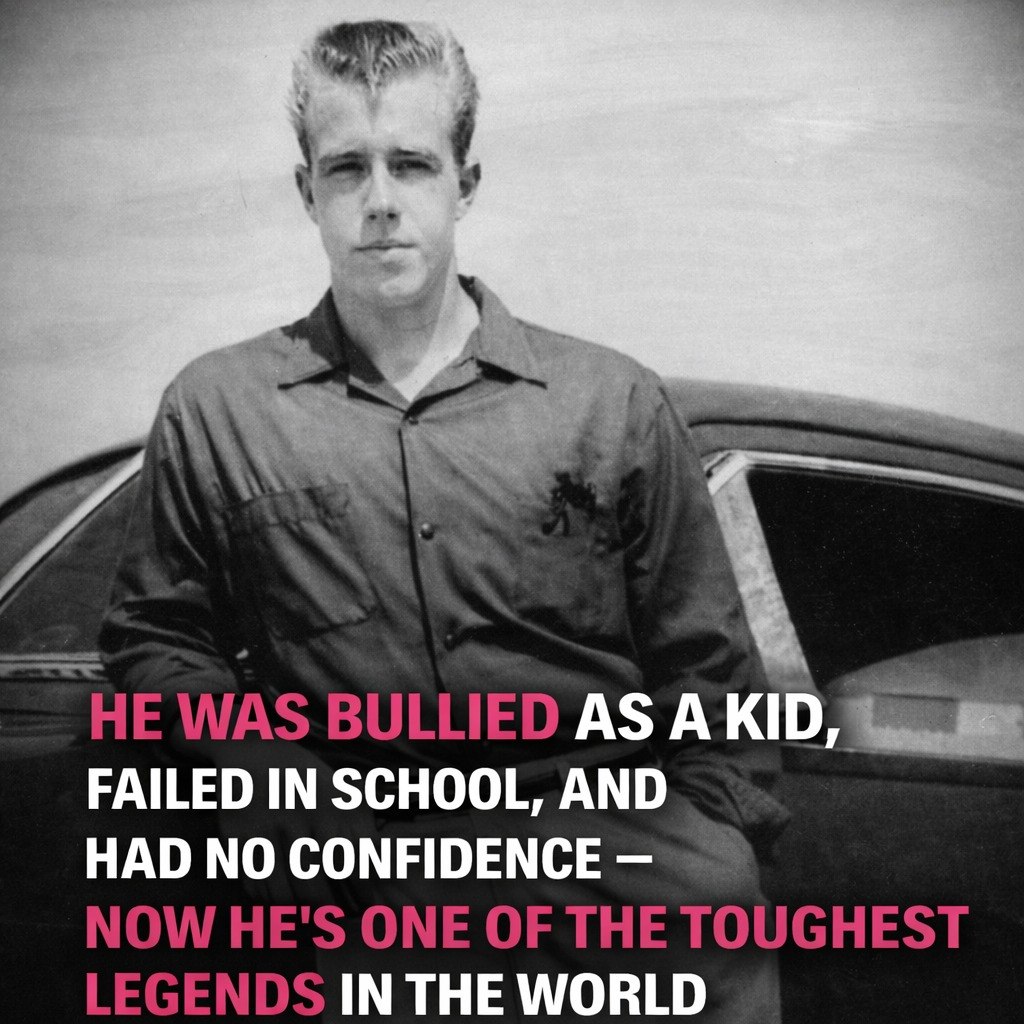
He grew up feeling small long before the world ever saw him as strong. No one looked at that quiet, insecure boy and imagined a future action legend standing undefeated in martial arts tournaments or staring down villains on television screens across America. To most people, he barely seemed noticeable at all. He was shy, uncertain, often withdrawn — the kind of child who learned early how to disappear into the background because attention usually brought pain.
Chuck Norris entered the world in poverty and instability, raised in a home overshadowed by alcoholism, financial struggle, and emotional chaos. His father drifted in and out of his life while addiction slowly hollowed out the family from the inside. Home never fully felt safe or steady. His mother fought to hold everything together, eventually moving the family repeatedly in search of something better, but instability leaves marks on children even after the scenery changes.
At school, Norris was painfully shy. He struggled socially, avoided confrontation, and became an easy target for bullies who sensed weakness immediately. He later admitted he lacked confidence almost completely during those years. He wasn’t athletic in any remarkable way. He wasn’t popular. He wasn’t especially successful academically. In many ways, he moved through childhood feeling invisible, carrying the quiet belief that stronger, louder people simply mattered more.
When his parents eventually separated and the family relocated to California, life improved materially in some ways but not emotionally. The insecurity stayed with him. After graduating high school, he still had no real direction, no clear ambition, and little sense of identity. Unlike the larger-than-life image people associate with him now, young Chuck Norris did not enter adulthood believing he was destined for greatness.
He joined the United States Air Force partly because he didn’t know what else to do.
And that decision changed everything.
Stationed in South Korea during the late 1950s, Norris encountered martial arts for the first time through Tang Soo Do. What began as curiosity slowly became transformation. For the first time in his life, he found structure that made sense to him — discipline, repetition, respect, and gradual mastery earned through effort rather than personality or popularity.
Martial arts gave him something deeper than physical skill.
It gave him identity.
Inside training halls, the shy young man who once avoided conflict discovered he could become stronger without becoming cruel. Confidence grew slowly through discipline rather than ego. Every movement practiced, every belt earned, every bruise survived rebuilt parts of him that childhood had convinced him were broken.
And perhaps most importantly, martial arts taught him control.
Not just over opponents, but over fear, emotion, and self-perception.
By the time Norris returned to America, he was no longer the same uncertain young man who had left. He began competing professionally, quickly building a reputation as one of the most dominant martial artists in the country. His discipline and relentless work ethic turned him into a champion repeatedly. He opened martial arts schools, trained celebrities, and eventually crossed paths with another rising icon: Bruce Lee.
Their friendship — and eventual on-screen fight in The Way of the Dragon — introduced Norris to international audiences in unforgettable fashion. Standing opposite Bruce Lee, Norris possessed a quiet intensity that felt authentic because it was. He did not move like someone pretending to be tough. He moved like someone who had fought internally for years before ever stepping in front of a camera.
Hollywood noticed.
Over time, Norris evolved from martial arts champion into action star, becoming famous through films and eventually through the television phenomenon Walker, Texas Ranger. His screen persona — calm, disciplined, morally grounded, physically unstoppable — resonated deeply with audiences because it reflected the qualities he spent his entire life trying to build within himself.
Yet the irony of his story never fully disappears.
One of America’s most recognizable symbols of toughness began life as a frightened, lonely boy who felt powerless almost all the time.
That contrast is what makes his journey meaningful beyond fame itself.
Chuck Norris did not emerge from childhood overflowing with confidence or destined for success from the beginning. He became who he was through transformation, repetition, discipline, and the refusal to let pain define the final version of himself. The strength people admired later was not inherited naturally. It was constructed slowly against the weight of insecurity, instability, and fear.
And maybe that is why his story continues to resonate.
Because beneath the action scenes, martial arts trophies, and larger-than-life reputation is something surprisingly human: proof that some of the strongest people in the world begin as the quietest, softest, and most uncertain versions of themselves before life forces them to become something more.