The letter from my attorney arrived at his doorstep three days later.
I imagine he read it twice.
Maybe three times.
The first time through anger.
The second through disbelief.
The third through fear.
For most of his life, my father had operated under the assumption that consequences were things that happened to other people. He had spent decades using intimidation as a substitute for respect and control as a substitute for love. The possibility that someone might one day possess greater authority than him had never entered his calculations.
Now it had.
The notices outlined everything with professional precision.
The unpaid taxes.
The auction results.
The legal transfer of ownership.
The timeline for relocation.
No insults.
No threats.
No cruelty.
Just facts.
Facts are often far more powerful than revenge.
Two weeks later, he called again.
This time, his voice sounded different.
Older.
Smaller.
“You’re really doing this?” he asked.
I looked out the window of my office at a crew installing a new roof across town.
“Doing what?”
“Taking my home.”
The irony almost made me laugh.
Your home.
Not the house.
Not the property.
Your home.
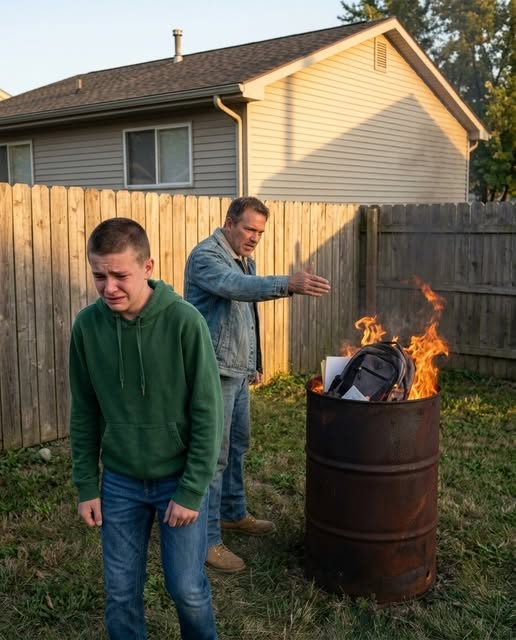
The same man who had burned my belongings in a barrel and told me never to return was suddenly speaking about the sanctity of home.
“I didn’t take it,” I replied calmly.
“You lost it.”
Silence.
Then came the anger.
It always came.
“You think you’re better than me now?”
“No.”
The answer caught him off guard.
“I think I’m different than you.”
Another long silence followed.
Because deep down, he understood exactly what I meant.
The weeks passed.
I continued running my business.
He continued delaying the inevitable.
Finally, the day arrived.
The house was empty except for a few broken pieces of furniture and decades of bad memories.
I stood in the living room while sunlight streamed through dusty windows.
The place smelled of mildew and neglect.
For a moment, I saw flashes of the boy I used to be.
The kid who walked carefully through these hallways.
The teenager who learned to stay quiet.
The young man who stood in the backyard watching his future burn.
I expected anger.
I expected satisfaction.
Instead, I felt something entirely different.
Sadness.
Not for myself.
For him.
Because somewhere along the way, my father had mistaken fear for strength.
He had spent his entire life believing that power came from domination.
From making other people smaller.
From controlling every room he entered.
And in the end, all that power left him completely alone.
A week later, I received another call.
This time, there was no anger.
No arrogance.
No shouting.
Just exhaustion.
“I don’t have anywhere else to go.”
The words sounded foreign coming from him.
For the first time in my life, he was asking instead of demanding.
I closed my eyes.
Part of me remembered the barrel.
The flames.
The photographs curling into ash.
The words he used when he told me I was nothing.
But another part of me remembered the promise I made that night.
If I ever gained power, I would never use it the way he did.
So I made him an offer.
Not because he deserved it.
Because I deserved to keep my word.
There was a small apartment above one of my company’s storage buildings.
Nothing luxurious.
Nothing free.
Just a modest place he could rent at a fair rate while figuring out what came next.
When I told him, he was silent for so long I thought the call had dropped.
“Why?” he finally asked.
The answer came easily.
Because I had spent years thinking about it.
“Because somebody has to end this.”
His breathing caught.
For a brief moment, I heard something I had never heard from him before.
Shame.
Real shame.
Months later, the old house stood transformed.
My crews repaired the foundation, rebuilt the porch, replaced the roof, and restored the property piece by piece.
Eventually, a young family purchased it.
A husband.
A wife.
Two little girls.
I watched them unload boxes one Saturday morning.
The children ran across the yard laughing.
The same yard where my father once burned my future.
Except he hadn’t.
Not really.
The fire destroyed objects.
It never touched my future.
That belonged to me.
As I drove away, I glanced in the rearview mirror one last time.
The house looked smaller than ever.
Almost insignificant.
And that’s when I realized something.
For years, I believed success would feel like standing above the man who hurt me.
But real success felt nothing like that.
It felt like freedom.
Freedom from anger.
Freedom from fear.
Freedom from needing his approval.
The boy who left with forty-three dollars and a backpack had spent years rebuilding his life.
The man driving away that day finally understood something far more important.
The greatest victory isn’t getting even.
It’s becoming someone who no longer needs to.
And somewhere behind me, in a house filled with laughter instead of fear, a new family was beginning their story.
That felt like justice.
Not the loud kind.
The lasting kind.