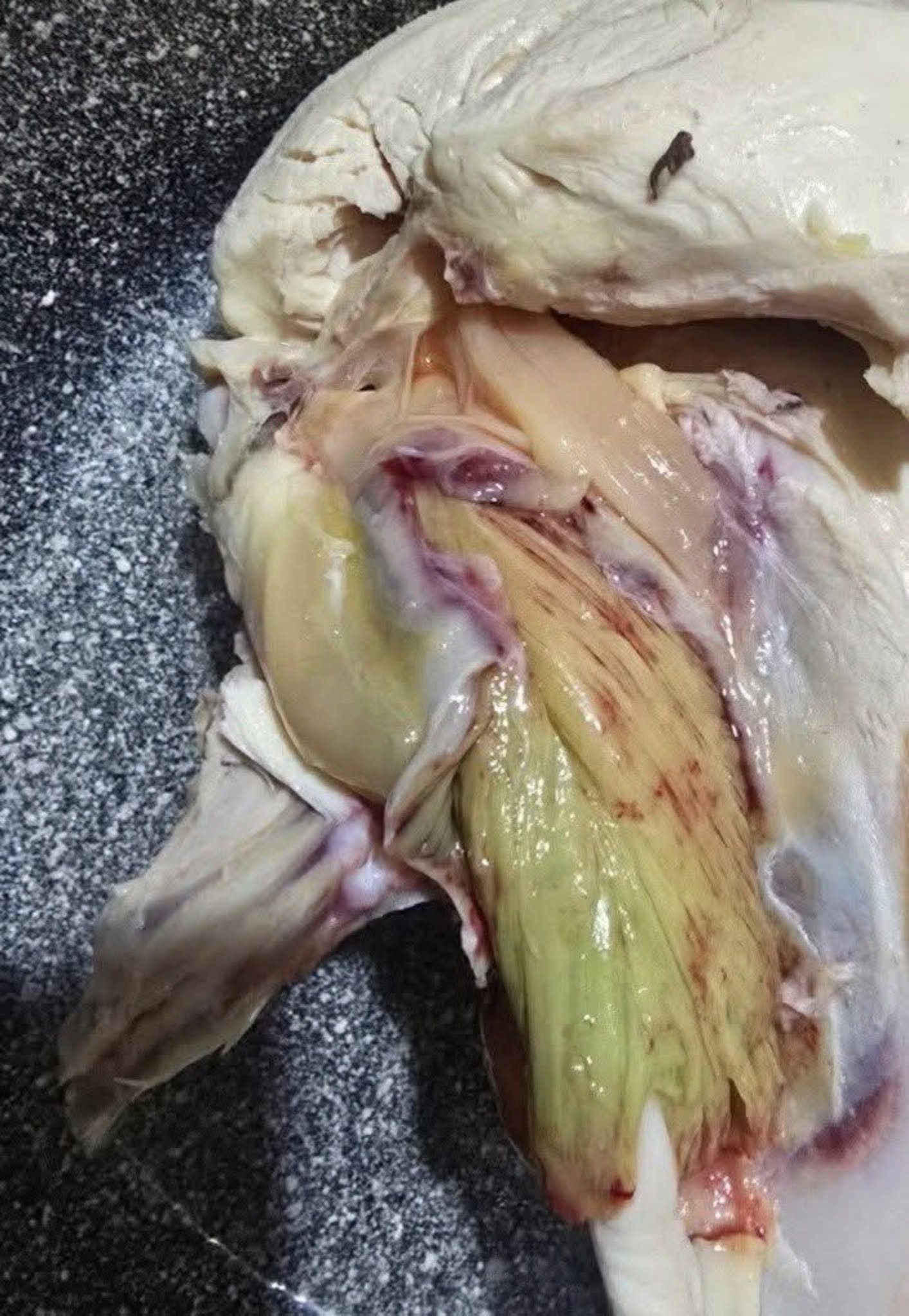
Few kitchen moments are more unsettling than slicing into what appears to be a perfectly cooked chicken only to discover an unexpected green patch hidden inside the meat. Your appetite disappears instantly as your mind races toward the worst possible conclusion. Is it spoiled? Is it contaminated? Could eating it make someone seriously ill? Green meat feels instinctively wrong because we naturally associate unusual colors with food that has gone bad. However, the truth is more complicated. While green discoloration can sometimes signal dangerous spoilage, there are several harmless biological reasons why chicken meat may develop green or greenish areas. Understanding the difference between harmless discoloration and genuine food safety hazards can help you make informed decisions in the kitchen, avoid unnecessary waste, and most importantly, protect yourself and your family from foodborne illness. Fortunately, evaluating suspicious chicken usually begins with three simple tools that everyone already has: your eyes, your nose, and your judgment.
At first glance, any green coloring inside chicken appears alarming.
Most people expect poultry to be white, pale pink, or lightly browned after cooking.
Anything outside those familiar colors immediately raises concern.
Fortunately, not every green patch means the chicken is unsafe to eat.
One of the most common harmless causes is bruising.
Just like people, chickens can develop bruises.
During transportation, processing, or even while the bird is still alive, muscles may experience injury from flapping, bumping into equipment, or rough handling.
When blood becomes trapped inside muscle tissue, it gradually breaks down over time.
As bruises heal, the pigments inside the blood change color.
They may shift from reddish-purple to blue.
Then yellow.
Sometimes even greenish.
The same biological process that causes an old bruise on your arm to turn green can occur inside poultry muscle.
These bruises often appear deep within the meat while the outside of the chicken looks completely normal.
Although visually unpleasant, bruised tissue itself is not necessarily dangerous if the chicken has otherwise been properly handled, refrigerated, and thoroughly cooked.
Another possible explanation is a condition commonly known as green muscle disease.
Despite its alarming name, this condition is not caused by bacteria or infection.
Instead, it results from poor blood supply to a portion of the breast muscle.
Modern broiler chickens and turkeys have been selectively bred for rapid growth and large breast muscles.
In some birds, the inner breast muscle—particularly the tenderloin—does not receive enough oxygen-rich blood.
Without sufficient oxygen, that muscle tissue gradually dies.
Over time, it changes color, becoming greenish, gray-green, or brownish-green.
The affected area may also feel firmer, spongier, or somewhat dry compared to healthy meat.
The outer breast often appears completely normal, leaving the discoloration hidden until the meat is cut open.
Although green muscle disease makes the meat less appealing in both appearance and texture, the condition itself is generally not considered a food safety hazard if the bird was otherwise healthy and properly processed.
Many consumers simply choose to trim away the affected portion or discard it because of its appearance.
Light can also play surprising tricks on our eyes.
Some chicken, particularly vacuum-packed products, may display an iridescent green or rainbow sheen across the surface.
This shimmering effect results from the way light reflects off tightly packed muscle fibers.
It is similar to the colorful appearance sometimes seen on sliced roast beef or ham.
In these situations, the meat itself remains perfectly normal.
The color changes when viewed from different angles and usually disappears under different lighting conditions.
Packaging materials can sometimes enhance these optical effects.
The most important distinction is that optical discoloration affects only appearance.
The texture remains normal.
The smell remains fresh.
The meat otherwise appears healthy.
The situation changes entirely when spoilage is involved.
Spoiled chicken presents warning signs that should never be ignored.
Unlike harmless bruising or muscle discoloration, bacterial decomposition affects multiple characteristics simultaneously.
The smell often provides the first clue.
Fresh chicken has very little odor.
Spoiled chicken frequently develops sour, sulfur-like, ammonia-like, or otherwise unpleasant smells.
If opening the package causes you to immediately pull away because of the odor, the safest decision is to discard the meat.
Texture also matters.
Fresh chicken feels slightly moist but not slimy.
Spoiled poultry often becomes sticky.
Slimy.
Tacky.
Or unusually soft.
The surface may develop a slippery coating caused by bacterial growth.
Color changes associated with spoilage often appear uneven and may include gray, green, yellow, or black patches accompanied by other signs of deterioration.
When several warning signs occur together—off-color, foul smell, and slimy texture—the chicken should never be eaten.
No amount of cooking can reliably make spoiled meat safe.
Cooking destroys many harmful bacteria, but some bacteria produce toxins that remain dangerous even after heat kills the organisms themselves.
That is why food safety experts consistently recommend discarding poultry that shows obvious signs of spoilage.
When evaluating chicken, it’s helpful to rely on all of your senses rather than color alone.
Ask yourself several simple questions.
Does it smell normal?
Does it feel normal?
Has it remained properly refrigerated?
Is it within its safe use-by date?
Has the packaging remained intact?
If the answer to any of these raises concern, caution is usually the wisest choice.
Proper storage also plays a major role in preventing spoilage.
Raw chicken should remain refrigerated at or below 40°F (4°C) and should not be left at room temperature for more than two hours, or one hour if temperatures exceed 90°F (32°C).
Frozen chicken should be thawed safely in the refrigerator, under cold running water, or in the microwave immediately before cooking.
Cross-contamination should also be avoided by keeping raw poultry separate from ready-to-eat foods and washing hands, utensils, and cutting boards thoroughly after handling raw meat.
Cooking chicken to a safe internal temperature of 165°F (74°C), measured with a food thermometer in the thickest part of the meat, remains one of the most effective ways to reduce the risk of foodborne illness.
Even healthy-looking chicken should always be fully cooked before consumption.
In the end, green chicken does not always signal danger.
Sometimes it reflects a simple bruise.
Sometimes a naturally occurring muscle condition.
Sometimes nothing more than unusual light reflecting across the meat.
But when green discoloration appears alongside unpleasant odors, slimy texture, or other signs of decomposition, it should always be treated seriously.
The safest kitchen habit is remarkably simple.
Trust your senses.
Inspect the meat carefully.
When something genuinely seems wrong, do not take unnecessary risks.
Replacing one package of chicken is far less costly than dealing with a serious case of foodborne illness.
A few moments of careful observation can protect both your meal and your health, allowing confidence—not uncertainty—to remain the final ingredient on your dinner table.