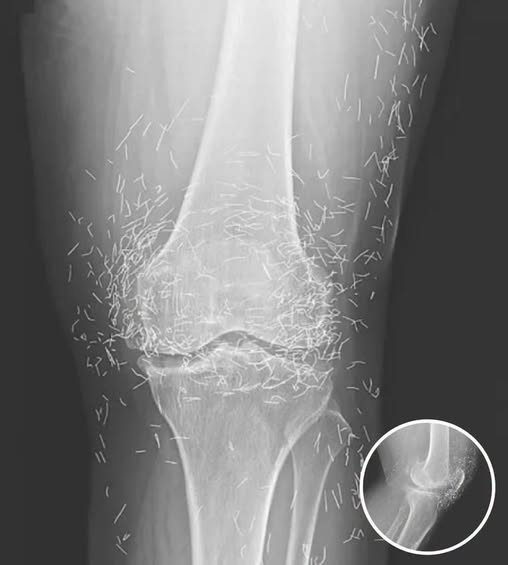
When a 65-year-old woman walked into a medical clinic in South Korea complaining of chronic, debilitating joint pain, the physicians expected to see the usual hallmarks of long-term degenerative disease. They anticipated narrowed joint spaces, telltale bone spurs, and cartilage erosion—the classic signatures of osteoarthritis. Yet, when the X-ray was developed, the team was confronted with a scene that defied conventional expectations. Staring back at them were hundreds of tiny, hair-thin gold needles, meticulously embedded deep in the tissue and muscle around her knees. This was no accident or sudden injury—it was the record of years of extreme measures taken to control pain, a physical manifestation of a decades-long struggle with osteoarthritis.
Her journey began with a diagnosis millions face daily. Osteoarthritis relentlessly wears down cartilage, allowing bones to grind together, sparking inflammation, swelling, and stiffness that can turn even walking into agony. Standard medical treatments—painkillers and anti-inflammatory medications—offered only temporary relief and came with significant side effects. Over time, these drugs wreaked havoc on her digestive system, creating a burden nearly as severe as her joint pain.
Desperate for a solution without chemical trade-offs, she turned to her culture’s deep-rooted traditions. In South Korea, acupuncture is a mainstream medical practice, widely trusted and accepted. However, the procedure she underwent went far beyond the typical insertion of needles. In a method known as gold thread or needle implantation, practitioners intentionally leave the needles inside the body. The theory is that gold provides ongoing stimulation to the acupuncture points, potentially offering a long-term reduction in pain signals. To the patient, it promised a life without pills; to the doctors examining the X-rays decades later, it raised alarms about long-term risks.
The medical community has long warned about the dangers of leaving foreign objects inside the body. Dr. Ali Guermazi, a leading radiologist at Boston University, explains that the immune system reacts aggressively to invaders—even noble metals like gold. Foreign body reactions often start with chronic inflammation, progressing to dense scar tissue as the body attempts to isolate the object. In some cases, “forgotten” needles can trigger infections or abscesses that require surgical removal.
Metal fragments also complicate modern diagnostic procedures. In radiology, metal creates bright streaks, or artifacts, that obscure vital anatomy, making it difficult to monitor disease progression or detect issues like tumors or fractures. Metal needles pose an even greater hazard for MRI scans: strong magnetic forces could dislodge them, causing injury to nerves, tendons, or blood vessels. A procedure meant to relieve pain could inadvertently create life-threatening complications.
Yet, the appeal of permanent, “natural” pain relief continues to drive interest in extreme acupuncture techniques. In cultures where these traditions are passed down, trust in the method often outweighs scientific skepticism. Proponents claim gold implants provide unique bio-electrical benefits that support joint health, but large-scale, rigorous studies validating these claims remain virtually nonexistent.
Acupuncture has also gained popularity in the United States as patients seek alternatives to opioids and invasive surgery. Millions now integrate temporary acupuncture into wellness routines, but needles are always removed afterward. The South Korean woman’s case serves as a cautionary boundary: a vivid reminder that even well-intentioned alternative therapies can turn hazardous when taken to extremes.
Published in the New England Journal of Medicine, her case has become a landmark warning. While she may have initially felt relief from the constant stimulation, she ultimately ended up with knees that were a literal minefield of metal. The X-rays act as a stark reminder that human bodies are not designed to house permanent foreign objects, no matter how precious the metal.
The lesson is clear: transparency, evidence, and informed consent are essential. Patients with osteoarthritis must explore relief options but understand the long-term consequences of extreme therapies. A solution that temporarily silences pain should not compromise the body’s integrity over a lifetime. The South Korean woman’s knees tell a story of desperate pursuit of comfort—but they also issue a lasting warning: sometimes, the “cure” can be just as dangerous as the disease.