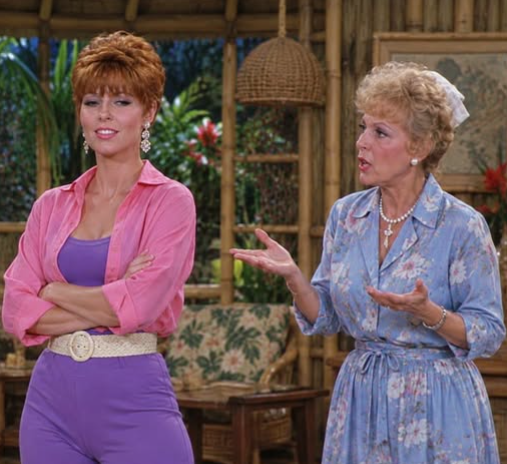
The illusion was never perfect—and **that’s exactly why it still haunts us.** A boat that seems to change size from one scene to the next. A shoreline that quietly rearranges itself between shots. A bracelet that mysteriously disappears, only to return moments later. A prop that moves several feet without anyone touching it. A costume detail that changes when the camera cuts away and comes back.
At first, these things look like mistakes.
Look a little closer, though, and they begin to feel like fingerprints.
Every continuity error leaves behind a tiny trace of the people who made the show—the rushed hands, improvised solutions, limited resources, and vanished routines of an older television industry. The island begins to crumble, not because the story was poorly told, but because the machinery behind the illusion becomes visible.
And once you notice those cracks, **you can never quite stop seeing them.**
*Gilligan’s Island* survives not because it was seamless, but because its seams still show. The shifting beaches, wandering props, inconsistent costumes, and changing set details quietly reveal a studio world constructed from lumber, canvas, painted scenery, artificial foliage, and whatever practical solution could get the next shot completed on time.
Television production was not always the polished, digitally controlled process audiences know today.
There were physical sets.
There were stage lights.
There were camera operators, carpenters, costume workers, prop departments, makeup artists, sound crews, directors, assistants, and actors trying to keep everything moving. When something was slightly out of place, the answer wasn’t always to stop everything and rebuild the scene. Sometimes you simply kept filming.
The audience was expected to follow the story.
And for decades, most of us did.
That is part of what makes those imperfections so fascinating now. What once looked like careless mistakes can be read as evidence of **human presence**. They remind us that the island was never real, no matter how familiar it became. It was assembled piece by piece by people working with the tools and limitations of their time.
A beach could be extended.
A palm tree could suddenly appear at a different angle.
A prop could be placed differently because the crew needed the camera somewhere else.
An actor could wear a slightly different version of the same outfit because filming schedules did not always follow the fictional timeline perfectly.
None of it was supposed to matter.
The story mattered.
The joke mattered.
The characters mattered.
And if the shoreline moved a little between scenes, viewers generally accepted it without stopping to investigate.
Today, however, those tiny inconsistencies have become part of the experience.
Rewatching the series can feel almost like opening a time capsule. You aren’t simply watching Gilligan, the Skipper, and the rest of the cast struggle through another ridiculous island adventure. You’re also watching a production environment from another era reveal itself in small, accidental ways.
A continuity error becomes a clue.
A misplaced object becomes a timestamp.
A changing shadow becomes evidence that two scenes were filmed at different times.
A piece of scenery that suddenly seems slightly different reminds you that what looked like an enormous tropical island to a child was actually a carefully controlled collection of sets and locations.
And suddenly, the magic becomes even more interesting.
Because behind every “mistake” was somebody working.
Somebody had to build the set.
Somebody had to move the furniture.
Somebody had to paint the scenery.
Somebody had to construct the illusion of a lagoon, position the artificial plants, adjust the lights, prepare the props, and make sure the actors could move through the scene without everything collapsing around them.
You can almost imagine the chaos just outside the camera’s frame.
A crew member carrying something heavy.
A camera operator trying to find the right angle.
Someone waiting for an actor to hit a mark.
Someone else realizing that a prop is missing.
And then the director calls for another take.
The actors repeat their lines.
The scene continues.
Meanwhile, the sun and shadows refuse to cooperate with the fictional passage of time.
That is the strange beauty of old television.
Modern audiences are accustomed to visual effects that can erase almost anything. Objects can be digitally removed. Backgrounds can be replaced. Continuity can be corrected after filming. Entire environments can be created without ever physically existing.
Older productions had fewer ways to hide their seams.
So the seams remained.
And those seams tell stories of their own.
The visible compromises transform *Gilligan’s Island* from a simple sitcom into something more revealing: a record of how television once felt when production was **hurried, inventive, physical, and unapologetically imperfect.**
The show wasn’t trying to convince you that every leaf was perfectly positioned.
It was trying to make you laugh.
It was trying to create a world quickly enough that the audience could forget about the cameras and believe, at least for twenty-two minutes, that seven people were really stranded somewhere far from home.
And remarkably, it worked.
Children weren’t counting palm trees.
Families weren’t measuring the distance between the hut and the beach.
Nobody paused the television to determine whether a bracelet had disappeared.
They were watching the story.
That may be why the imperfections feel so nostalgic today. They belong to a time when television did not necessarily demand perfection from every frame. The audience brought some of the imagination themselves.
A painted backdrop could become an ocean.
A small stage could become an island.
A prop could represent an entire world.
And a continuity error could simply be ignored because everyone was having too much fun to care.
The comedy remains, but the context becomes richer with every rewatch.
You begin noticing the people behind the illusion rather than simply the illusion itself. You start thinking about the carpenter who extended a set, the prop worker who placed an object that later wandered, the camera operator navigating around palm fronds, or the actors repeating the same lines while the physical world around them subtly changed.
Those workers rarely received the same recognition as the stars on screen.
Yet their fingerprints remain everywhere.
They are hidden inside the mismatched props, the shifting scenery, the costumes, the shadows, and the tiny details that somehow survived decades of television history.
In that sense, the mistakes are not failures.
**They are evidence.**
Evidence that the show was made by human beings under real constraints. Evidence that time moved differently on a television set than it did inside the story. Evidence that behind the polished final product was a complicated process of construction, adjustment, improvisation, and repetition.
Nostalgia has a strange habit of smoothing everything.
We remember the theme song.
The characters.
The jokes.
The island.
The feeling of sitting in front of the television.
But memory can make the past look cleaner than it really was.
Those little errors push back against that polished version. They remind us that the past was messy too. People made mistakes. Props moved. Sets changed. Shadows shifted. Costumes didn’t always match.
And somehow, that makes the memory feel **more authentic**, not less.
Because perfection can feel artificial.
Imperfection feels lived-in.
So the next time you watch *Gilligan’s Island*, don’t only search for continuity errors to prove the production wasn’t perfect. Look at them differently. See them as tiny windows into the work happening beyond the frame.
The comedy is still there.
The absurdity is still there.
But now there is another story underneath it—the story of the people who built an impossible island with ordinary materials, limited technology, and an enormous amount of imagination.
The island may have been fictional.
The mistakes may have been accidental.
But the human effort behind them was real.
And decades later, those tiny cracks in the illusion may be the very things keeping that old television world alive.