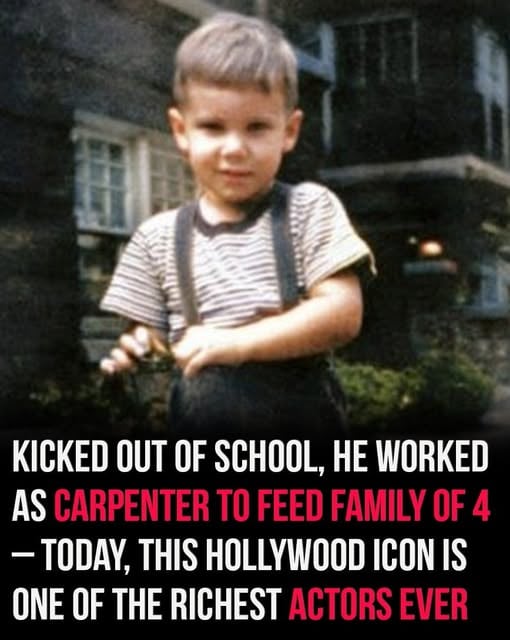
Harrison Ford didn’t start out with privilege, connections, or even a clear strategy in order to become one of Hollywood’s most well-known individuals. It began in a small Park Ridge house with aspirations but no clear plan. There were no early indications that he would eventually define some of the most memorable characters in film, nor were there any connections to the industry to rely on. In actuality, his route appeared doubtful right away. He was expelled a few days before he was set to graduate from college—a sudden conclusion that might have shut doors before they opened.
Rather, it drove him in the direction of Los Angeles, where he arrived with little more than resolve. The world he found himself in was anything but glamorous. He was frequently disregarded in casting decisions, tiny jobs hardly paid the bills, and early acting contracts brought him no success. His contributions were not immediately acknowledged by the industry, and for a while it appeared that they would never be.
In order to provide for his expanding family, Ford made a sensible choice that would subtly influence the rest of his life: he taught himself how to be a carpenter. What started out as a need became into a career and a way to become independent. He constructed decks, made cabinets, and handled intricate woodworking projects for customers all around the city. It was a means of surviving without sacrificing his dignity, not merely a backup plan. He didn’t have to accept every role that came his way, in contrast to many struggling actors. He had a unique ability to wait because he was a carpenter.
It turned out that patience was essential. Ford met important people in the film industry, such as George Lucas, through his employment as a carpenter. Eventually, their prior relationship led to an audition for the role of Han Solo in Star Wars, which would change everything. What transpired next was nothing short of revolutionary. Ford’s portrayal of the roguish smuggler struck a chord with viewers in a manner that few characters ever have, and the movie went on to become a global hit.
The success didn’t end there. He later played Indiana Jones, another fabled character, in Raiders of the Lost Ark and its follow-up films. Ford established himself as a pivotal figure in contemporary film with those parts; his characters were not only well-liked but also profoundly ingrained in popular culture.
Nevertheless, the core of his identity remained unchanged despite his celebrity. Ford has always led a simple life away from movie scenes and premieres. He spends time flying airplanes, fixing fences, and using his hands at his Wyoming ranch—the same hands that previously created a living when acting was unable to. He has frequently approached his work with a tradesman’s perspective, one that is disciplined, focused, and uninterested in show for its own purpose.
His narrative endures not only because of how successful he was, but also because of how he got there. Without context, there can be no overnight transformation that is unrelated to effort. His profession developed gradually as a result of rejection, perseverance, and a readiness to perform unglamorous labor when needed.
Harrison Ford ultimately stands for something less common than celebrity: evidence that perseverance, fortitude, and independence can have just as much of an impact on a person’s life as skill. His place in film history may be defined by his iconic parts, but the actual significance of his legacy lies in the more subdued reality that lies behind them—the years of waiting, building, and refusing to give up.