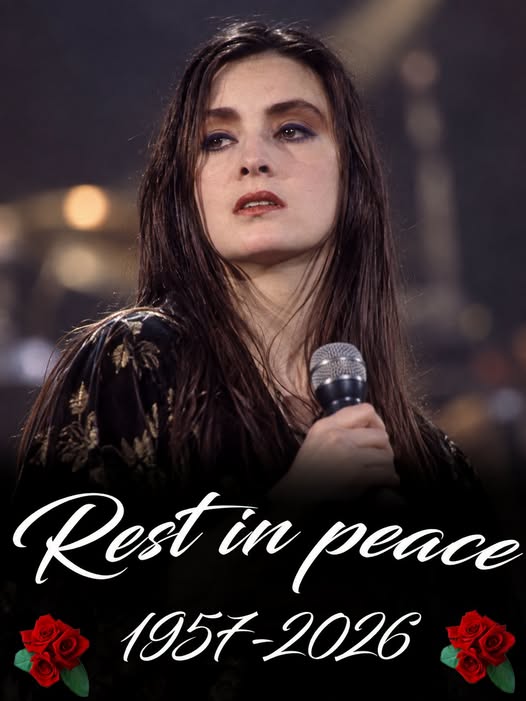
French music woke up shattered. Catherine Ringer, the wild, fearless soul of Les Rita Mitsouko, is gone at 68, taken almost overnight by a brutal, fast-acting cancer. Fans, friends, fellow musicians, and even France’s highest political circles were left in shock by the news. For generations of listeners, Ringer had seemed almost impossible to imagine as anything other than alive, moving, creating, performing, and challenging every expectation placed in front of her. Her presence was so intense that it often felt larger than the stage itself. So how did a woman who seemed made of pure electricity disappear so suddenly?
Her death marked the end of a remarkable chapter in French music, but it also reopened memories of everything she had carried throughout her life. Ringer was never simply a singer standing behind a microphone. She was an artist who transformed pain, rebellion, humor, theatricality and vulnerability into something unmistakably her own. Her career crossed decades, styles and generations, while her voice remained instantly recognizable.
She was born in the shadow of history and horror, the daughter of a Holocaust survivor whose story would later become part of Ringer’s artistic world. That early darkness never completely left her. Instead of allowing it to silence her, she gradually transformed it into something fierce and luminous. Her art often carried an awareness of suffering without surrendering to it, turning difficult memories into expression, movement and sound.
Then came Fred Chichin.
Together, Ringer and Chichin created Les Rita Mitsouko and crashed into French rock like a meteor. Their music refused to stay inside a single category. It could be playful one moment and unsettling the next, theatrical yet deeply personal, strange without becoming inaccessible. It was part cabaret, part punk, part pop, part dream — a combination that sounded unlike anything else around them.
Their hits—“Marcia Baïla,” “C’est comme ça,” and “Andy”—were not simply songs that appeared on radio playlists. They became cultural moments. Each carried its own visual identity, its own rhythm and its own world. Ringer’s performances made the songs feel almost cinematic, as if audiences were watching scenes from a strange film only she and Chichin could have directed.
There was always something unpredictable about them.
They could be glamorous without being conventional.
They could be rebellious without losing their sense of humor.
And they could make audiences dance while quietly carrying much heavier ideas beneath the surface.
For many French listeners, Les Rita Mitsouko became part of the soundtrack of an entire generation.
Then tragedy arrived.
When cancer took Fred Chichin in 2007, it almost stole Ringer’s voice too.
The loss was devastating because Chichin had not simply been her musical partner. He had been the person beside her through the creation of the world they had built together. Their artistic relationship and personal lives were deeply intertwined, making his death impossible to separate from her own history.
For a time, she stopped singing.
She struggled to return to the stage.
Even music in private became difficult.
The silence after Fred’s death was different from ordinary silence. It carried memories of rehearsals, performances, conversations and years of shared creativity. The person who had always been there was suddenly absent.
But slowly, stubbornly, Ringer returned.
She began performing again.
This time, she was often alone onstage, but she was never truly alone.
Fred remained present in the memories behind the music, in the songs they had created together, and in the history that could never be separated from her voice. Every performance carried something forward.
She continued creating.
She continued challenging expectations.
She continued speaking about women, freedom, the planet and the right to exist without constantly asking permission.
Her career became a testament to persistence.
She had already survived the loss of the person with whom she had built her most famous musical partnership. She had continued performing when grief could have convinced her to disappear. She had reached new audiences while remaining connected to the work that made her famous.
And even decades after Les Rita Mitsouko first became a force in French music, she could still command a stage.
Onstage in Paris this February, she still burned.
There was still movement.
Still presence.
Still that unmistakable sense that Ringer was capable of filling a room simply by walking into it.
That makes the news of her death feel even more abrupt.
The woman who had spent a lifetime refusing to be predictable was suddenly gone.
Now France is left with the recordings, the photographs, the performances and the memories.
Fans are replaying her voice.
Old songs are being heard again by people who first discovered them decades ago, while younger listeners are encountering the strange, fearless energy of Les Rita Mitsouko for the first time.
Her music remains.
Fred’s memory remains.
The stories remain.
And perhaps that is the final contradiction of Catherine Ringer’s extraordinary career.
She spent her life proving that art could turn pain into movement, memory into music, and tragedy into something that could still shine.
Now France stands in silence, listening again to the voice that once seemed impossible to stop.
In losing Catherine Ringer, it has lost a singular artist — one whose sound, image and fearless spirit became woven into the cultural memory of a country.
The electricity is gone from the stage.
But it remains in every song she left behind.